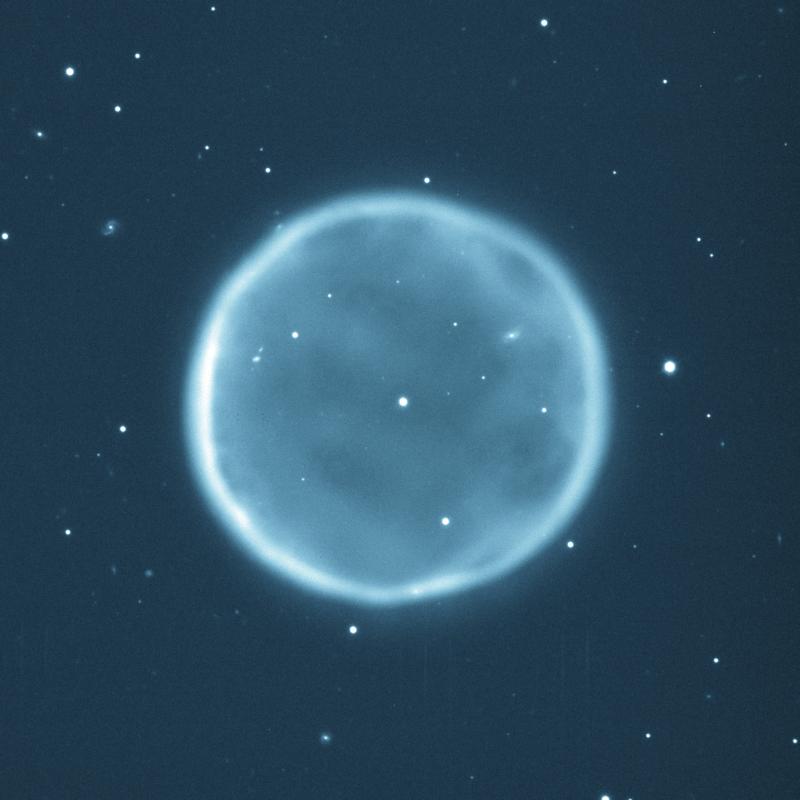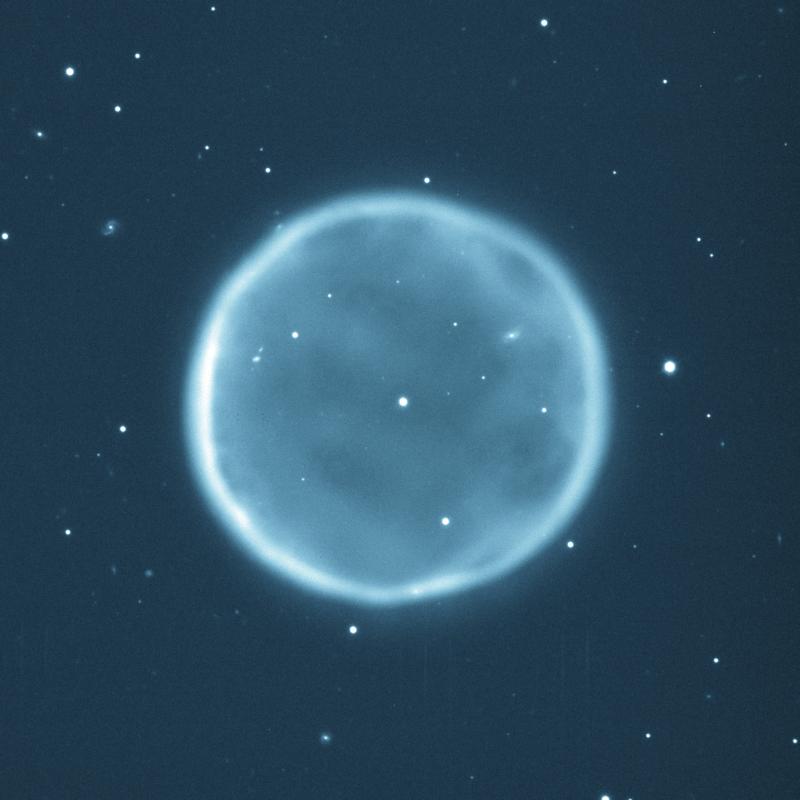
One of the largest spheres in our Galaxy is giving valuable clues about the chemical composition of stars by its very shape. Planetary nebula Abell 39, now six light-years across, was once a sun-like star's outer atmosphere expelled thousands of years ago. The nearly perfect spherical nature of Abell 39 allows astronomers to accurately estimate how much relative material is actually absorbing and emitting light. Observations indicate that Abell 39 contains only about half of the oxygen found in the Sun, an intriguing but not surprising confirmation of the chemical differences between stars. The reason why the central star is slightly off center by 0.1 light-years is currently unknown. Abell 39 lies about 7000 light years away, although several galaxies millions of light years away can be seen through and around the nebula.
Una de las esferas más grandes de nuestra Galaxia está proporcionando valiosas pistas sobre la composición química de las estrellas precisamente por su forma. La nebulosa planetaria Abell 39, ahora con un diámetro de seis años luz, fue la atmósfera exterior de una estrella similar al Sol expulsada hace miles de años. La naturaleza casi perfectamente esférica de Abell 39 permite a los astrónomos estimar con precisión cuánto material relativo está realmente absorbiendo y emitiendo luz. Las observaciones indican que Abell 39 contiene aproximadamente la mitad del oxígeno que se encuentra en el Sol, una confirmación intrigante pero no sorprendente de las diferencias químicas entre las estrellas. La razón por la cual la estrella central está ligeramente descentrada 0,1 años luz es actualmente desconocida. Abell 39 se encuentra a unos 7000 años luz de distancia, aunque varias galaxias a millones de años luz de distancia pueden verse a través de la nebulosa y alrededor de ella.