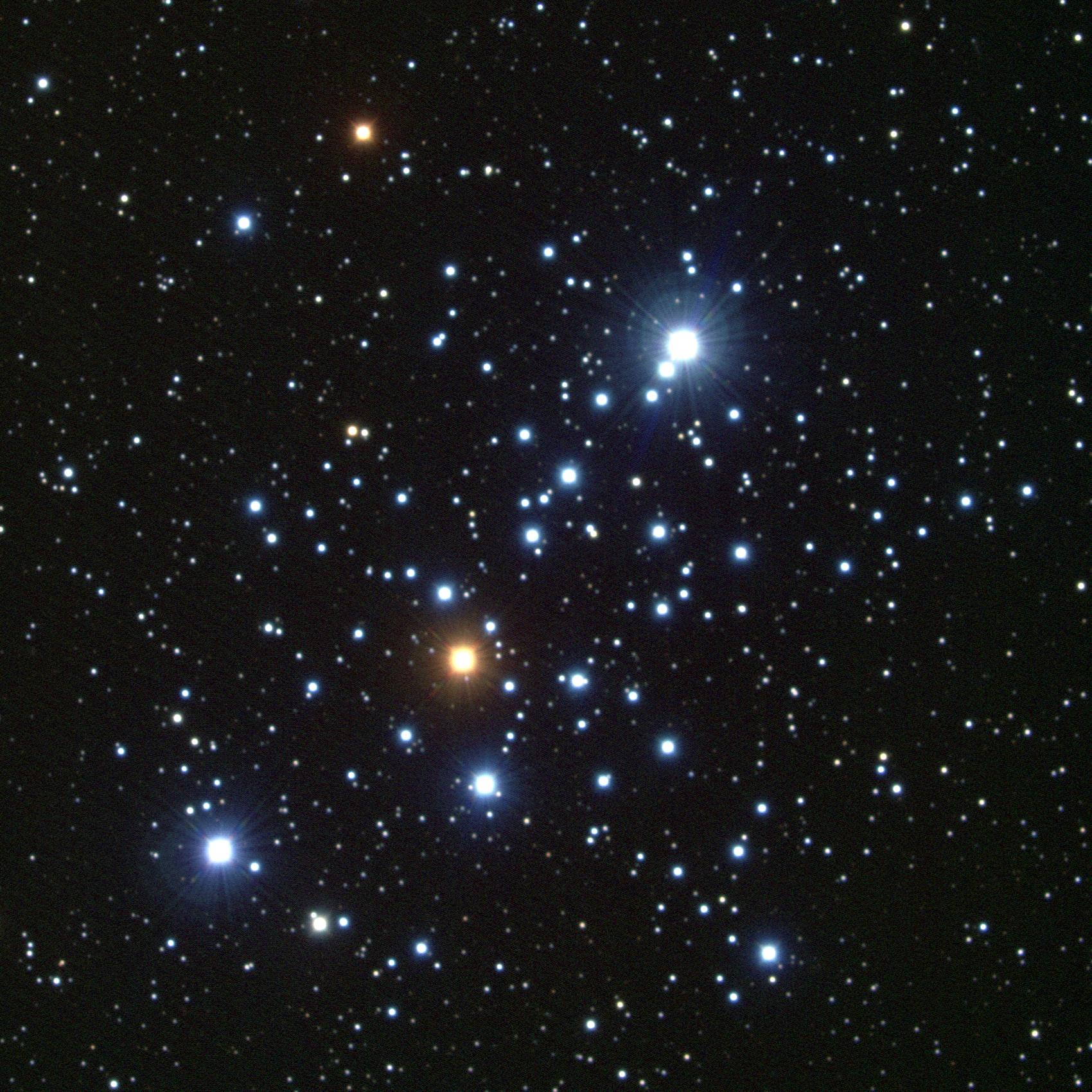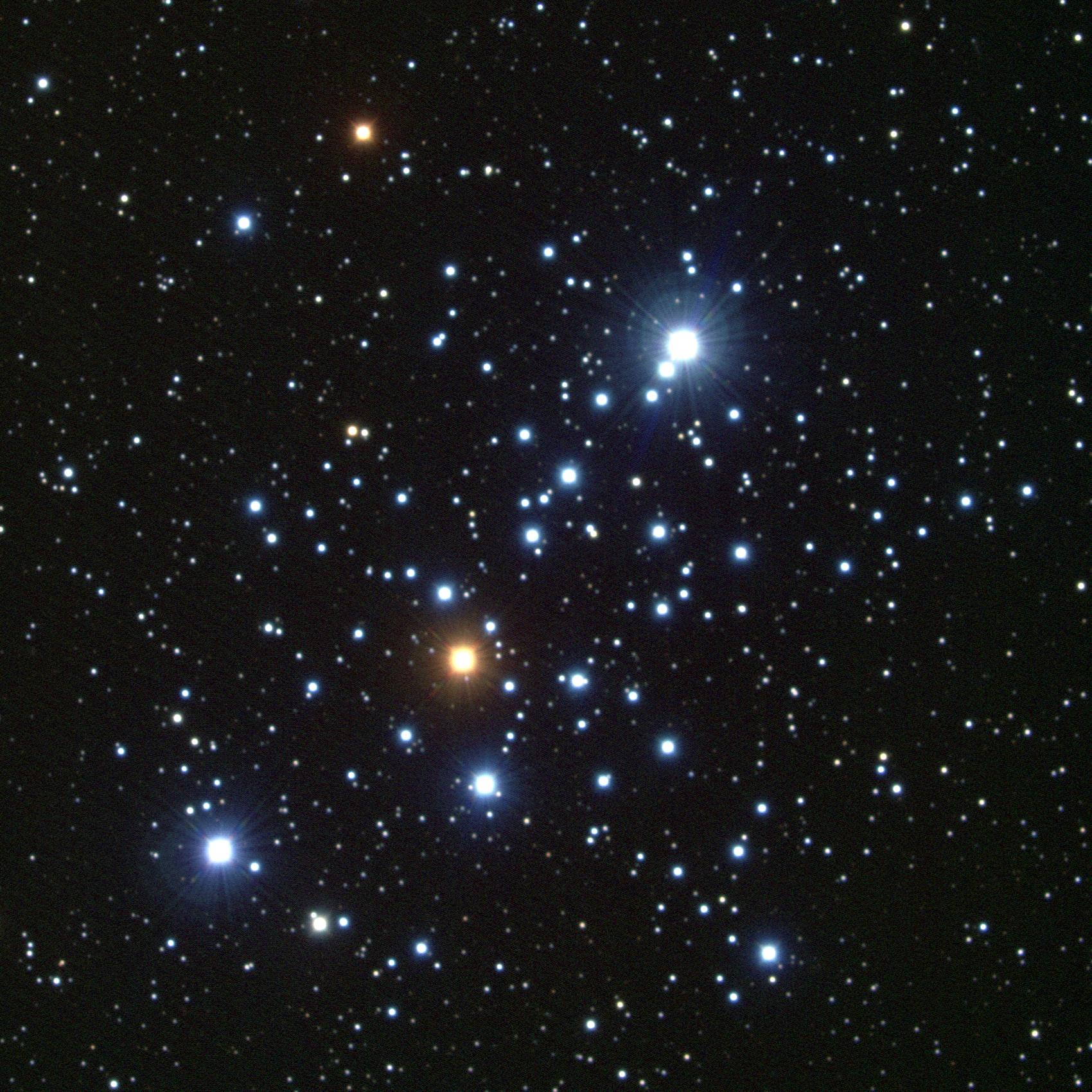
Bright blue stars highlight the open cluster known as M103. The gas clouds from which these stars condensed has long dispersed. Of the stars that were formed, the brightest, bluest, and most massive have already used up their nuclear fuel and self-destructed in supernova explosions. A 20 million-year age for M103 was estimated by finding the brightest main-sequence stars that still survive and theoretically computing their lifetimes. In fact, a formerly blue star has recently evolved off the main sequence and is visible above as the red giant star near the cluster center. In general, yellow stars like our Sun are usually less bright and hence less prominent in open clusters than their massive blue cousins. Light takes about 14 years to cross M103. Although visible with binoculars toward the constellation of Cassiopeia, M103's great distance of 8000 light years makes it appear four times smaller than a full moon.
Estrellas azules brillantes destacan en el cúmulo abierto conocido como M103. Las nubes de gas de las que estas estrellas se condensaron se han dispersado hace tiempo. De las estrellas que se formaron, las más brillantes, más azules y más masivas ya han agotado su combustible nuclear y se han autodestruido en explosiones de supernova. Se estimó una edad de 20 millones de años para M103 al encontrar las estrellas más brillantes de la secuencia principal que aún sobreviven y calculando teóricamente sus vidas útiles. De hecho, una estrella anteriormente azul ha evolucionado recientemente fuera de la secuencia principal y es visible arriba como la estrella gigante roja cerca del centro del cúmulo. En general, las estrellas amarillas como nuestro Sol suelen ser menos brillantes y, por lo tanto, menos prominentes en cúmulos abiertos que sus masivos primos azules. La luz tarda aproximadamente 14 años en cruzar M103. Aunque es visible con binoculares hacia la constelación de Casiopea, la gran distancia de M103 de 8000 años luz hace que parezca cuatro veces más pequeño que la luna llena.