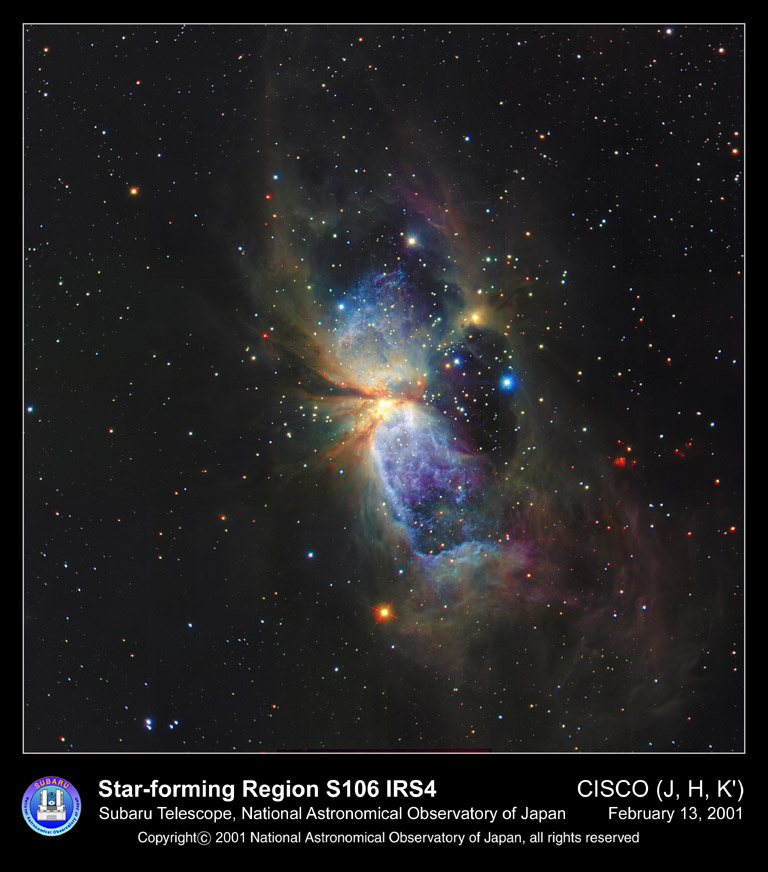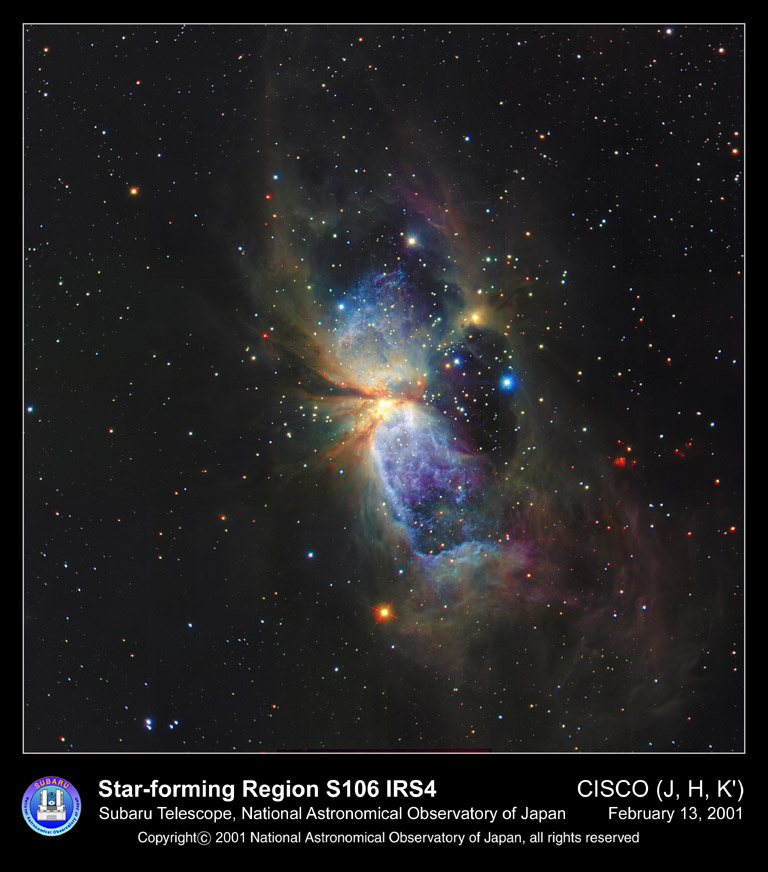
Massive star IRS4 is beginning to spread its wings. Born only about 100,000 years ago, material streaming out from this newborn star has formed the nebula dubbed Sharpless 106 Nebula (S106), pictured above. A large disk of dust and gas orbiting Infrared Source 4 (IRS4), visible in dark red near the image center, gives the nebula an hourglass shape. S106 gas near IRS4 acts as an emission nebula as it emits light after being ionized, while dust far from IRS4 reflects light from the central star and so acts as a reflection nebula. Detailed inspection of this representative color infrared image has revealed hundreds of low-mass brown dwarf stars lurking in the nebula's gas. S106 spans about 2 light-years and lies about 2000 light-years away toward the constellation of Cygnus.
La estrella masiva IRS4 está comenzando a desplegar sus alas. Nacida hace tan solo aproximadamente 100,000 años, el material que fluye desde esta estrella recién formada ha creado la nebulosa denominada Nebulosa Sharpless 106 (S106), que se muestra en la imagen anterior. Un gran disco de polvo y gas que orbita la Fuente Infrarroja 4 (IRS4), visible en rojo oscuro cerca del centro de la imagen, le confiere a la nebulosa una forma de reloj de arena. El gas de S106 cerca de IRS4 actúa como una nebulosa de emisión ya que emite luz después de ser ionizado, mientras que el polvo alejado de IRS4 refleja la luz de la estrella central y actúa como una nebulosa de reflexión. Una inspección detallada de esta imagen infrarroja representativa en color ha revelado cientos de estrellas enanas marrones de baja masa acechando en el gas de la nebulosa. S106 abarca aproximadamente 2 años luz y se encuentra a unos 2000 años luz de distancia hacia la constelación del Cisne.