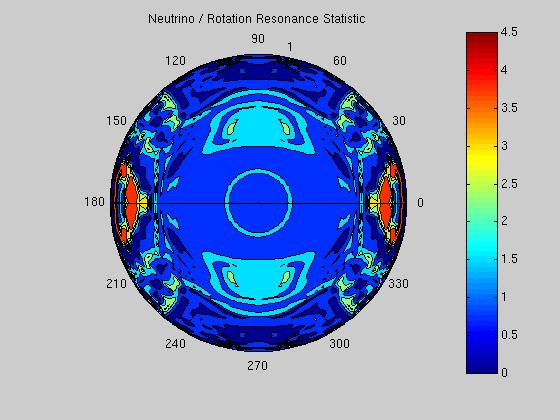
Neutrinos are subatomic particles generated by the nuclear reactions which power stars like our Sun. Flying outward from the Sun's core, they easily pass through the Sun (and almost anything else!) unimpeded and should be detectable by earth-based neutrino "telescopes". Still, to the long-standing consternation of astrophysicists, the observed flux of solar neutrinos is less than expected. In a new twist to this solar neutrino saga, an analysis of data from the GALLEX / GNO neutrino detector finds a solar neutrino flux that varies over about 27 days ... approximately matching the Sun's rotation period. In fact, since different parts of the Sun rotate at different rates, the neutrino flux variations match most exactly the rotation rates of the areas shown in red on this colorful cross-sectional map of the solar interior rotation. So how could solar rotation affect the neutrino flux? Some theoretical models say that neutrinos can change quantum properties when they interact with tangled solar magnetic fields and become particles that the neutrino experiments were not designed to detect. Then, as the Sun rotates, the neutrinos sometimes come to us unaffected and sometimes come through magnetic fields, diminishing the flux that can be measured.
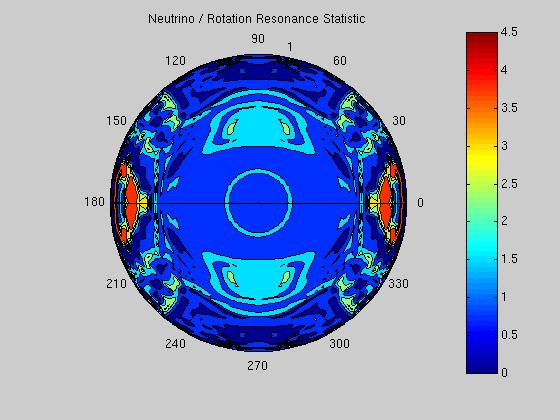
Los neutrinos son partículas subatómicas generadas por las reacciones nucleares que alimentan estrellas como nuestro Sol. Al salir del núcleo solar, estos atraviesan fácilmente el Sol (y casi cualquier otra cosa) sin obstáculos y deberían ser detectables por telescopios de neutrinos basados en la Tierra. Sin embargo, durante mucho tiempo ha sido una fuente de consternación para los astrofísicos el hecho de que el flujo observado de neutrinos solares sea menor al esperado. En un giro reciente a esta historia de los neutrinos solares, un análisis de datos del detector de neutrinos GALLEX/GNO revela un flujo de neutrinos solares que varía aproximadamente cada 27 días, coincidiendo con el período de rotación del Sol. De hecho, dado que diferentes partes del Sol giran a diferentes velocidades, las variaciones en el flujo de neutrinos coinciden con mayor exactitud con las velocidades de rotación de las regiones mostradas en rojo en este mapa colorido de la rotación interna del Sol. ¿Cómo podría la rotación solar afectar el flujo de neutrinos? Algunos modelos teóricos sugieren que los neutrinos pueden cambiar sus propiedades cuánticas al interactuar con campos magnéticos solares entrelazados, convirtiéndose en partículas que los experimentos de neutrinos no están diseñados para detectar. Así, a medida que el Sol gira, los neutrinos a veces llegan a nosotros sin alteración y otras veces atraviesan campos magnéticos, reduciendo el flujo que puede ser medido.