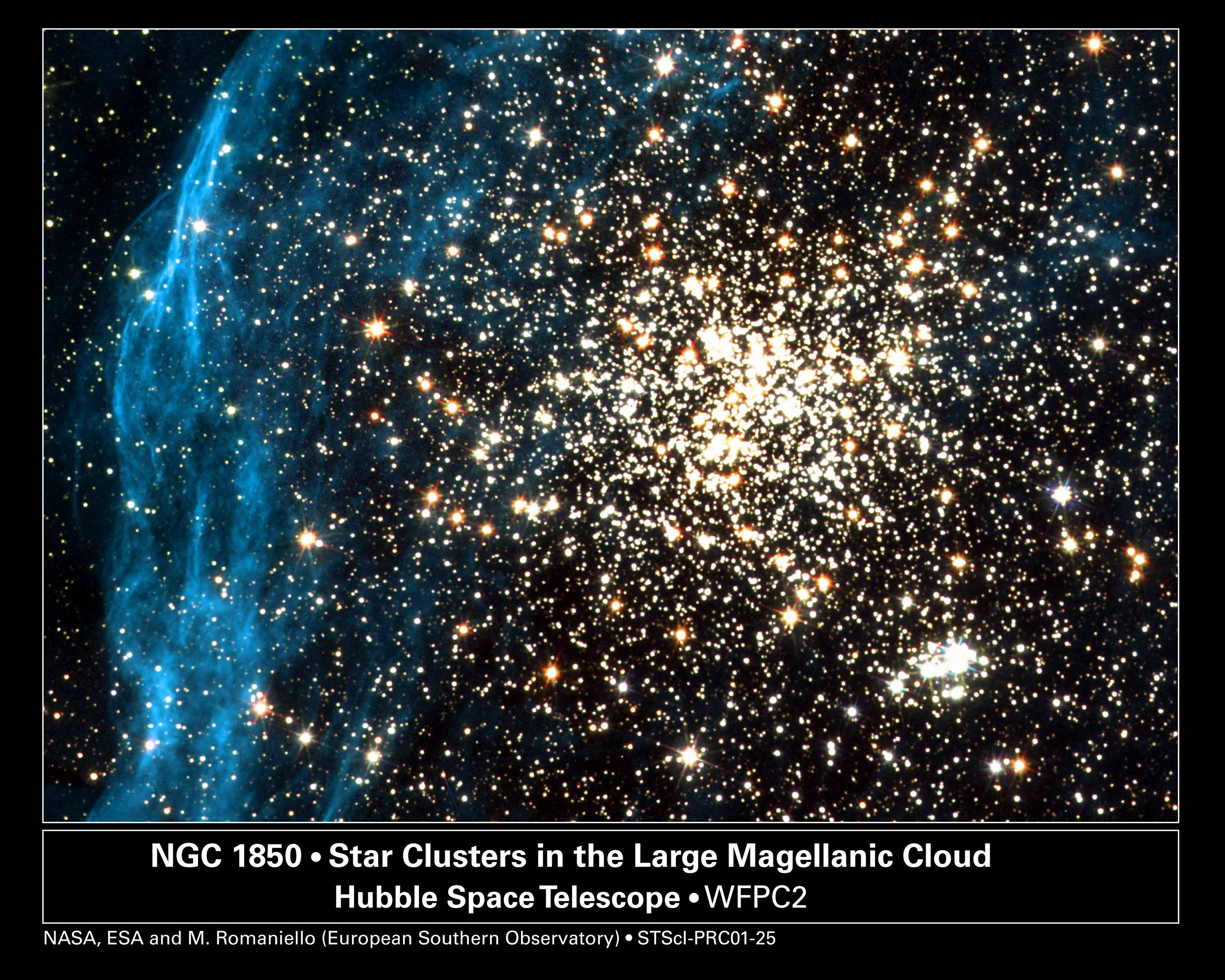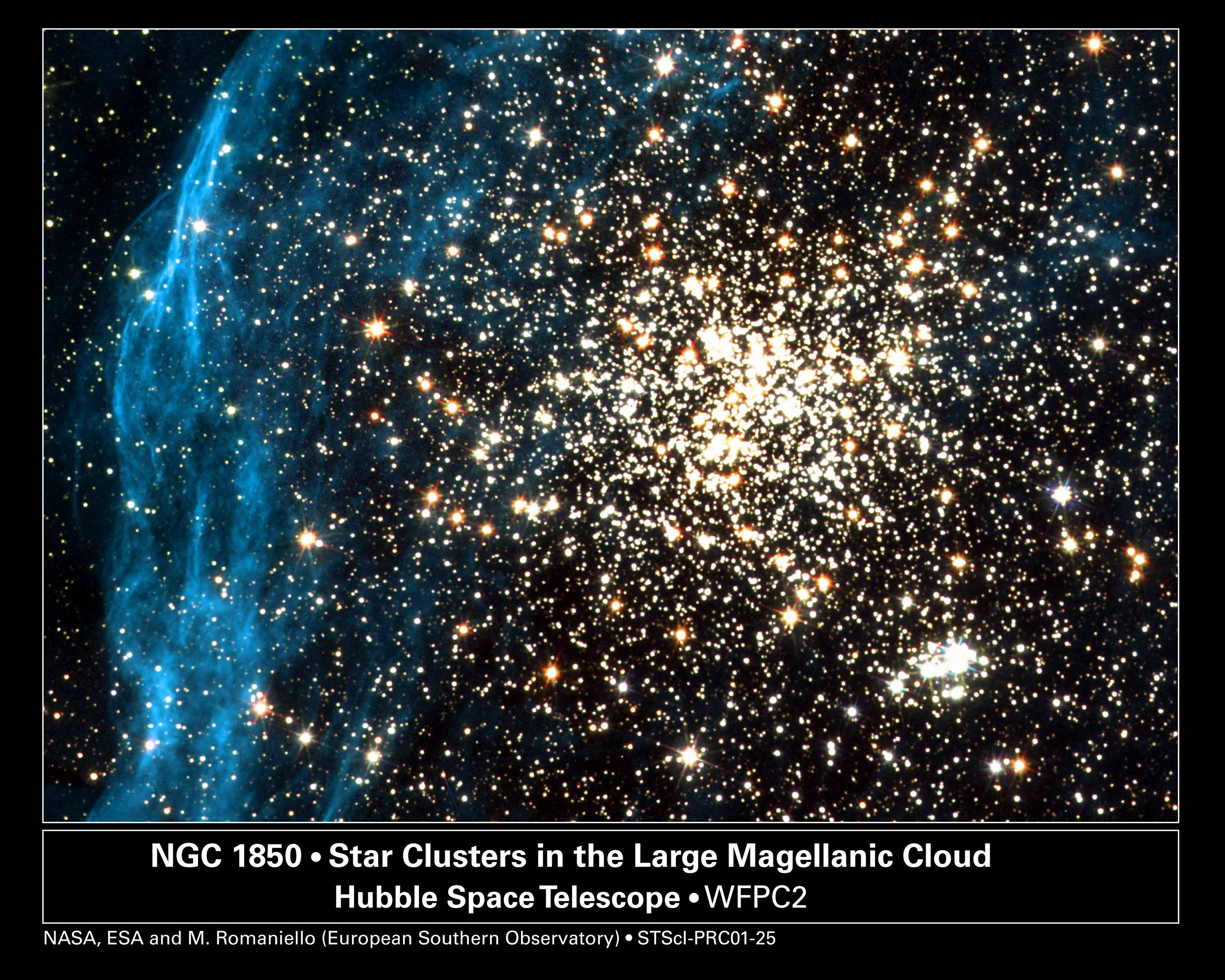
A mere 168,000 light-years distant, this large, lovely cluster of stars, NGC 1850, is located near the outskirts of the central bar structure in our neighboring galaxy, the Large Magellanic Cloud. A first glance at this Hubble Space Telescope composite image suggests that this cluster's size and shape are reminiscent of the ancient globular star clusters which roam our own Milky Way Galaxy's halo. But NGC 1850's stars are young ... making it a type of star cluster with no known counterpart in the Milky Way. NGC 1850 is also a double star cluster, with a second, compact cluster of stars visible here below and to the right of the large cluster's central region. Stars in the large cluster are estimated to be 50 million years young, while stars in the compact cluster are younger still, with an age of about 4 million years. In fact, the smaller cluster contains T-Tauri stars, thought to be low mass, solar-type stars still in the process of formation. The glowing nebula at the left, like the supernova remnants in our own galaxy, testifies to violent stellar explosions, indicating short-lived massive stars were also present in NGC 1850.
A tan solo 168 000 años luz de distancia, este gran y hermoso cúmulo de estrellas, NGC 1850, se encuentra cerca del borde de la estructura en barra central en nuestra galaxia vecina, la Gran Nube de Magallanes. A primera vista, esta imagen compuesta del Telescopio Espacial Hubble sugiere que el tamaño y la forma de este cúmulo recuerdan a los antiguos cúmulos globulares de estrellas que se mueven por el halo de nuestra propia galaxia, la Vía Láctea. Pero las estrellas de NGC 1850 son jóvenes... convirtiéndolo en un tipo de cúmulo estelar sin contraparte conocida en la Vía Láctea. NGC 1850 también es un cúmulo estelar doble, con un segundo cúmulo compacto de estrellas visible aquí debajo y a la derecha de la región central del gran cúmulo. Se estima que las estrellas del cúmulo grande tengan 50 millones de años, mientras que las estrellas del cúmulo compacto son aún más jóvenes, con una edad de aproximadamente 4 millones de años. De hecho, el cúmulo más pequeño contiene estrellas T-Tauri, que se cree que son estrellas de baja masa, similares al Sol, aún en proceso de formación. La nebulosa brillante a la izquierda, al igual que los restos de supernovas en nuestra propia galaxia, es testigo de explosiones estelares violentas, indicando que también estaban presentes estrellas masivas de corta vida en NGC 1850.