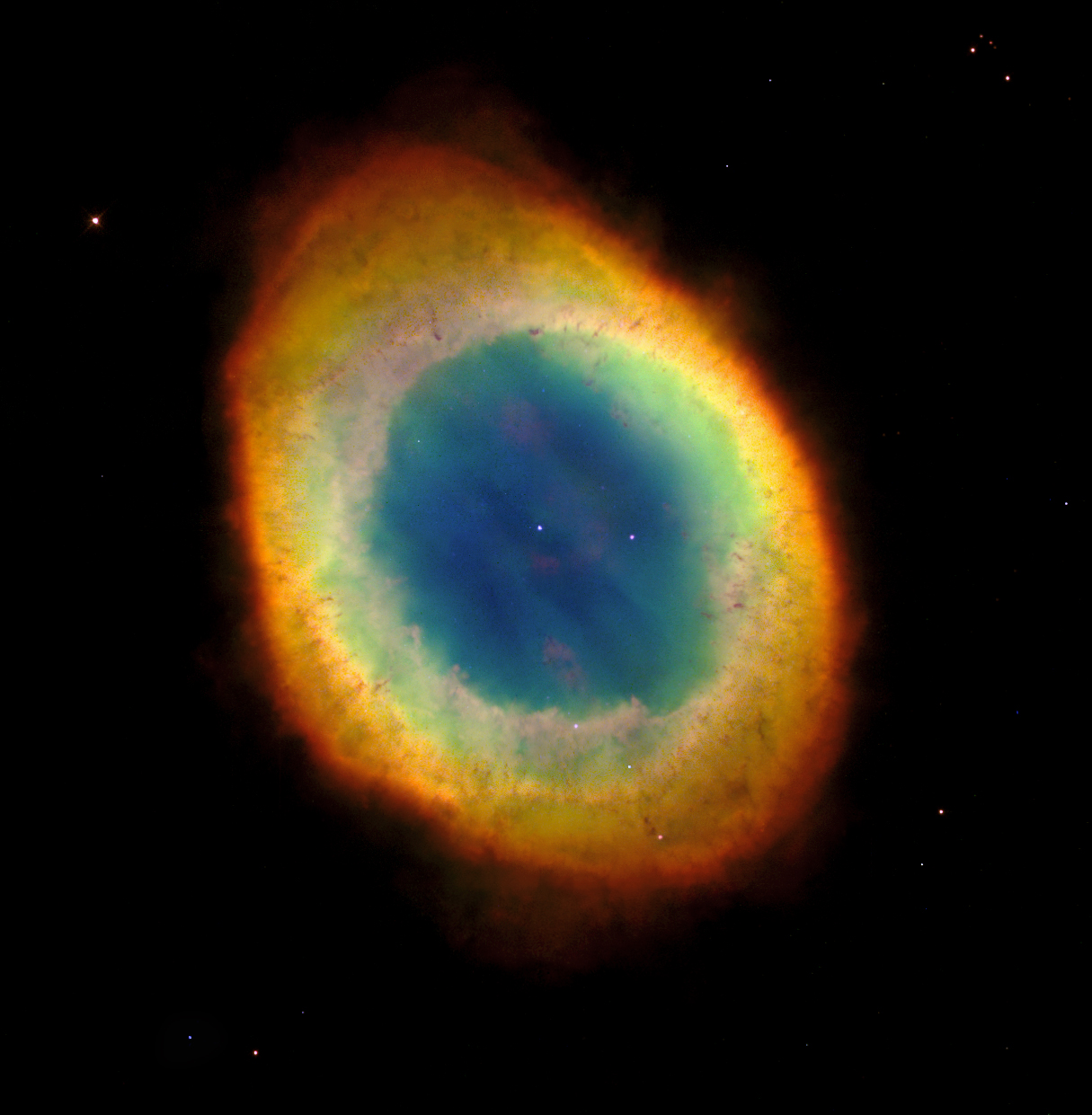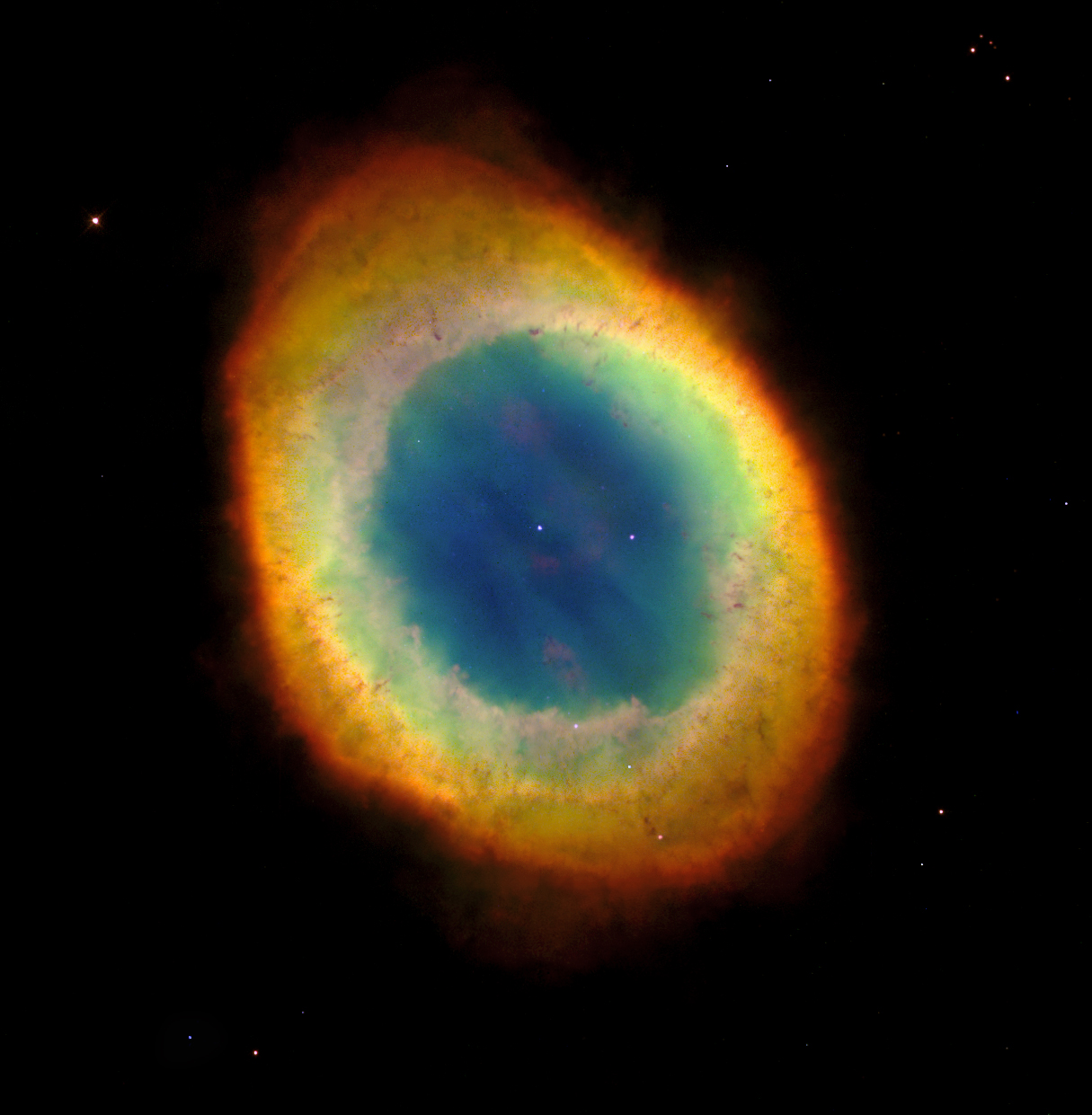
cept for the rings of Saturn, the Ring Nebula (M57) is probably the most famous celestial band. This planetary nebula's simple, graceful appearance is thought to be due to perspective -- our view from planet Earth looking straight into what is actually a barrel-shaped cloud of gas shrugged off by a dying central star. Astronomers of the Hubble Heritage Project produced this strikingly sharp image from Hubble Space Telescope observations using natural appearing colors to indicate the temperature of the stellar gas shroud. Hot blue gas near the energizing central star gives way to progressively cooler green and yellow gas at greater distances with the coolest red gas along the outer boundary. Dark, elongated structures can also be seen near the nebula's edge. The Ring Nebula is about one light-year across and 2,000 light-years away in the northern constellation Lyra.
Excepto por los anillos de Saturno, la Nebulosa Anular (M57) es probablemente la banda celeste más famosa. El sencillo y elegante aspecto de esta nebulosa planetaria se cree que se debe a la perspectiva: nuestra visión desde la Tierra mirando directamente hacia una nube en forma de barril de gas expulsado por una estrella central moribunda. Astrónomos del Proyecto Hubble Heritage produjeron esta imagen nítida y llamativa a partir de observaciones del Telescopio Espacial Hubble, utilizando colores que aparecen naturalmente para indicar la temperatura de la envoltura gaseosa estelar. El gas azul caliente cerca de la estrella central energética cede lugar progresivamente a gas verde y amarillo más frío a mayores distancias, con el gas rojo más frío a lo largo del límite exterior. También se pueden ver estructuras oscuras y alargadas cerca del borde de la nebulosa. La Nebulosa Anular tiene aproximadamente un año luz de diámetro y se encuentra a 2000 años luz de distancia en la constelación norteña de Lyra.