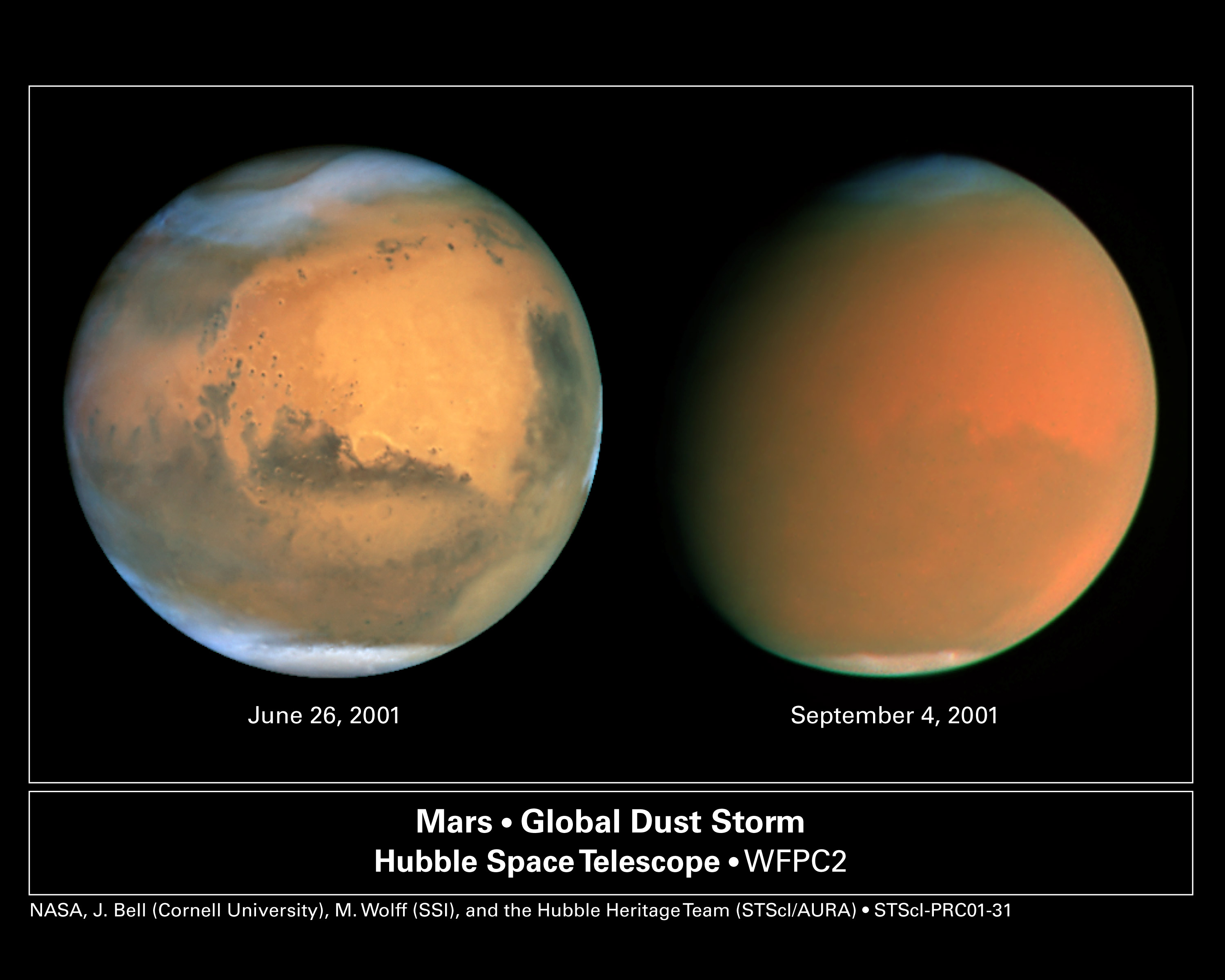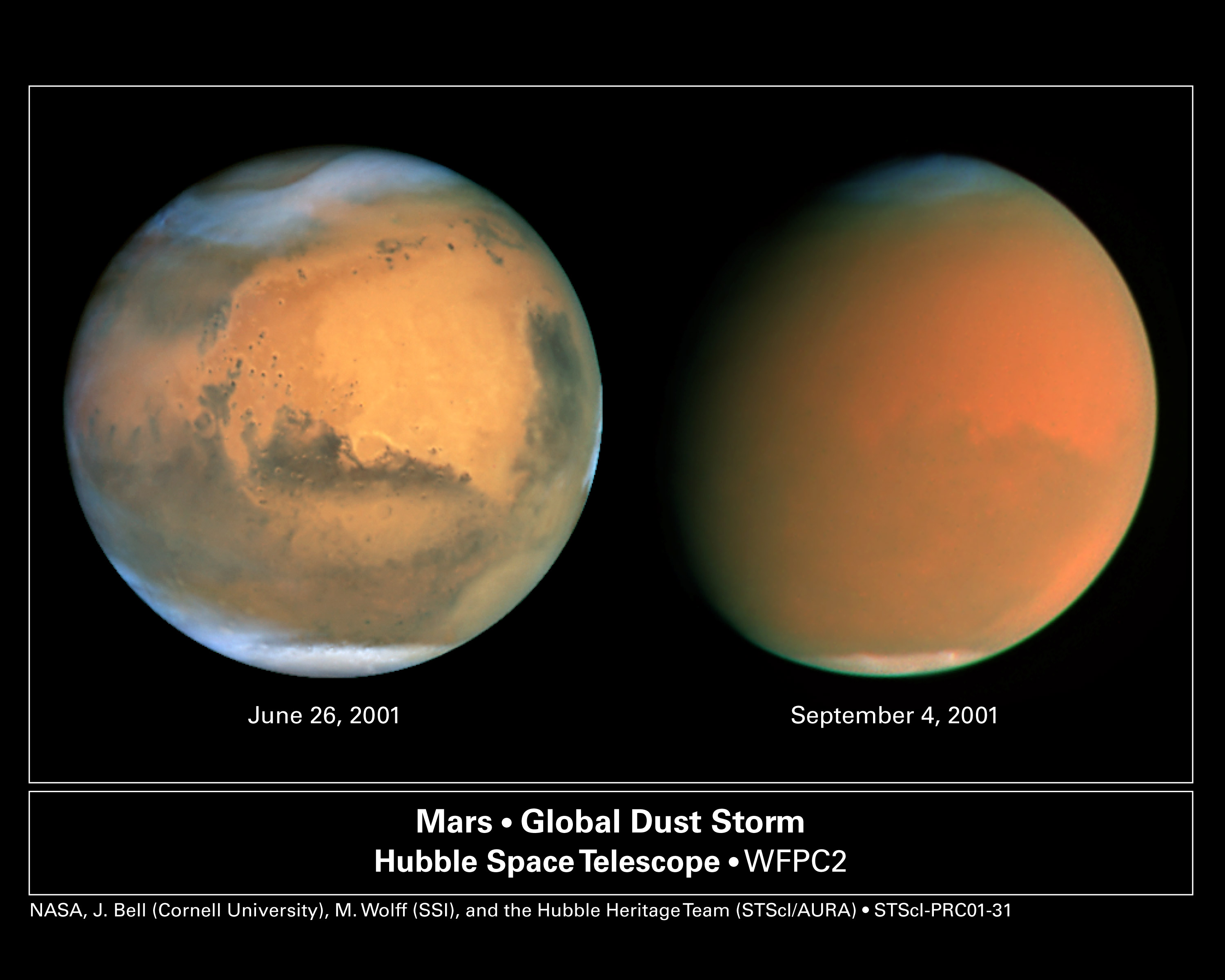
For months now, Mars has been engulfed by a great dust storm, the biggest seen raging across the Red Planet in decades. As a result, these two Hubble Space Telescope storm watch images from late June and early September offer dramatically contrasting views of the martian surface. At left, the onset of smaller "seed" storms can be seen near the Hellas basin (lower right edge of Mars) and the northern polar cap. A similar surface view at right, taken over two months later, shows the fully developed extent of the obscuring global dust storm. The storm is reported to be waning, but planet-wide effects such as the warming of the upper martian atmosphere and cooling of the surface are still being monitored daily by instruments on board the Mars Global Surveyor spacecraft. The present condition of the martian atmosphere is also important to the aerobraking Mars Odyssey spacecraft, scheduled to arrive at the Red Planet next week.
Durante meses, Marte ha estado envuelto por una gran tormenta de polvo, la más grande vista en el Planeta Rojo en décadas. Como resultado, estas dos imágenes de vigilancia de tormentas tomadas por el Telescopio Espacial Hubble a finales de junio y principios de septiembre ofrecen vistas contrastantes dramáticas de la superficie marciana. A la izquierda, se puede ver el inicio de tormentas más pequeñas cerca del basamento de Hellas (borde inferior derecho de Marte) y el casquete polar norte. Una vista similar de la superficie a la derecha, tomada más de dos meses después, muestra el alcance completo desarrollado de la tormenta global que oculta la superficie. Se informa que la tormenta está disminuyendo, pero los efectos a nivel planetario, como el calentamiento de la atmósfera superior marciana y el enfriamiento de la superficie, siguen siendo monitoreados diariamente por instrumentos a bordo de la nave espacial Mars Global Surveyor. El estado actual de la atmósfera marciana también es importante para la nave espacial Mars Odyssey, que utiliza frenado aerodinámico y está programada para llegar al Planeta Rojo la próxima semana.