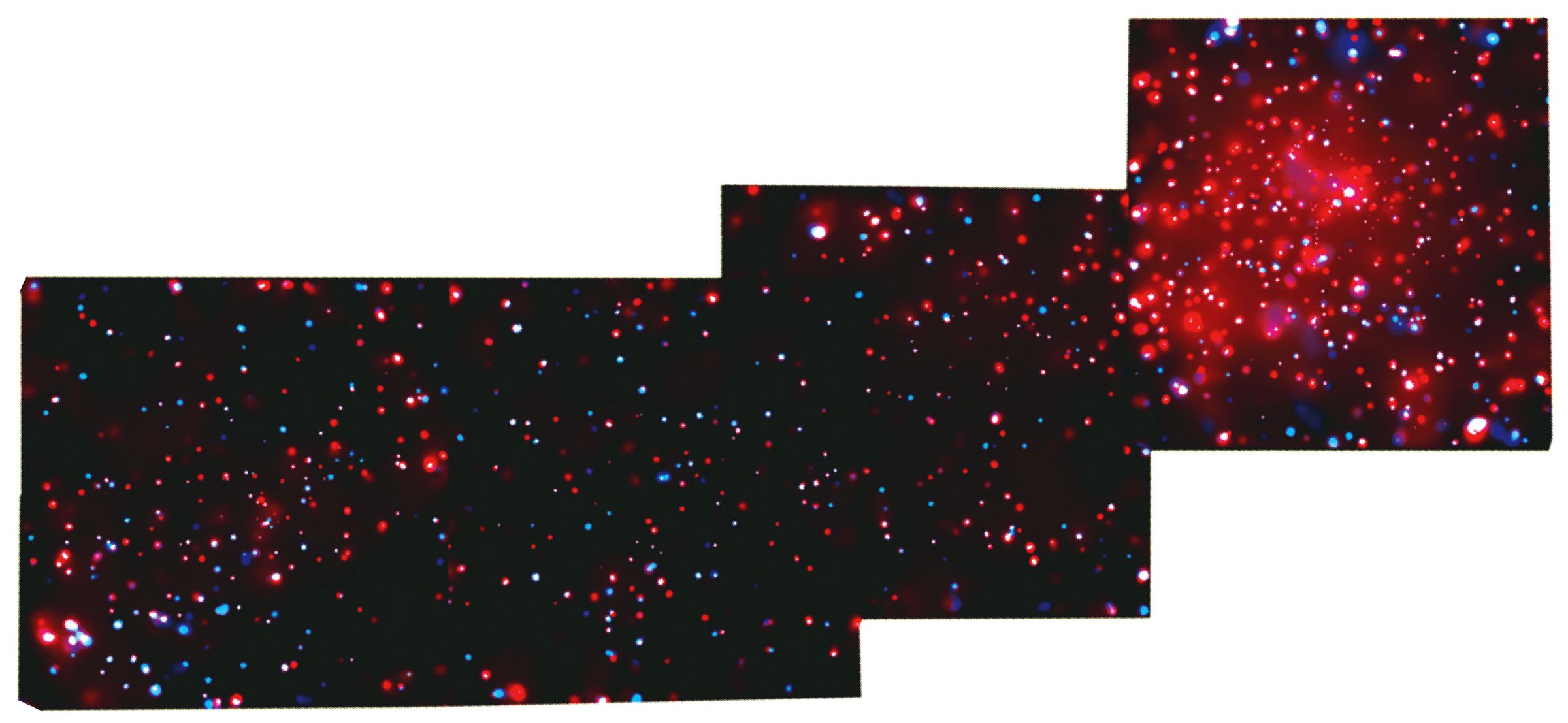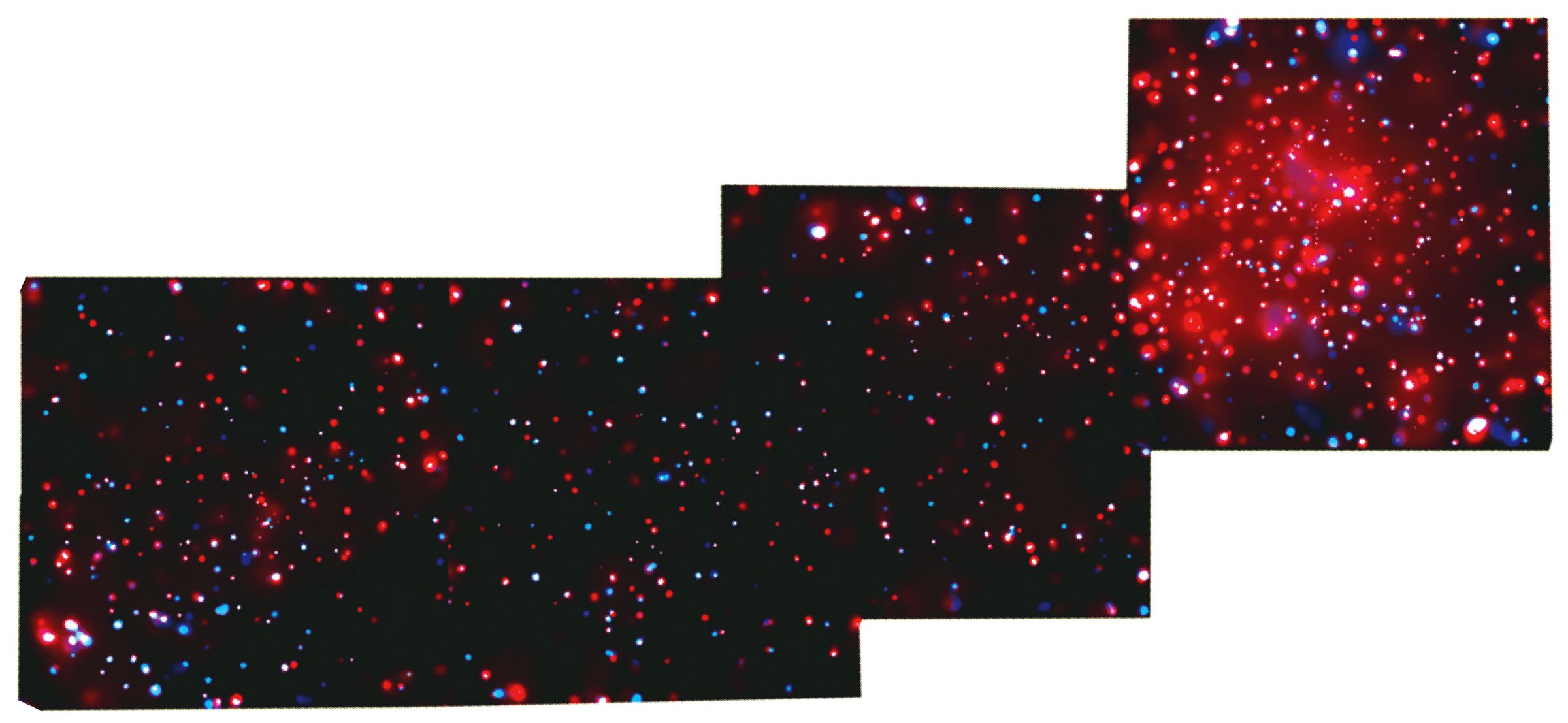
This mosaic of x-ray images cuts a swath across the photogenic Rosette Nebula, a stellar nursery 5,000 light-years from Earth in the constellation Monoceros, the Unicorn. Constructed from data recorded by the orbiting Chandra X-ray Observatory, the mosaic spans less than 100 light-years and is color coded to show low energies in red and high energy x-rays in blue. At the upper right is the young star cluster NGC 2244, central to the Rosette Nebula itself. The hot outer layers of the massive stars are seen to be copious sources of x-rays, but a diffuse x-ray glow also pervades this cluster of newborn stars. Since these stars are so young (less than few million years old!) the diffuse x-ray emission is thought to be powered by energetic, colliding stellar winds rather than remnants of supernovae explosions, a final act in the life cycle of a massive star. Moving away from the center, south and east across the nebula (upper right to lower left), the hot, blustery environment gives way to dense molecular gas, absorbing low energy x-rays while revealing the penetrating high energy x-rays from embedded stars.
Crédito: NASA, Chandra X-ray Observatory Esta mosaico de imágenes en rayos X corta un camino a través de la fotogénica nebulosa Rosetta, un criadero estelar situado a 5.000 años luz de la Tierra en la constelación de Monoceros, el Unicornio. Construido a partir de datos registrados por la observación orbital Chandra X-ray Observatory, el mosaico abarca menos de 100 años luz y está codificado en colores para mostrar energías bajas en rojo y rayos X de alta energía en azul. En la parte superior derecha se encuentra el joven cúmulo estelar NGC 2244, central en la nebulosa Rosetta en sí. Las capas externas calientes de las estrellas masivas se ven como fuentes abundantes de rayos X, pero un resplandor difuso de rayos X también impregna este cúmulo de estrellas recién nacidas. Dado que estas estrellas son muy jóvenes (menos de unos pocos millones de años), se cree que la emisión difusa de rayos X está impulsada por vientos estelares energéticos y colisionantes, en lugar de por restos de explosiones de supernovas, un acto final en el ciclo de vida de una estrella masiva. Alejándose del centro, hacia el sur y el este de la nebulosa (de la parte superior derecha a la inferior izquierda), el entorno cálido y ventoso cede paso a gas molecular denso, que absorbe los rayos X de baja energía mientras revela los rayos X de alta energía penetrantes provenientes de estrellas incrustadas.