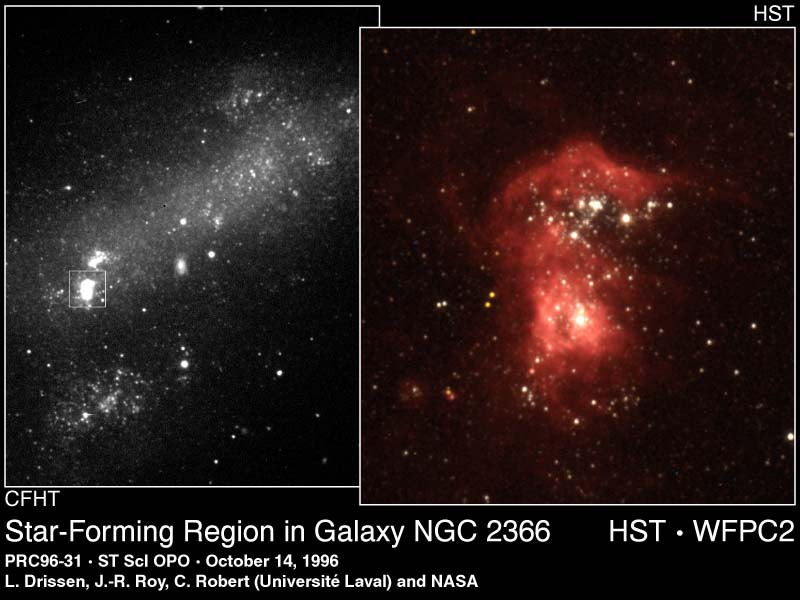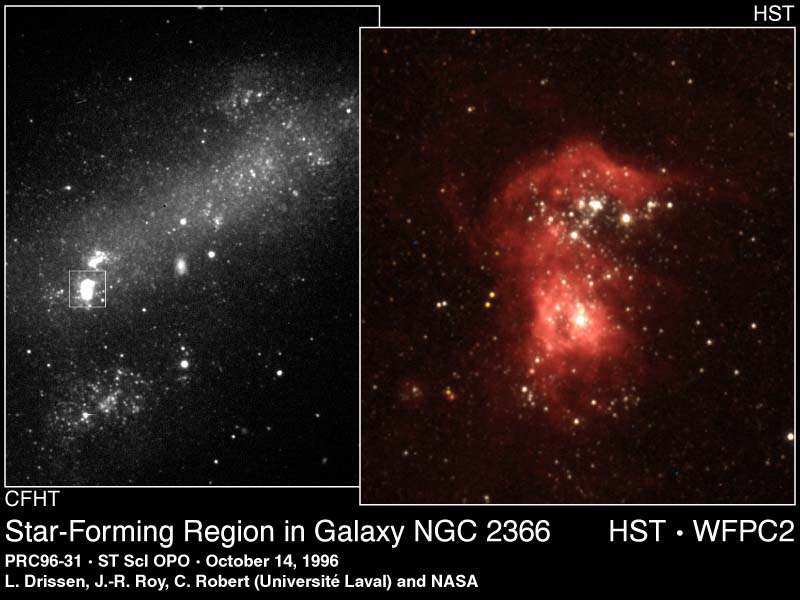
These two clusters of bright, newly formed stars surrounded by a glowing nebula lie 10 million light-years away in the dim, irregular galaxy cataloged as NGC 2366. The Hubble Space Telescope image shows that the youngest cluster, the bottom one at about 2 million years old, is still surrounded by the gas and dust cloud it condensed from, while powerful stellar winds from the stars in the older cluster at the top (4-5 million years old), have begun to clear away its central areas giving the entire nebula an apparent inverted hook shape. Compared to the sun, the stars in these clusters are massive and short lived. The brightest one, near the tip of the hook, is a rare Luminous Blue Variable with 30 to 60 times the mass of the sun - similar to the erruptive Eta Carinae in our own Milky Way. Stars this massive are extremely variable. A comparison with ground based images indicates that in three years this star's brightness increased by about 40 times making it currently the brightest star in this dim galaxy.
Crédito: NASA, Hubble Space Telescope Estos dos cúmulos de estrellas brillantes y recientemente formadas, rodeados por una nebulosa luminosa, se encuentran a 10 millones de años luz de distancia en la galaxia irregular y tenue catalogada como NGC 2366. La imagen del Telescopio Espacial Hubble muestra que el cúmulo más joven, el de abajo con aproximadamente 2 millones de años de edad, aún está rodeado por la nube de gas y polvo de la cual se condensó, mientras que los fuertes vientos estelares provenientes de las estrellas en el cúmulo más antiguo de arriba (de 4 a 5 millones de años), han comenzado a limpiar sus áreas centrales, dando a toda la nebulosa una aparente forma de gancho invertido. Comparadas con el Sol, las estrellas en estos cúmulos son masivas y de corta vida. La más brillante, cerca del extremo del gancho, es una rara Variable Azul Luminosa con 30 a 60 veces la masa del Sol - similar a la eruptiva Eta Carinae en nuestra propia Vía Láctea. Estrellas tan masivas son extremadamente variables. Una comparación con imágenes tomadas desde el suelo indica que en tres años la brillantez de esta estrella aumentó aproximadamente 40 veces, convirtiéndola actualmente en la estrella más brillante de esta galaxia tenue.