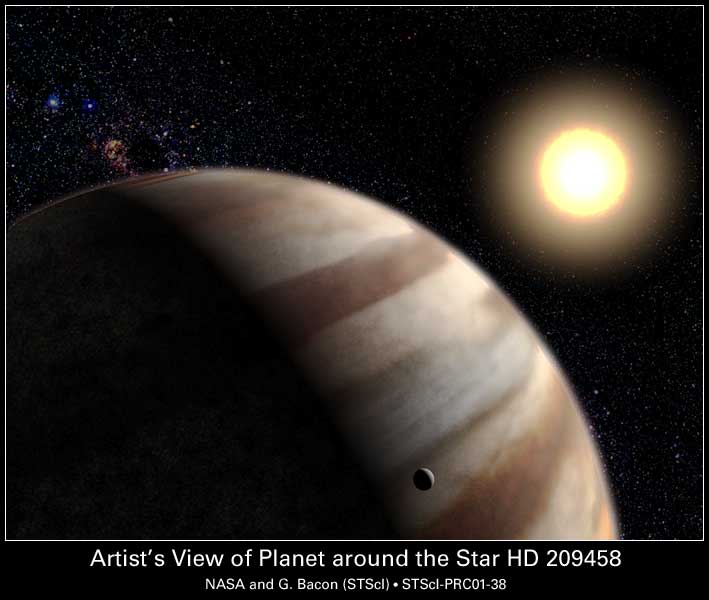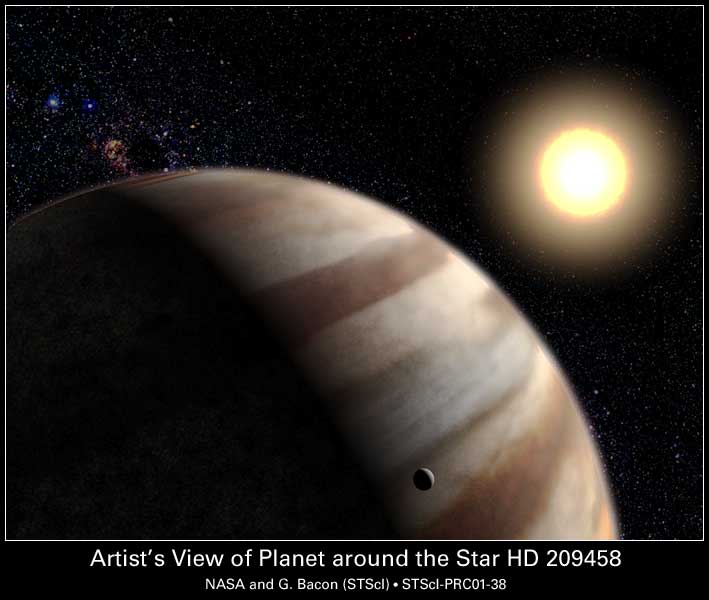
By directly detecting the atmosphere of a planet outside our Solar System, humanity has taken another small step toward finding extraterrestrial life. The unexpected detection by David Charbonneau (Caltech) and associates came from Hubble Space Telescope observations of Sun-like star HD 209458. As an orbiting planet crossed between that star and the Earth, sodium in the planet's atmosphere absorbed starlight at very specific colors. The planet, originally discovered two years ago, has about 70 percent the mass of Jupiter but orbits very close in. A long-term goal of this type of research is the detection of planetary biomarkers that would indicate life, such as oxygen, water, or methane.
Al detectar directamente la atmósfera de un planeta fuera de nuestro Sistema Solar, la humanidad ha dado otro pequeño paso hacia la búsqueda de vida extraterrestre. La inesperada detección realizada por David Charbonneau (Caltech) y sus colaboradores provino de observaciones del Telescopio Espacial Hubble del estrella similar al Sol HD 209458. Cuando un planeta en órbita se interpuso entre esa estrella y la Tierra, el sodio en la atmósfera del planeta absorbió la luz estelar en colores muy específicos. El planeta, originalmente descubierto hace dos años, tiene aproximadamente el 70 por ciento de la masa de Júpiter, pero orbita muy cerca. Un objetivo a largo plazo de este tipo de investigación es la detección de biomarcadores planetarios que indicarían vida, como oxígeno, agua o metano.