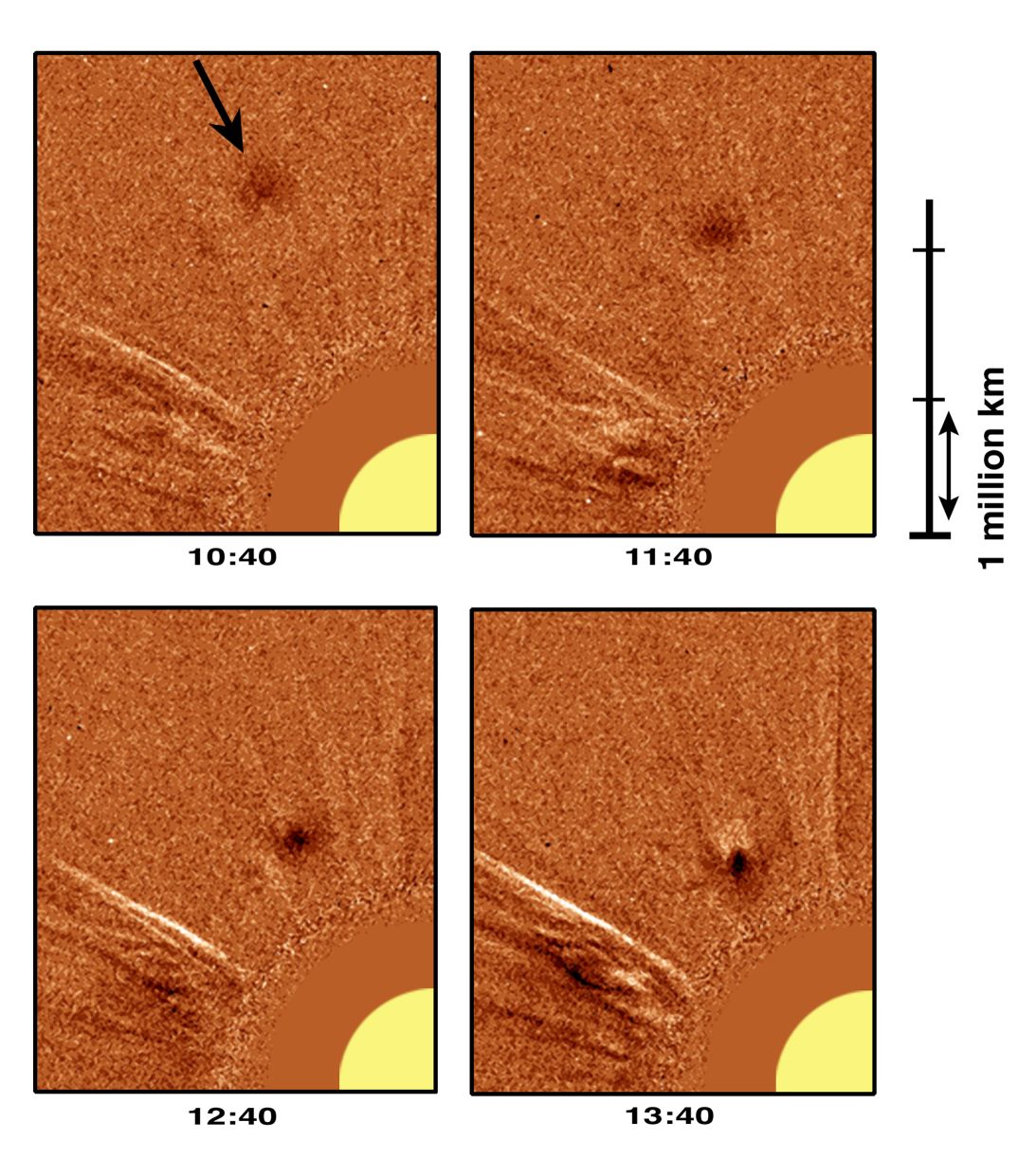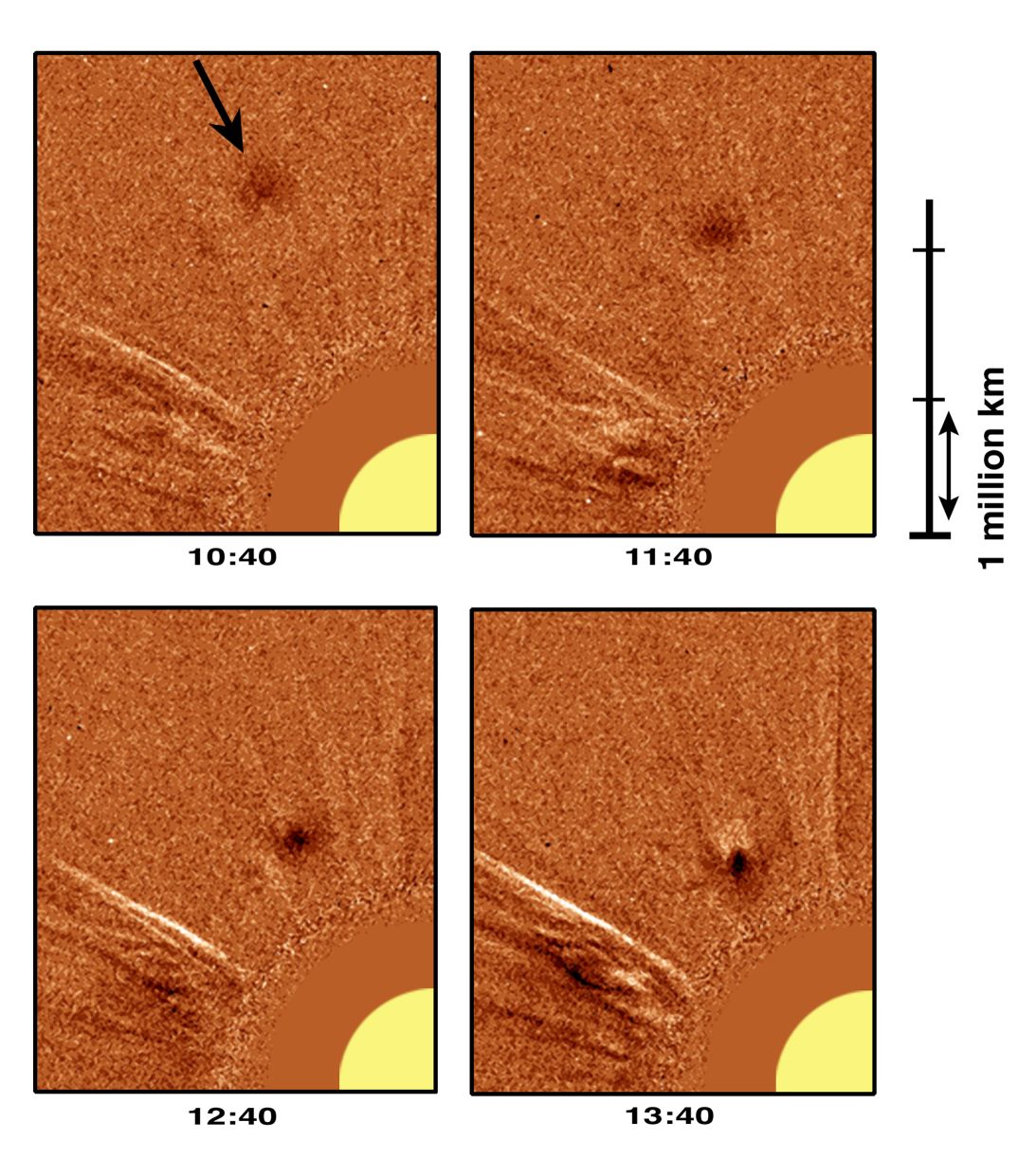
The active Sun has thrown a lot our way lately, including storms of particles streaming outward in the solar wind and clouds of plasma which triggered awesome auroral displays. Still, a growing body of intriguing observations from the LASCO instrument on board the space-based SOlar and Heliospheric Observatory (SOHO) indicates material also flows back toward the Sun, starting from over 2 million kilometers above its visible surface. Relatively hard to detect against the outflowing solar corona, a dark inflowing cloud's relative motion is tracked above in two highly processed images recorded an hour apart. The solar surface, graphically shown by the yellow quarter circle at the lower right, is blocked from view by a smooth occulting disk. Fighting against a solar wind outflow of about 120 kilometers per second the cloud seems to be moving inward at 50-100 kilometers per second. Occasionally appearing as often as once per hour, the clouds, seem to be dragged in by collapsing magnetic field loops rather than gravity alone. Researchers are now working to relate this surprising inflow to the solar wind and magnetic environment of the Sun.
El Sol activo ha lanzado muchas cosas hacia nosotros últimamente, incluyendo tormentas de partículas que se desplazan hacia afuera en el viento solar y nubes de plasma que desencadenaron asombrosas auroras. Sin embargo, un creciente conjunto de observaciones intrigantes del instrumento LASCO a bordo de la observatorio espacial SOlar y Heliosférico (SOHO) indica que material también fluye de vuelta hacia el Sol, comenzando desde más de 2 millones de kilómetros por encima de su superficie visible. Relativamente difícil de detectar contra la corona solar que fluye hacia afuera, el movimiento relativo de una nube oscura que fluye hacia adentro se rastrea arriba en dos imágenes altamente procesadas registradas una hora aparte. La superficie solar, mostrada gráficamente por el cuarto de círculo amarillo en la esquina inferior derecha, está bloqueada de la vista por un disco de ocultación suave. Luchando contra un flujo de viento solar de aproximadamente 120 kilómetros por segundo, la nube parece moverse hacia adentro a 50-100 kilómetros por segundo. Apareciendo ocasionalmente tan a menudo como una vez por hora, las nubes parecen ser arrastradas hacia adentro por bucles magnéticos colapsantes más que por la gravedad sola. Los investigadores ahora están trabajando para relacionar este sorprendente ingreso con el viento solar y el entorno magnético del Sol.