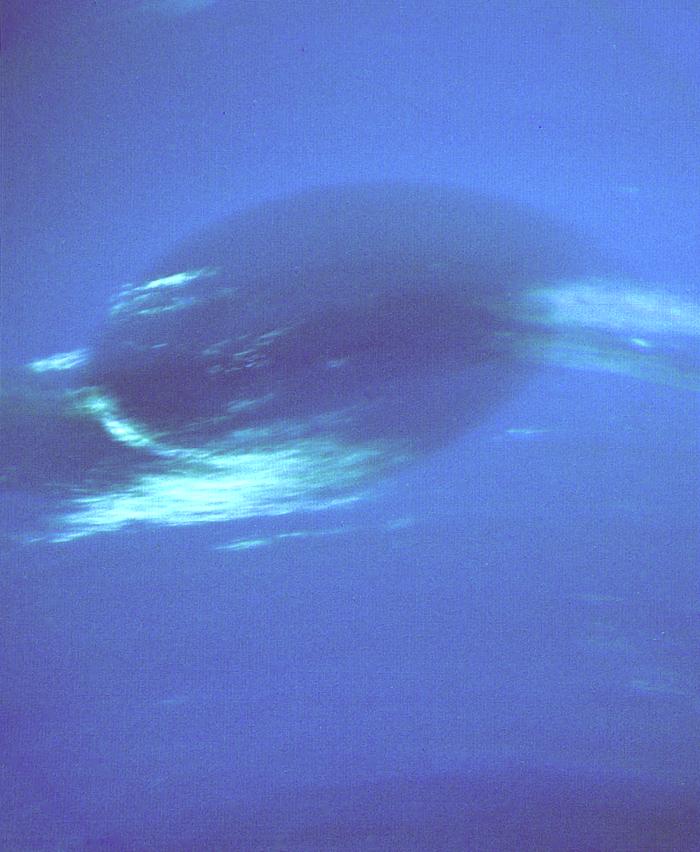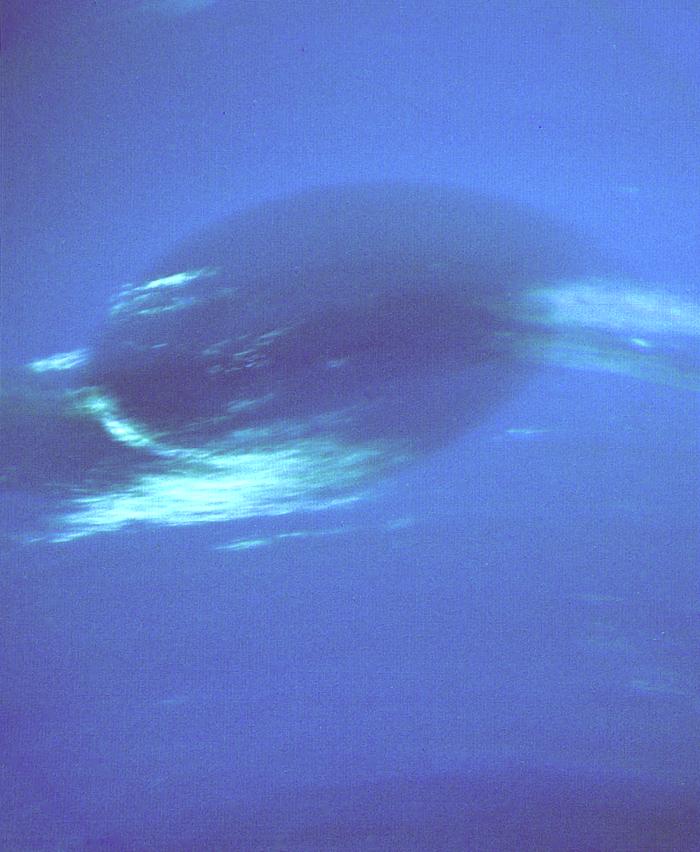
When NASA's Voyager 2 spacecraft flew by distant Neptune in August of 1989, astronomers were shocked. Since Neptune receives only 3 percent the sunlight Jupiter does, they expected to find a dormant, dark, frigid planet. Instead, the Voyager images revealed evidence of a dynamic and turbulent world. One of the most spectacular discoveries was of the Great Dark Spot, shown here in close-up. Surprisingly, it was comparable in size and at the same relative southern latitude as Jupiter's Great Red Spot, appearing to be a similar rotating storm system. Winds near the spot were measured up to 1500 miles per hour, the strongest recorded on any planet. The Voyager data also revealed that the Great Dark Spot varied significantly in size during the brief flyby. When the Hubble Space Telescope viewed the planet in 1994, the spot had vanished -- only to be replaced by another dark spot in the planet's northern hemisphere!
Cuando la nave espacial Voyager 2 de la NASA sobrevoló el distante Neptuno en agosto de 1989, los astrónomos quedaron sorprendidos. Dado que Neptuno recibe solo el 3 por ciento de la luz solar que recibe Júpiter, esperaban encontrar un planeta inactivo, oscuro y frío. En cambio, las imágenes de Voyager revelaron evidencia de un mundo dinámico y turbulento. Uno de los descubrimientos más espectaculares fue el de la Gran Mancha Oscura, mostrada aquí en detalle. Sorprendentemente, era comparable en tamaño y se encontraba en la misma latitud sur relativa que la Gran Mancha Roja de Júpiter, pareciendo ser un sistema de tormenta similar en rotación. Los vientos cerca de la mancha se midieron hasta 1500 millas por hora, los más fuertes registrados en cualquier planeta. Los datos de Voyager también revelaron que la Gran Mancha Oscura varió significativamente en tamaño durante el breve sobrevuelo. Cuando el Telescopio Espacial Hubble observó el planeta en 1994, la mancha había desaparecido, para ser reemplazada por otra mancha oscura en el hemisferio norte del planeta.