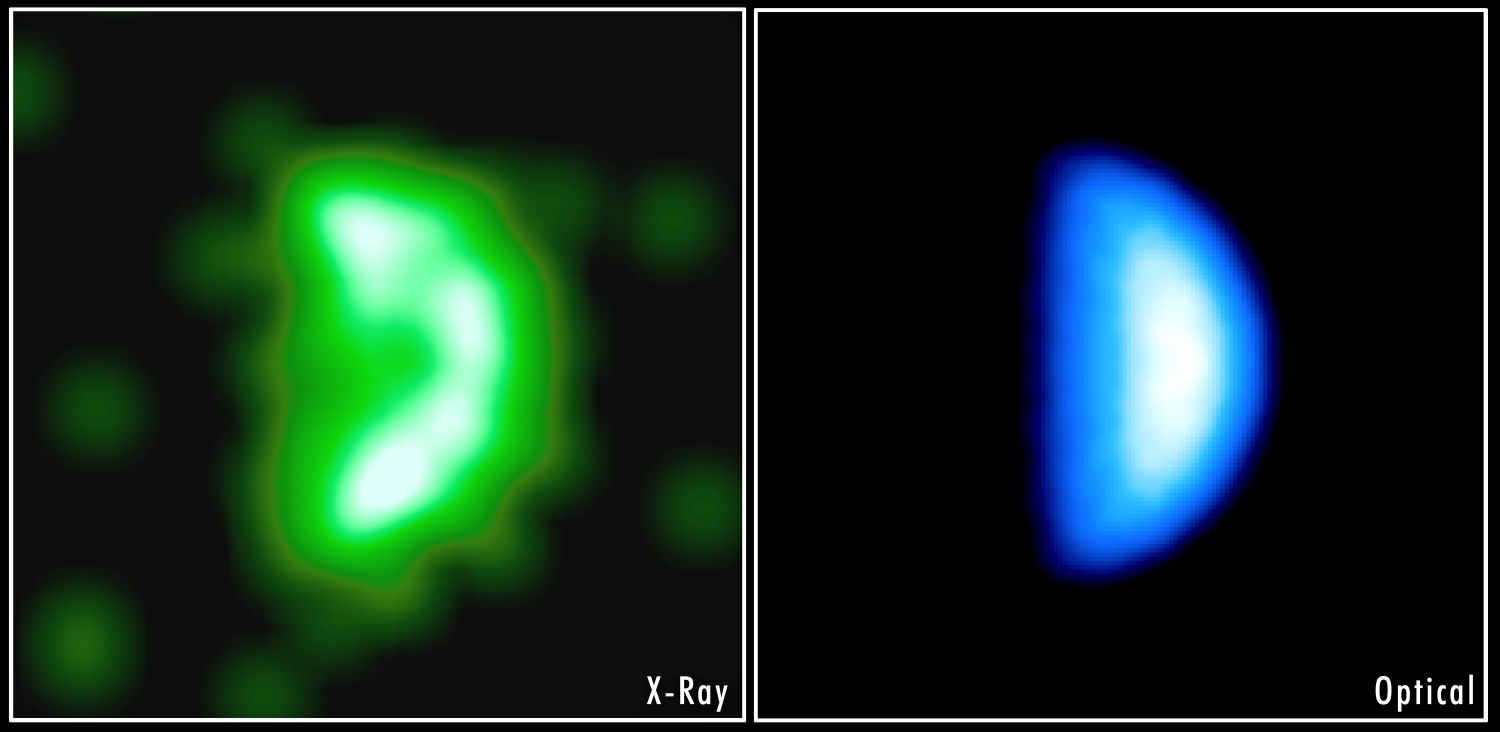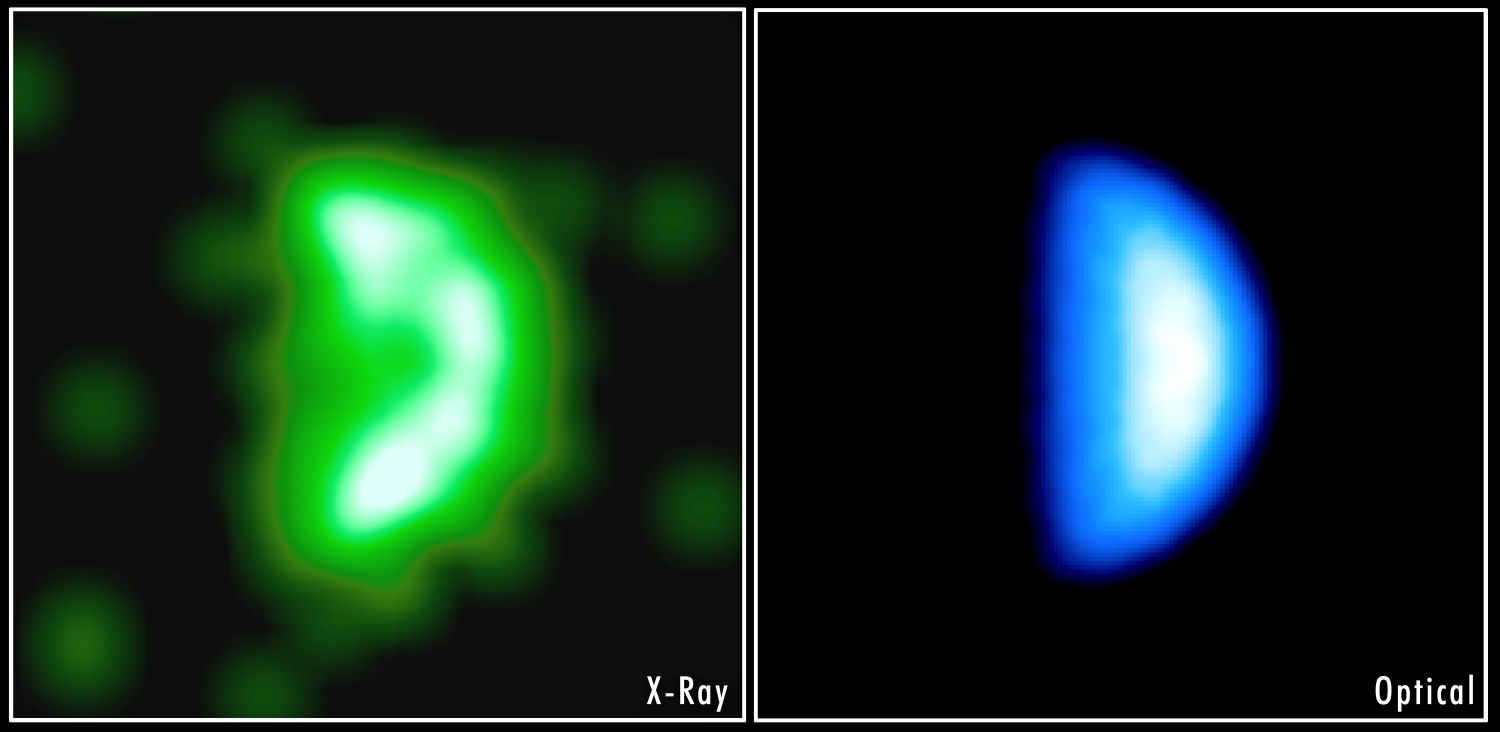
Venus, second planet from the Sun, appears above imaged for the first time ever in x-rays (left) by the orbiting Chandra Observatory. Chandra's smoothed, false-color, x-ray view is compared to an optical image (right) from a small earthbound telescope. Both show Venus illuminated by the Sun from the right, with only half the sunward hemisphere visible, but at least one striking difference is apparent. While the optical image in reflected sunlight is filled and bright at the center, Venus in x-rays is bright around the edge. Venus' x-rays are produced by fluorescence rather than reflection. About 120 kilometers or so above the surface, incoming solar x-rays excite atoms in the Venusian atmosphere to unstable energy levels. As the atoms rapidly decay back to their stable ground states they emit a "fluorescence" x-ray, creating a glowing x-ray half-shell above the sunlit hemisphere. More x-ray emitting material can be seen looking at the edge of the shell, so the edge appears brighter in the x-ray image.
Venus, el segundo planeta desde el Sol, aparece capturado por primera vez en rayos X (izquierda) por la observación orbital de Chandra. La imagen en rayos X suavizada y en color falso de Chandra se compara con una imagen óptica (derecha) obtenida por un pequeño telescopio terrestre. Ambas muestran a Venus iluminado por el Sol desde la derecha, con solo la mitad del hemisferio que mira al Sol visible, pero al menos una diferencia llamativa es evidente. Mientras que la imagen óptica en luz reflejada es brillante y llena en el centro, Venus en rayos X es brillante alrededor del borde. Los rayos X de Venus se producen por fluorescencia en lugar de reflexión. A unos 120 kilómetros por encima de la superficie, los rayos X solares entrantes excitan átomos en la atmósfera de Venus a niveles de energía inestables. A medida que los átomos decaen rápidamente a sus estados estables, emiten un rayo X de "fluorescencia", creando una media concha luminosa en rayos X sobre el hemisferio iluminado por el Sol. Se puede ver más material emisor de rayos X mirando hacia el borde de la concha, por lo que el borde aparece más brillante en la imagen en rayos X.