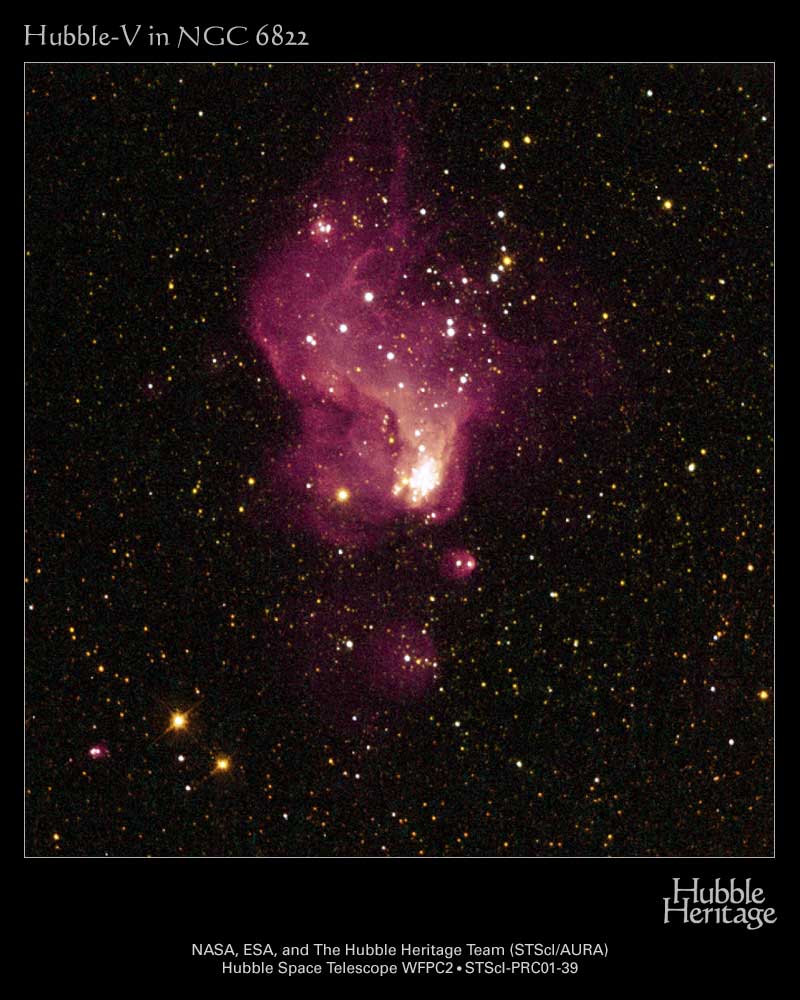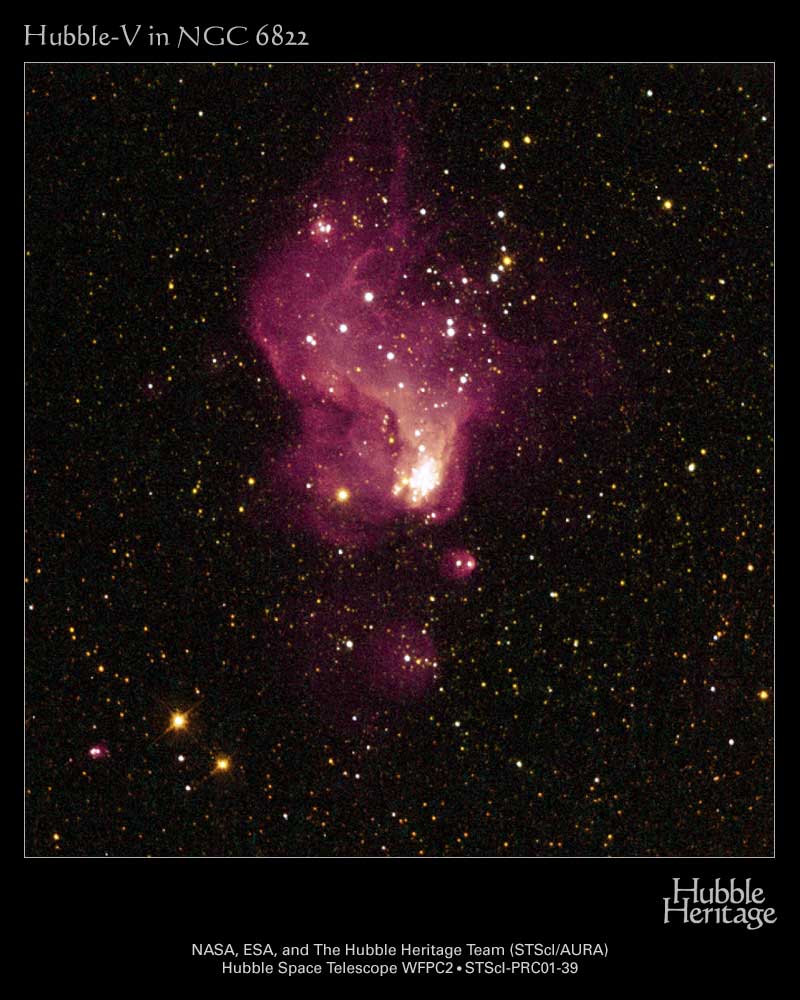
How did stars form in the early universe? Astronomers are gaining insight by studying NGC 6822, a nearby galaxy classified as irregular by modern standards but appearing more typical of galaxies billions of years ago. Inspection of NGC 6822 shows several bright star groups, including two dubbed Hubble-X and Hubble-V. Pictured above, the Hubble Space Telescope has resolved Hubble V into the energetic stars that are lighting up the surrounding gas. Each star in the central dense knot of Hubble V shines brighter than 100,000 Suns. The Hubble V gas cloud spans about 200 light years and lies about 1.5 million light-years away toward the constellation Sagittarius.
¿Cómo se formaron las estrellas en el universo primitivo? Los astrónomos están obteniendo información al estudiar NGC 6822, una galaxia cercana clasificada como irregular por los estándares modernos, pero que parece más típica de las galaxias que existían hace miles de millones de años. La inspección de NGC 6822 revela varios grupos brillantes de estrellas, incluyendo dos llamados Hubble-X y Hubble-V. En la imagen mostrada, el Telescopio Espacial Hubble ha resuelto Hubble V en las estrellas energéticas que están iluminando el gas circundante. Cada estrella en el nudo denso central de Hubble V brilla más intensamente que 100 000 soles. La nube de gas de Hubble V tiene un tamaño de aproximadamente 200 años luz y se encuentra a unos 1,5 millones de años luz de distancia, en dirección a la constelación de Sagitario.