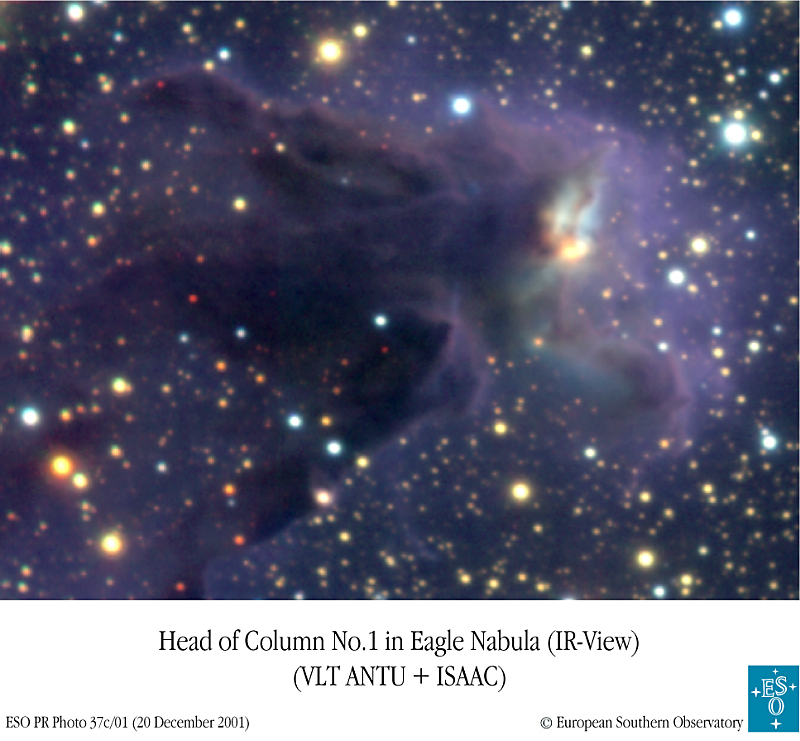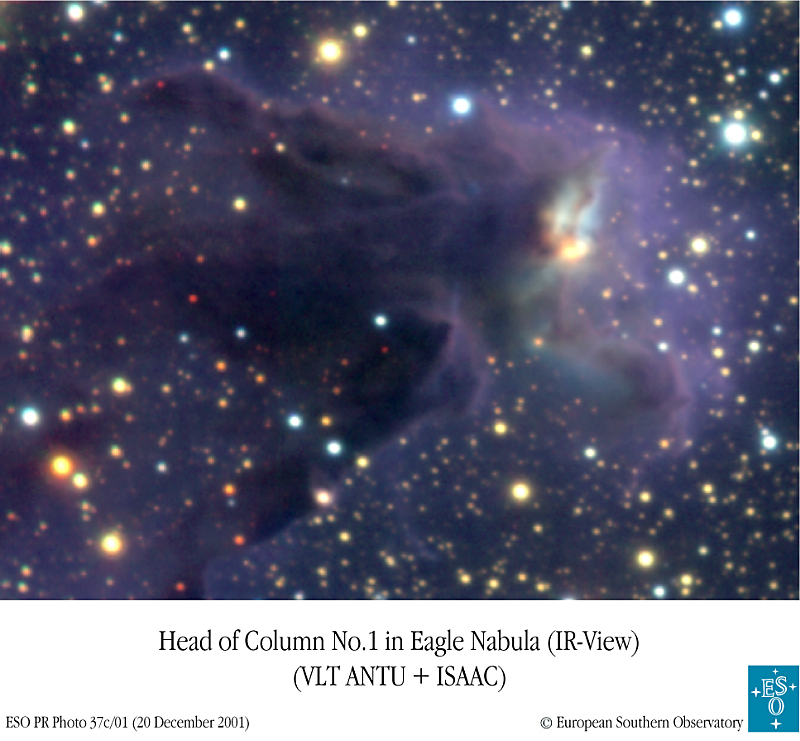
The head of an interstellar gas and dust cloud is shown here in false-color, a near-infrared view recorded by astronomers hunting for stars within M16's Eagle Nebula. Made famous in a 1995 Hubble image of the 7,000 light-year distant star forming region, the pillar-shaped cloud's surface was seen to be covered with finger-like evaporating gaseous globules (EGGs). The near-infrared image penetrates the obscuring dust cloud's edges. But the cloud's core appears dark and opaque, even at these relatively long wavelengths. Still, this image, made with ESO's Antu telescope, reveals a massive, bright yellow star not directly detected in the visible light Hubble data. This very young star lights up the small bluish nebula with a dark, twisted central stripe, just above it. Below and to its right are several much fainter, less massive stars also not seen in visible light - newborn stars which lie within the Eagle's EGGs. These newborn stars may have already been collapsing, forming from material inside the nebula before the intense radiation from other, nearby, emerging hot stars eroded and sculpted the dramatic pillars and EGGs. In any event, as the dusty clouds are eroded away, stars still forming will be cutoff from their reservoir of star stuff. Further growth and even the development of planetary systems will likely be seriously affected.
Se muestra aquí la cabeza de una nube de gas y polvo interestelar en falso color, una vista en el infrarrojo cercano registrada por astrónomos en busca de estrellas dentro de la Nebulosa del Águila en M16. Hecha célebre en una imagen del Hubble de 1995 de la región formadora de estrellas a 7.000 años luz de distancia, se observó que la superficie de la nube en forma de pilar estaba cubierta de glóbulos gaseosos en evaporación (EGGs) con forma de dedos. La imagen en infrarrojo cercano penetra los bordes de la nube de polvo que oculta. Sin embargo, el núcleo de la nube aparece oscuro y opaco, incluso a estas longitudes de onda relativamente largas. No obstante, esta imagen, tomada con el telescopio Antu del ESO, revela una estrella masiva y brillante de color amarillo que no fue detectada directamente en los datos del Hubble en luz visible. Esta estrella muy joven ilumina la pequeña nebulosa azulada con una franja central oscura y retorcida, justo encima de ella. Debajo y a su derecha hay varias estrellas mucho más débiles y menos masivas, también no vistas en luz visible: estrellas recién nacidas que se encuentran dentro de los EGGs del Águila. Estas estrellas recién nacidas probablemente ya estaban colapsándose, formándose a partir del material dentro de la nebulosa antes de que la radiación intensa de otras estrellas calientes cercanas emergentes erosionara y esculpiera los pilares y EGGs espectaculares. En cualquier caso, a medida que las nubes polvorientas se erosionan, las estrellas que aún se están formando serán cortadas de su depósito de material estelar. El crecimiento adicional e incluso el desarrollo de sistemas planetarios probablemente se verán seriamente afectados.