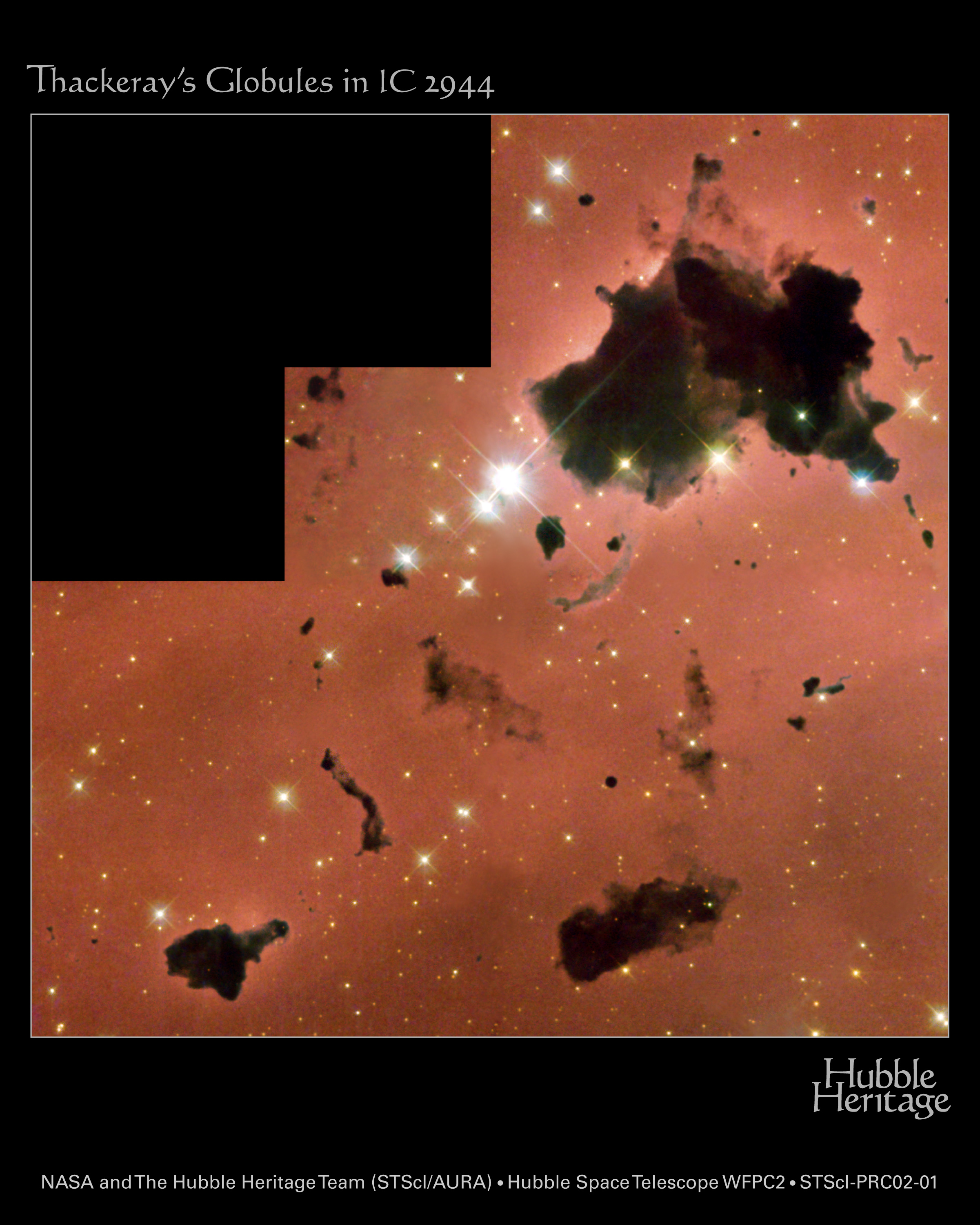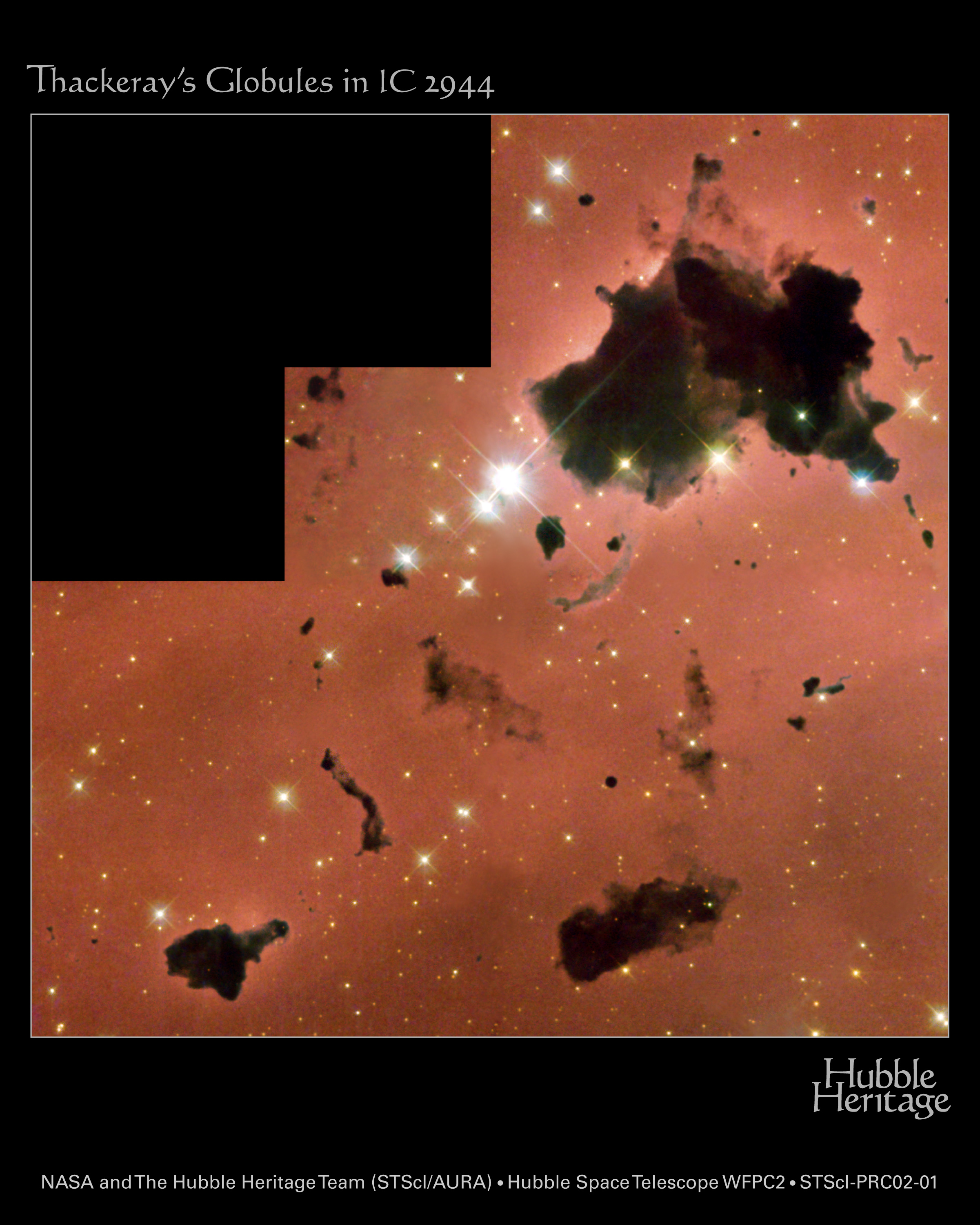
Rich star fields and glowing hydrogen gas silhouette dense, opaque clouds of interstellar gas and dust in this Hubble Space Telescope close-up of IC 2944, a bright star forming region in Centaurus, 5,900 light-years away. The largest of these dark globules, first spotted by South African astronomer A. D. Thackeray in 1950, is likely two separate but overlapping clouds, each more than one light-year wide. Combined the clouds contain material equivalent to about 15 times the mass of the Sun, but will they actually collapse to form massive stars? Along with other data, the sharp Hubble images indicate that Thackeray's globules are fractured and churning as a result of intense ultraviolet radiation from young, hot stars already energizing and heating the bright emission nebula. These and similar dark globules known to be associated with other star forming regions may ultimately be dissipated by their hostile environment -- like cosmic lumps of butter in a hot frying pan. The chevron shape of the picture outlines the detectors of the Hubble's WFPC2 camera.
Densos campos estelares y gas de hidrógeno incandescente proyectan siluetas de nubes opacas y densas de gas y polvo interestelar en esta imagen de primer plano del Telescopio Espacial Hubble de IC 2944, una región brillante de formación de estrellas en Centauro, a 5.900 años luz de distancia. El mayor de estos glóbulos oscuros, avistado por primera vez por el astrónomo sudafricano A. D. Thackeray en 1950, es probablemente dos nubes separadas pero superpuestas, cada una con un ancho superior a un año luz. En conjunto, las nubes contienen material equivalente a aproximadamente 15 veces la masa del Sol, pero ¿llegarán realmente a colapsar para formar estrellas masivas? Junto con otros datos, las imágenes nítidas del Hubble indican que los glóbulos de Thackeray están fracturados y en ebullición como resultado de la intensa radiación ultravioleta de estrellas jóvenes y calientes que ya están energizando y calentando la nebulosa de emisión brillante. Estos y similares glóbulos oscuros que se sabe están asociados con otras regiones de formación estelar pueden finalmente ser disipados por su entorno hostil, como terrones cósmicos de mantequilla en una sartén caliente. La forma de chevron de la imagen delinea los detectores de la cámara WFPC2 del Hubble.