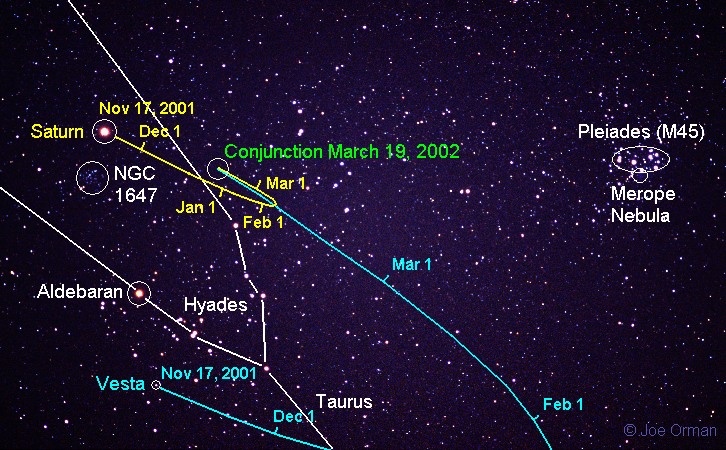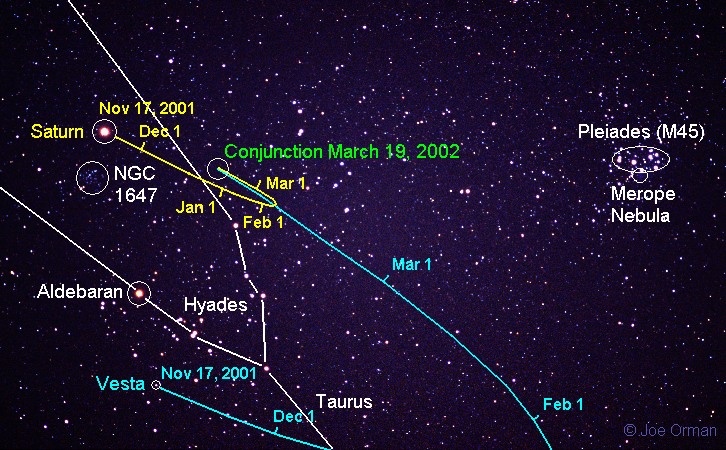
Last November, while skygazing toward the constellation Taurus, astrophotographer Joe Orman arranged this time exposure to include the lovely Hyades and Pleiades star clusters in the field of his telephoto lens. A distance of 400 light-years for the close-knit Pleiades and 150 light-years for the V-shaped Hyades puts these clusters in the general galactic neighborhood of the Sun. Punctuating the Hyades' appearance, bright yellow Aldebaran, 60 light-years away, is not actually a member of the cluster, but it is Taurus' brightest star. Above Aldebaran a yellower, even brighter Saturn is is seen about 1.2 light-hours from our fair planet. Last and least massive, one of the faint specks below Aldebaran is main-belt asteroid Vesta, a mere 13 light-minutes away. Still cruising through Taurus, Vesta is steadily approaching a close alignment or conjunction with Saturn on March 19. Need a program to follow the players? Click on the image for a labeled version.
En noviembre pasado, mientras observaba el cielo en dirección de la constelación de Tauro, el astrofotógrafo Joe Orman realizó esta exposición de tiempo para incluir los hermosos cúmulos estelares de las Híades y las Pléyades en el campo de su teleobjetivo. Una distancia de 400 años luz para las Pléyades, compactamente agrupadas, y 150 años luz para las Híades, con forma de V, sitúa estos cúmulos en el vecindario galáctico general del Sol. Acentuando la apariencia de las Híades, el brillante Aldebarán amarillento, a 60 años luz de distancia, no es en realidad miembro del cúmulo, pero es la estrella más brillante de Tauro. Por encima de Aldebarán se observa Saturno, aún más amarillento y brillante, a aproximadamente 1,2 horas luz de nuestro planeta. Por último, el asteroide de la banda principal Vesta, el menos masivo, es uno de los puntos débiles visibles bajo Aldebarán, a apenas 13 minutos luz de distancia. Continuando su travesía por Tauro, Vesta se aproxima constantemente hacia una alineación cerrada o conjunción con Saturno el 19 de marzo.