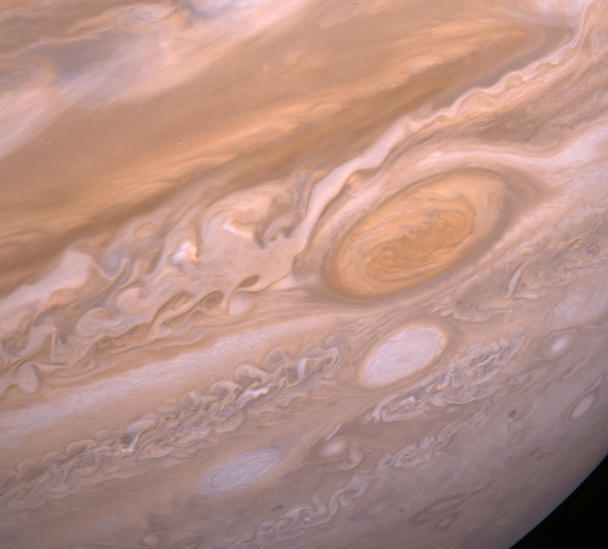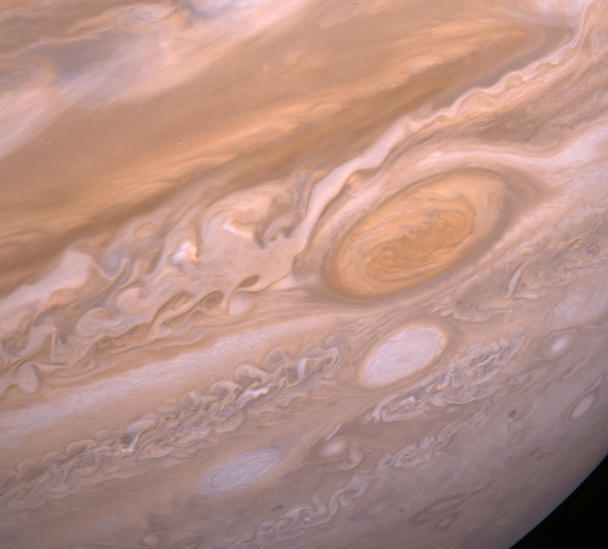
Two of the largest storm systems on Jupiter are colliding, and nobody is sure what will result. The larger storm is the famous Great Red Spot, while the smaller is a large white oval. Both are swirling cloud systems that circulate on Jupiter. The white oval is part of a belt of clouds that circles Jupiter faster than the Great Red Spot. The oval started being slowed by the Great Red Spot two weeks ago and the collision could last another month. The oval will likely survive but could possibly be disrupted or absorbed. The two storm systems went at it at least once before in 1975 causing the Spot's red color to fade for several years. The passing Voyager 2 robot spacecraft took the above picture of Jupiter's Great Red Spot in 1979. A different white oval was then visible below the Spot.
Dos de los mayores sistemas de tormentas en Júpiter están colisionando, y nadie está seguro de cuál será el resultado. La tormenta más grande es la famosa Gran Mancha Roja, mientras que la más pequeña es un óvalo blanco de gran tamaño. Ambos son sistemas de nubes que circulan en Júpiter. El óvalo blanco es parte de un cinturón de nubes que circunda Júpiter más rápidamente que la Gran Mancha Roja. El óvalo comenzó a ser desacelerado por la Gran Mancha Roja hace dos semanas, y la colisión podría durar otro mes. El óvalo probablemente sobrevivirá, pero podría posiblemente ser disrupto o absorbido. Los dos sistemas de tormentas chocaron al menos una vez antes en 1975, causando que el color rojo de la Mancha se desvaneciera durante varios años. La nave espacial robótica Voyager 2 de paso capturó la foto anterior de la Gran Mancha Roja de Júpiter en 1979. Un óvalo blanco diferente era entonces visible debajo de la Mancha.