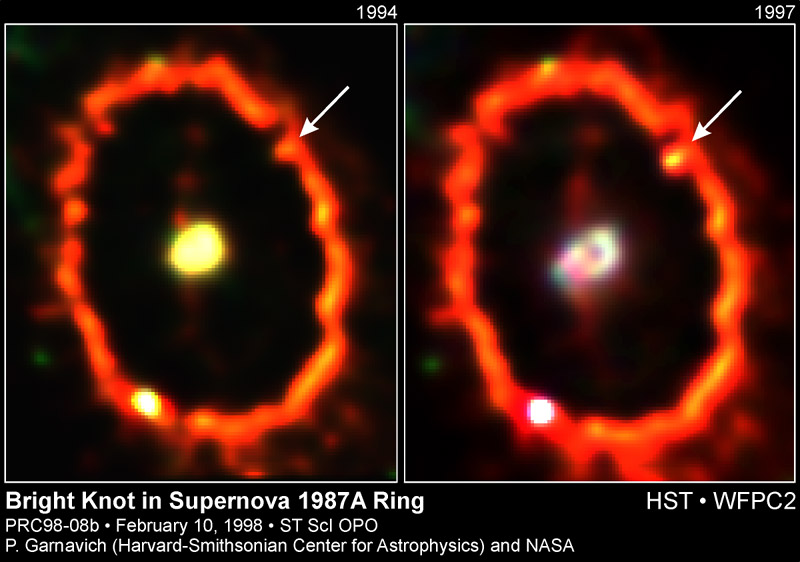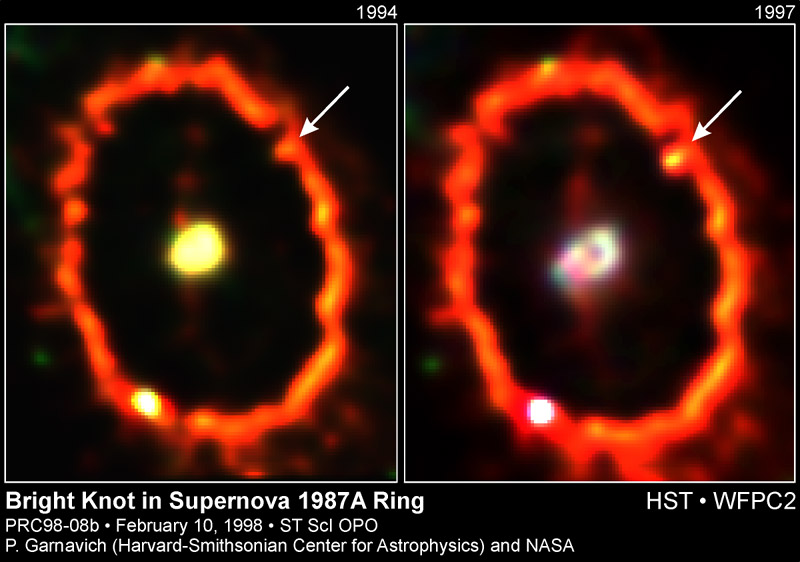
Fifteen years ago today, the brightest supernova of modern times was sighted. Over time, astronomers have watched and waited for the expanding debris from this tremendous stellar explosion to crash into previously expelled material. A clear result of such a collision is demonstrated above in two frames recorded by the Hubble Space Telescope in 1994 (left) and 1997(right). While the central concentration of stellar debris has clearly evolved over this period, the yellow spot on the ring in the righthand picture announces the collision of an outward moving blast wave with the pre-existing, light-year wide ring. The collision is occurring at speeds near 60 million kilometers per hour and shock-heats the ring material causing it to glow. Astronomers are hopeful that such collisions will illuminate the interesting past of SN 1987A, and perhaps provide more clues about the origin of the mysterious rings.
Hace quince años, hoy fue avistada la supernova más brillante de los tiempos modernos. Con el paso del tiempo, los astrónomos han observado y esperado que los escombros en expansión de esta tremenda explosión estelar chocaran contra el material previamente expulsado. Una demostración clara de tal colisión se presenta arriba en dos fotogramas registrados por el Telescopio Espacial Hubble en 1994 (izquierda) y 1997 (derecha). Si bien la concentración central de escombros estelares ha evolucionado claramente durante este período, la mancha amarilla en el anillo de la imagen derecha anuncia la colisión de una onda de choque que se expande hacia afuera con el anillo preexistente de aproximadamente un año luz de ancho. La colisión ocurre a velocidades cercanas a 60 millones de kilómetros por hora y calienta por choque el material del anillo, haciendo que brille. Los astrónomos esperan que tales colisiones iluminen el interesante pasado de SN 1987A y quizás proporcionen más pistas sobre el origen de los misteriosos anillos.