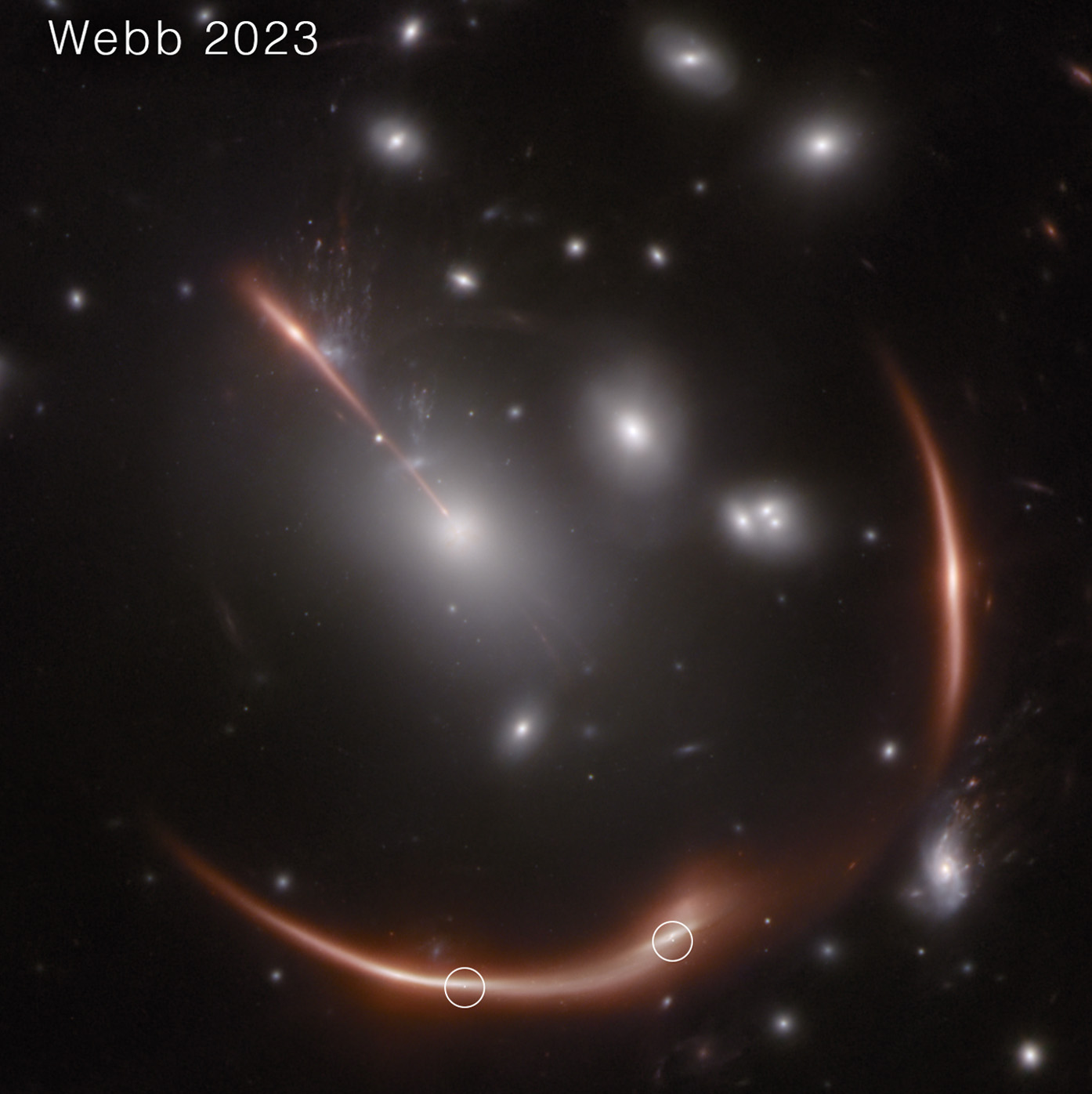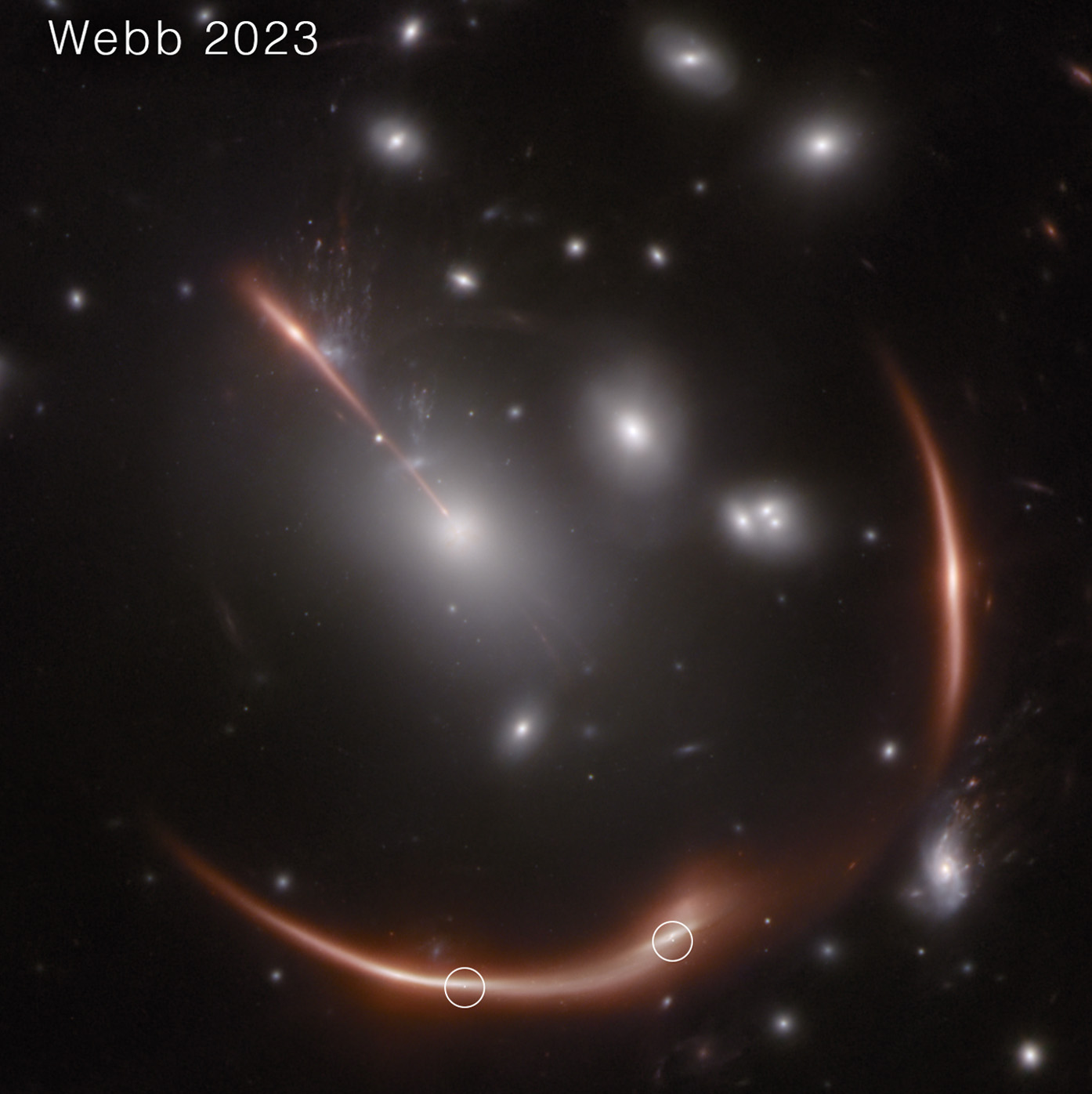
Now a second supernova in this same galaxy is repeating. The cause is the gravitational lens effect of a massive foreground cluster of galaxies (MACS J0138) -- it creates multiple images of a perfectly aligned background galaxy (MRG-M0138). What's particularly interesting is that this background galaxy has young stars that keep blowing up. And images of each supernova explosion keep coming to us multiple times through different paths through the cluster. The original lensed supernova set, shown in the rollover, is called Requiem and was first seen by the Hubble Space Telescope in 2016. This second lensed supernova set is called Encore and was first seen by the Webb Space Telescope in 2023. More images from these supernovas are predicted to be on the way, and exactly when they arrive should help humanity to better understand the mass distribution of the galaxy cluster, the supernovas themselves, and possibly even the universe.
Ahora una segunda supernova en esta misma galaxia se está repitiendo. La causa es el efecto lente gravitacional de un gran cúmulo de galaxias en primer plano (MACS J0138) — crea múltiples imágenes de una galaxia de fondo perfectamente alineada (MRG-M0138). Lo particularmente interesante es que esta galaxia de fondo tiene estrellas jóvenes que siguen explotando. Y las imágenes de cada explosión de supernova continúan llegando a nosotros múltiples veces a través de diferentes caminos por el cúmulo. El conjunto original de supernovas lenteadas, mostrado en el recuadro, se llama Requiem y fue observado por primera vez por el Telescopio Espacial Hubble en 2016. Este segundo conjunto de supernovas lenteadas se llama Encore y fue observado por primera vez por el Telescopio Espacial James Webb en 2023. Se predice que lleguen más imágenes de estas supernovas, y el momento exacto en que lleguen ayudará a la humanidad a comprender mejor la distribución de masa del cúmulo de galaxias, las propias supernovas y posiblemente incluso el universo.