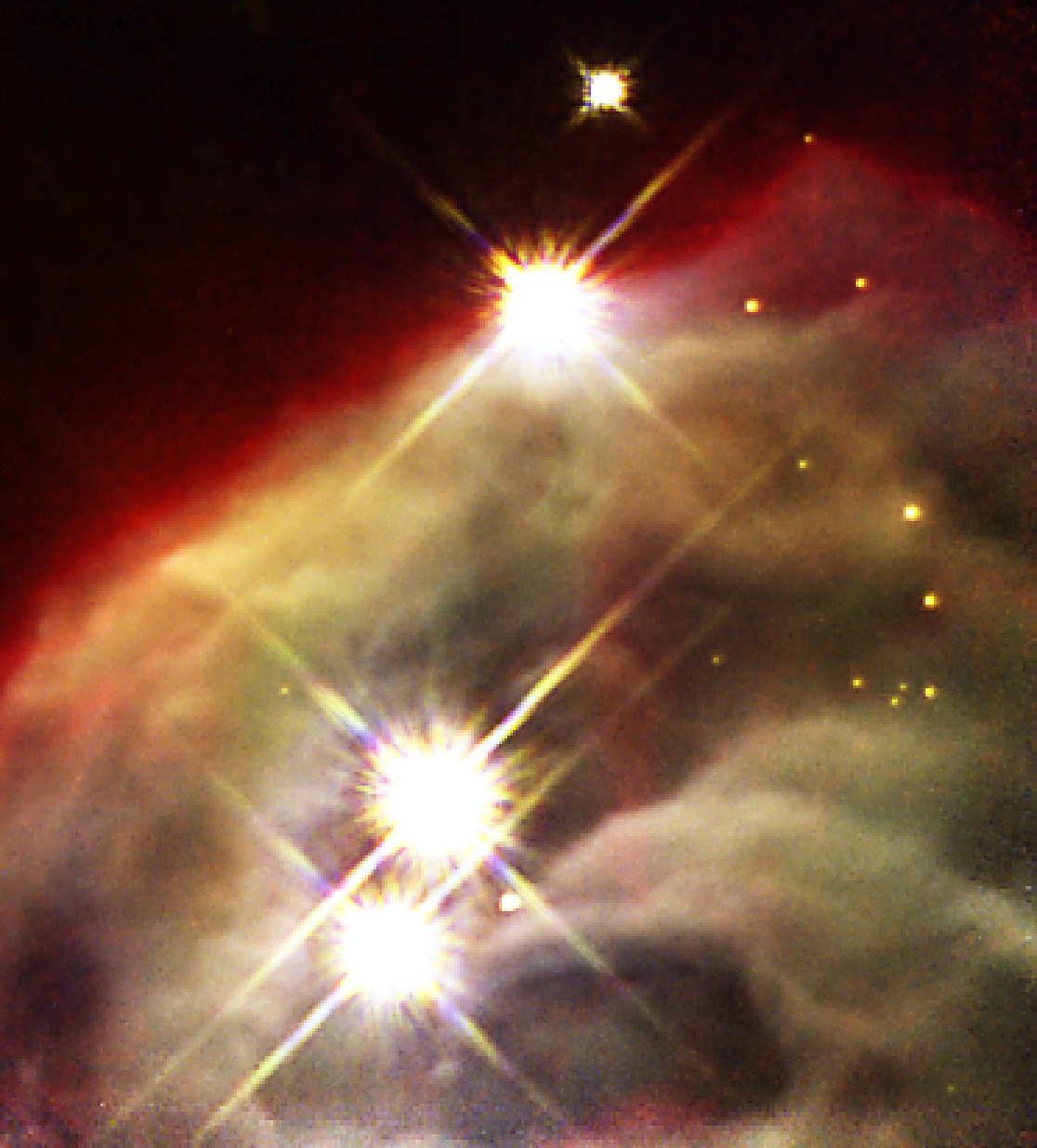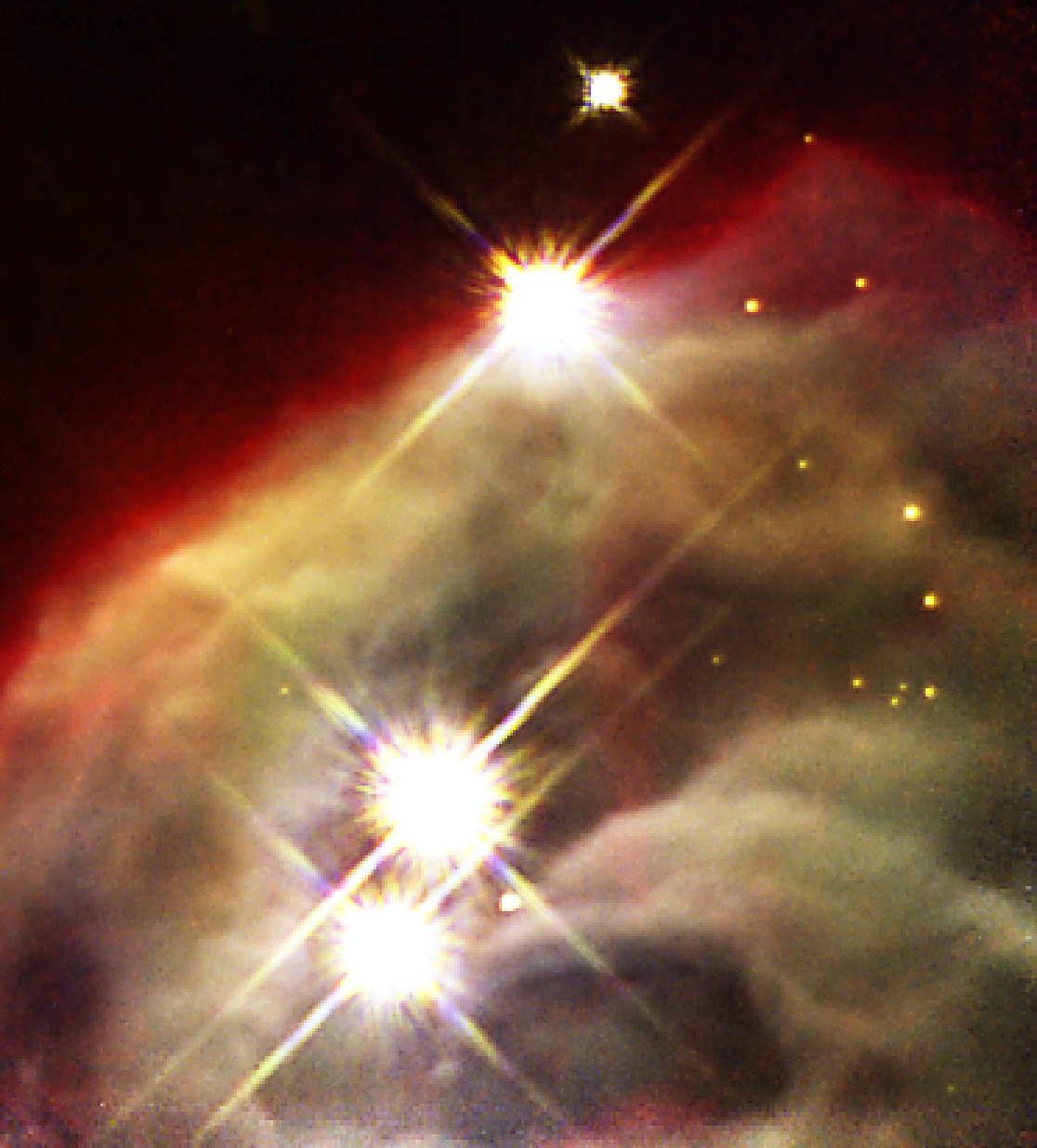
After astronauts repaired NICMOS - the Near Infrared Camera and Multi-Object Spectrometer - during the latest Hubble Space Telescope servicing mission, astronomers were quick to turn the sophisticated instrument on the photogenic stellar nursery known as the Cone Nebula. This remarkable NICMOS close-up of the Cone Nebula dramatically confirms that the Hubble's infrared vision has been restored. Gas and dust clouds at the blunted tip of the cone-shaped star-forming region are seen here in false-color covering an area about half a light-year across. Toward the left hand side of the picture, the four bright stars with diffraction spikes are also present in visible light images and are in front of the Cone Nebula, itself 2,500 light-years away. But the fainter stars to their right are embedded in or behind the nebula's obscuring dust clouds and are revealed only in this penetrating infrared view.
Después de que los astronautas repararan NICMOS —la Cámara de Infrarrojo Cercano y Espectrógrafo Multiobjeto— durante la misión más reciente de mantenimiento del Telescopio Espacial Hubble, los astrónomos se apresuraron a dirigir este sofisticado instrumento hacia la fotogénica guardería estelar conocida como Nebulosa del Cono. Este notable acercamiento de NICMOS de la Nebulosa del Cono confirma dramáticamente que la visión infrarroja del Hubble ha sido restaurada. Las nubes de gas y polvo en la punta redondeada de la región en forma de cono donde se forman estrellas se ven aquí en falso color, cubriendo un área de aproximadamente media año luz de ancho. Hacia el lado izquierdo de la imagen, las cuatro estrellas brillantes con puntas de difracción también están presentes en imágenes de luz visible y se encuentran frente a la Nebulosa del Cono, que está a 2,500 años luz de distancia. Sin embargo, las estrellas más débiles a su derecha están incrustadas en o detrás de las nubes de polvo opaco de la nebulosa y solo se revelan en esta penetrante vista infrarroja.