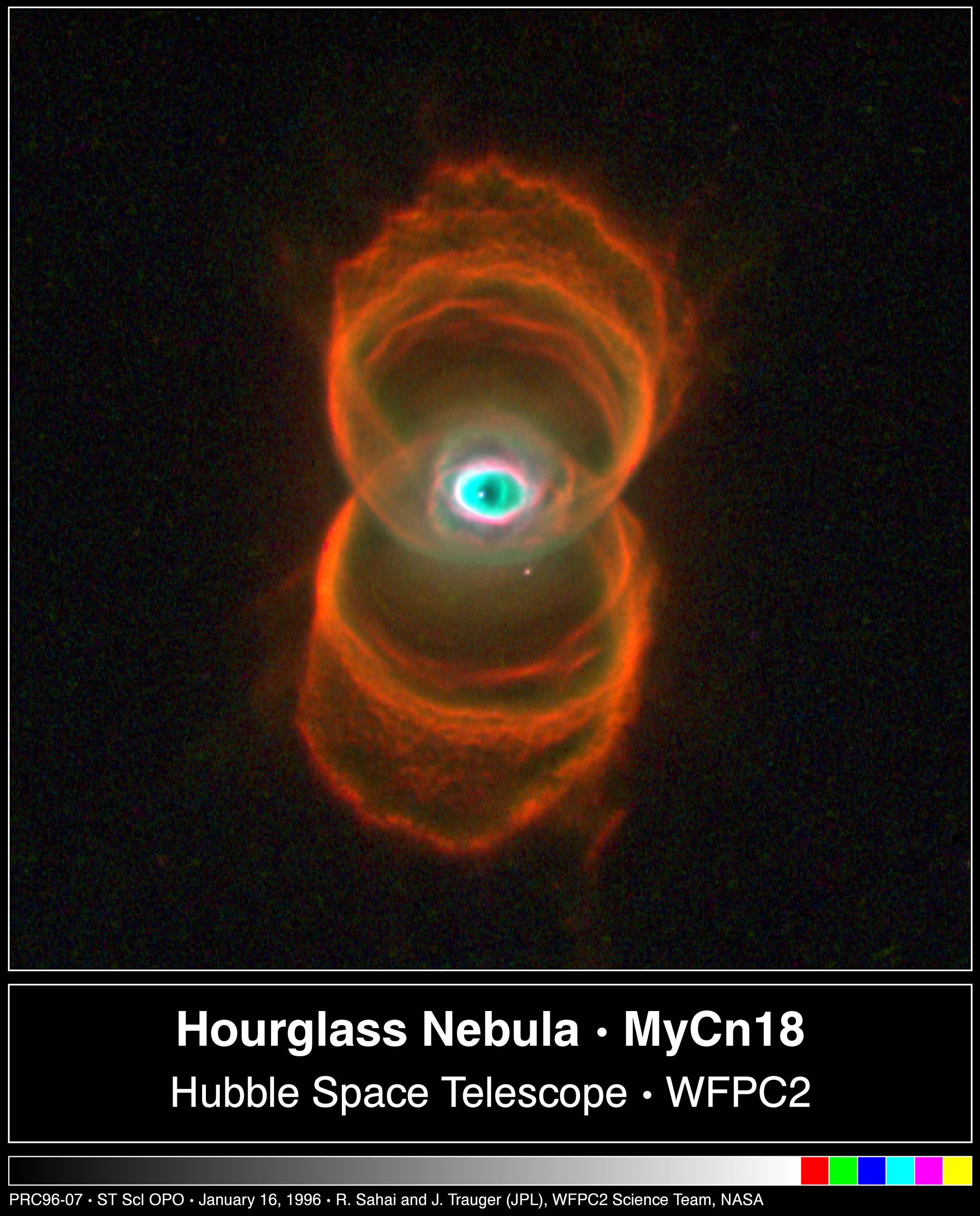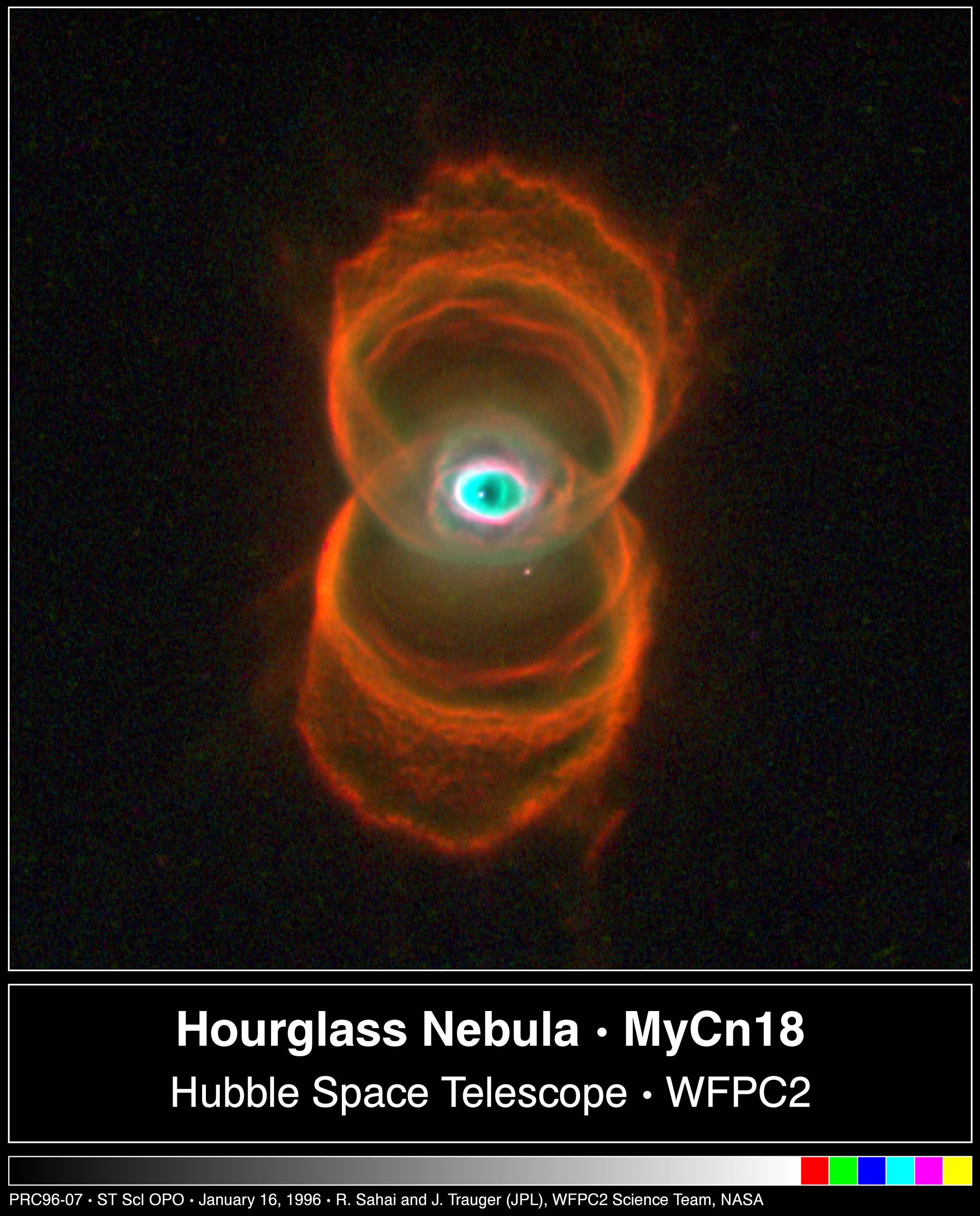
The sands of time are running out for the central star of this hourglass-shaped planetary nebula. With its nuclear fuel exhausted, this brief, spectacular, closing phase of a Sun-like star's life occurs as its outer layers are ejected - its core becoming a cooling, fading white dwarf. In 1995, astronomers used the Hubble Space Telescope (HST) to make a series of images of planetary nebulae, including the one above. Here, delicate rings of colorful glowing gas (nitrogen-red, hydrogen-green, and oxygen-blue) outline the tenuous walls of the "hourglass". The unprecedented sharpness of the HST images has revealed surprising details of the nebula ejection process and may help resolve the outstanding mystery of the variety of complex shapes and symmetries of planetary nebulae.
La arena del tiempo se agota para la estrella central de esta nebulosa planetaria con forma de reloj de arena. Con su combustible nuclear agotado, esta breve y espectacular fase final de la vida de una estrella similar al Sol ocurre cuando se expulsan sus capas exteriores, y su núcleo se convierte en una enana blanca que se enfría y se desvanece. En 1995, los astrónomos utilizaron el Telescopio Espacial Hubble (HST) para realizar una serie de imágenes de nebulosas planetarias, incluyendo la anterior. Aquí, delicados anillos de gas brillante y colorido (nitrógeno-rojo, hidrógeno-verde y oxígeno-azul) delinean las paredes tenues del "reloj de arena". La nitidez sin precedentes de las imágenes del HST ha revelado detalles sorprendentes del proceso de expulsión de la nebulosa y puede ayudar a resolver el misterio pendiente de la variedad de formas complejas y simetrías de las nebulosas planetarias.