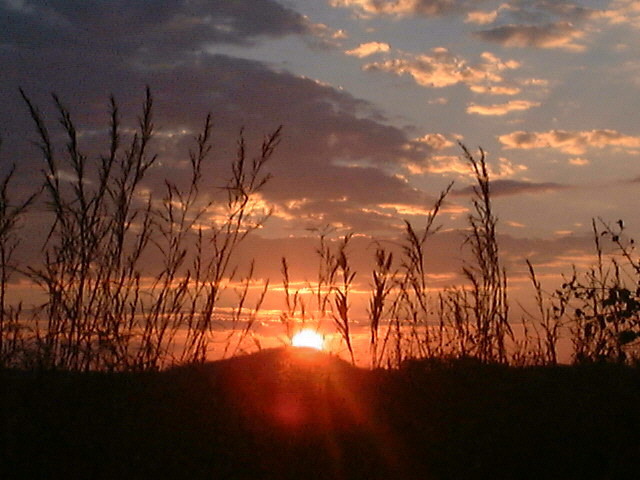
Today's scheduled geocentric astronomical event is the Solstice, with the Sun reaching its northernmost declination at 13 hours 24 minutes Universal Time. For denizens of planet Earth this Solstice marks the beginning of Summer in the northern hemisphere and Winter in the south. Of course, the tilt of the Earth's axis of rotation (and not a change in the Earth-Sun distance) is mainly responsible for the changing seasons and the Sun's yearly north-south motion through the sky. Following the rising and setting points of the Sun along the horizon is one way to track the Sun's progress along its seasonal cycle. Tall grasses and tinted clouds frame this dramatic view of the setting Sun approaching the northern limit of this year's seasonal journey as seen near Raffingora, Zimbabwe.
El evento astronómico geocéntrico programado para hoy es el Solsticio, momento en el que el Sol alcanza su declinación más septentrional a las 13 horas 24 minutos de Tiempo Universal. Para los habitantes del planeta Tierra, este Solsticio marca el comienzo del Verano en el hemisferio norte e Invierno en el sur. Por supuesto, la inclinación del eje de rotación terrestre (y no un cambio en la distancia Tierra-Sol) es principalmente responsable de los cambios de estación y del movimiento norte-sur anual del Sol en el cielo. Seguir los puntos de salida y puesta del Sol a lo largo del horizonte es una forma de rastrear el progreso del Sol a lo largo de su ciclo estacional. Altas hierbas y nubes teñidas enmarcan esta vista dramática del Sol en el ocaso aproximándose al límite septentrional del recorrido estacional de este año, tal como se observa cerca de Raffingora, Zimbabwe.