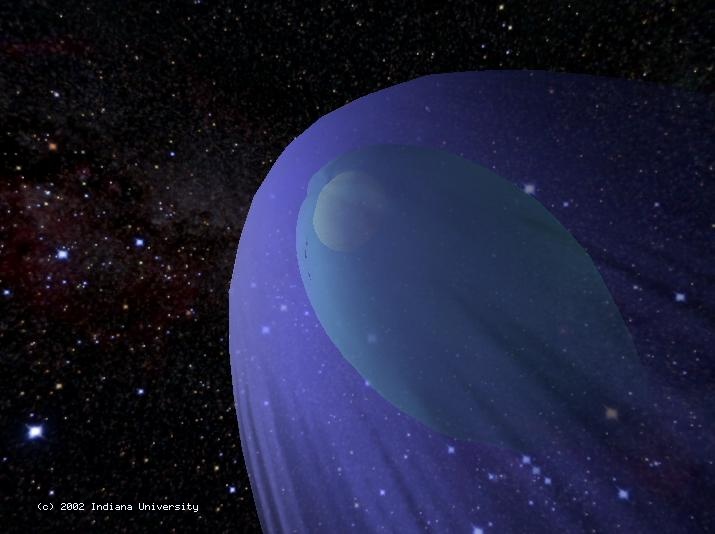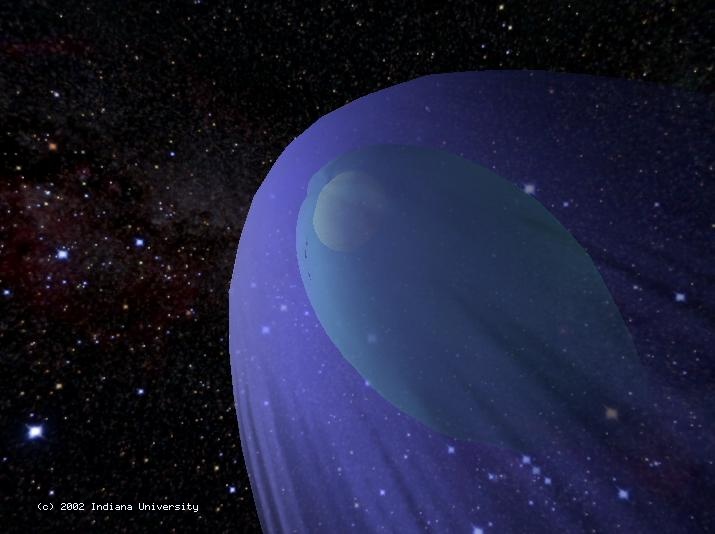
Where does the Sun's influence end? Nobody is sure. Out past the orbits of Neptune and Pluto extends a region named the heliosphere where the Sun's magnetic field and particles from the Solar Wind continue to dominate. The surface where the Solar Wind drops below sound speed is called the termination shock and is depicted as the inner oval in the above computer-generated illustration. It is thought that this surface occurs as close as 75-90 AU -- so close that a Pioneer or Voyager spacecraft may soon glide through it as they exit the Solar System at about 3 AU/year. The actual contact sheet between the Sun's ions and the Galaxy's ions is called the heliopause and is thought to occur at about 110 AU. It is depicted above as the middle surface. The Sun's heliopause moves through the local interstellar medium much as a boat moves on water, pushing a bow shock out in front, thought to occur near 230 AU.
¿Dónde termina la influencia del Sol? Nadie está seguro. Más allá de las órbitas de Neptuno y Plutón se extiende una región llamada heliosfera donde el campo magnético del Sol y las partículas del viento solar continúan dominando. La superficie donde el viento solar cae por debajo de la velocidad del sonido se llama choque de terminación y se representa como el óvalo interior en la ilustración generada por computadora anterior. Se piensa que esta superficie ocurre tan cerca como 75-90 UA, tan cercana que una nave espacial Pioneer o Voyager pronto podría atravesarla mientras salen del sistema solar a aproximadamente 3 UA/año. El contacto real entre los iones del Sol y los iones de la Galaxia se llama heliopausa y se cree que ocurre alrededor de 110 UA. Se representa arriba como la superficie intermedia. La heliopausa del Sol se mueve a través del medio interestelar local de la misma manera que un bote se mueve en el agua, empujando un choque de proa frente a él, que se cree que ocurre cerca de 230 UA.