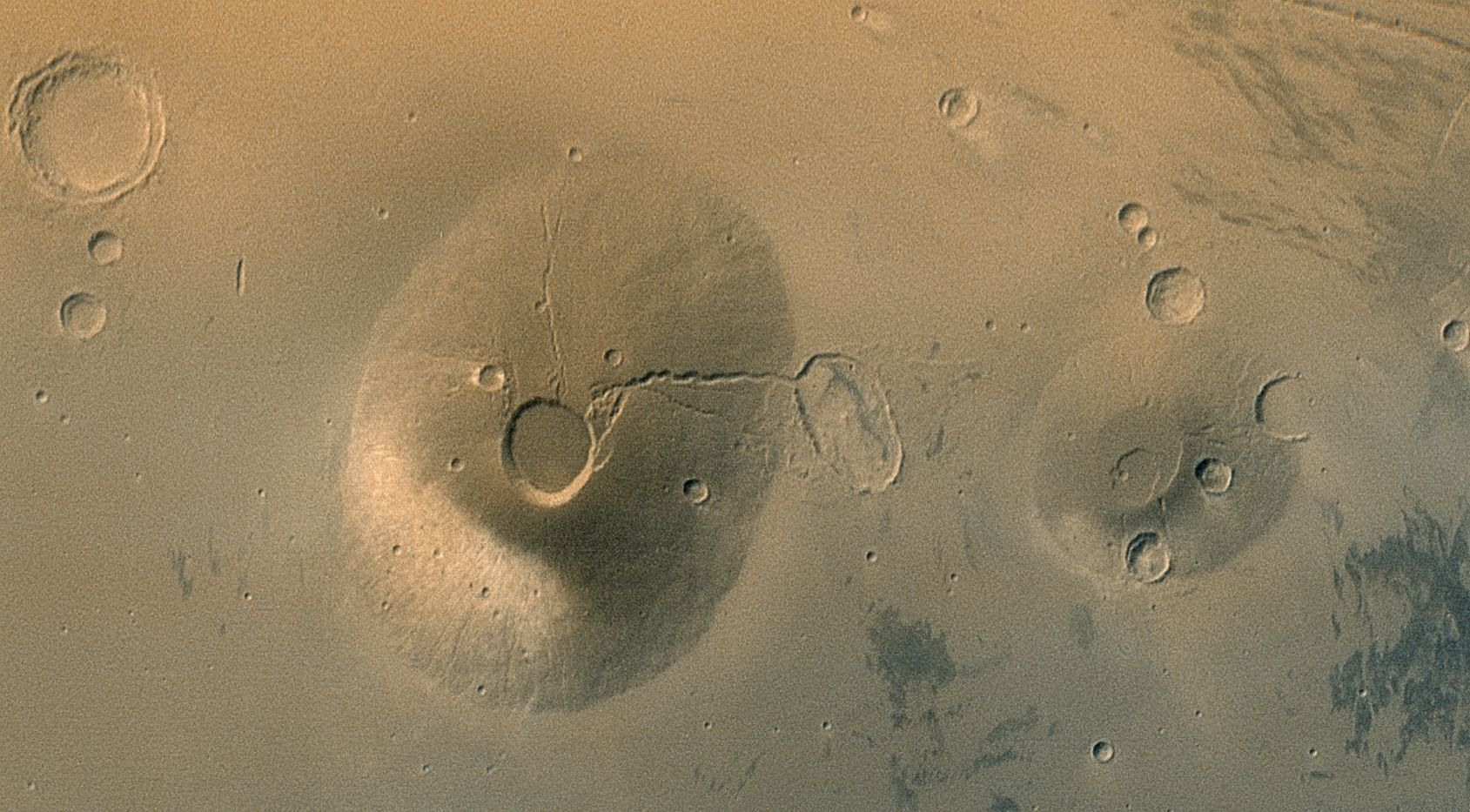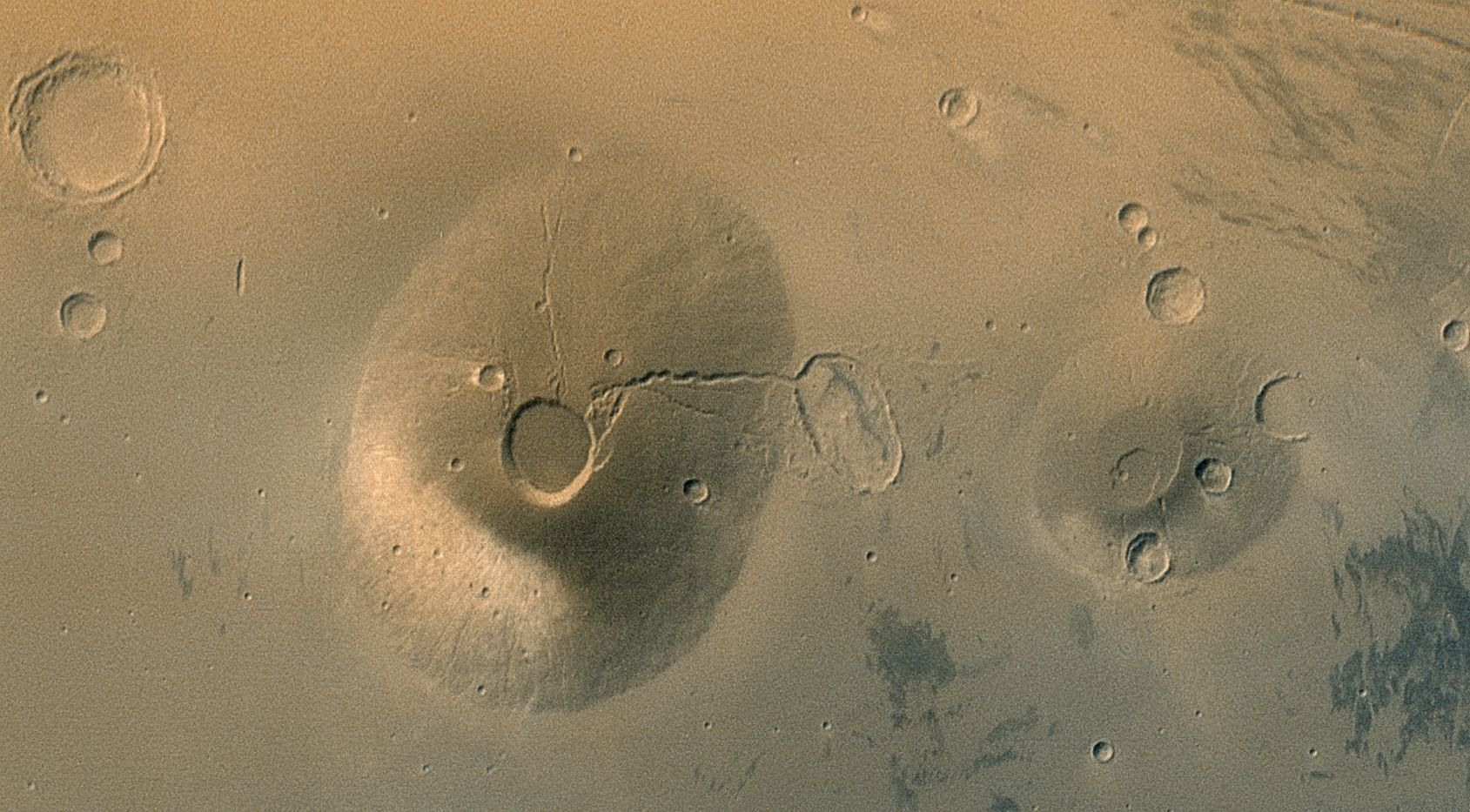
Findings of ancient martian microbial fossils in meteorites and liquid water related features on Mars' surface are currently controversial issues. But one thing long established by space-based observations of the Red Planet is the presence of volcanos, as Mars supports some of the largest volcanos in the solar system. This synthetic color picture recorded in March by the Mars Global Surveyor spacecraft shows two of them, Ceraunius Tholus (leftmost) and Uranius Tholus. Found north of the Tharsis region of truly large martian volcanos, these are actually two relatively small volcanos, Ceraunius Tholus being only about the size of the Big Island of Hawaii on planet Earth. Impact craters which overlay the volcanic martian terrain indicate that these volcanos are themselves ancient and inactive. North is to the right and the scene is illuminated by sunlight from the top left. A light region of dust deposited by recent global dust storms lies on the lower left flank of Ceraunius Tholus, whose summit crater is about 25 kilometers across.
Los hallazgos de antiguos fósiles microbianos marcianos en meteoritos y características relacionadas con agua líquida en la superficie de Marte son actualmente temas controvertidos. Pero una cosa establecida desde hace mucho tiempo por observaciones espaciales del Planeta Rojo es la presencia de volcanes, ya que Marte alberga algunos de los volcanes más grandes del sistema solar. Esta imagen de color sintético registrada en marzo por la nave espacial Mars Global Surveyor muestra dos de ellos, Ceraunius Tholus (más a la izquierda) y Uranius Tholus. Encontrados al norte de la región de Tharsis de volcanes marcianos verdaderamente grandes, estos son en realidad dos volcanes relativamente pequeños, siendo Ceraunius Tholus solo del tamaño de la Gran Isla de Hawái en el planeta Tierra. Los cráteres de impacto que se superponen al terreno volcánico marciano indican que estos volcanes son antiguos e inactivos. El norte está a la derecha y la escena está iluminada por la luz solar desde la parte superior izquierda. Una región clara de polvo depositada por tormentas de polvo globales recientes se encuentra en el flanco inferior izquierdo de Ceraunius Tholus, cuyo cráter de cumbre tiene aproximadamente 25 kilómetros de ancho.