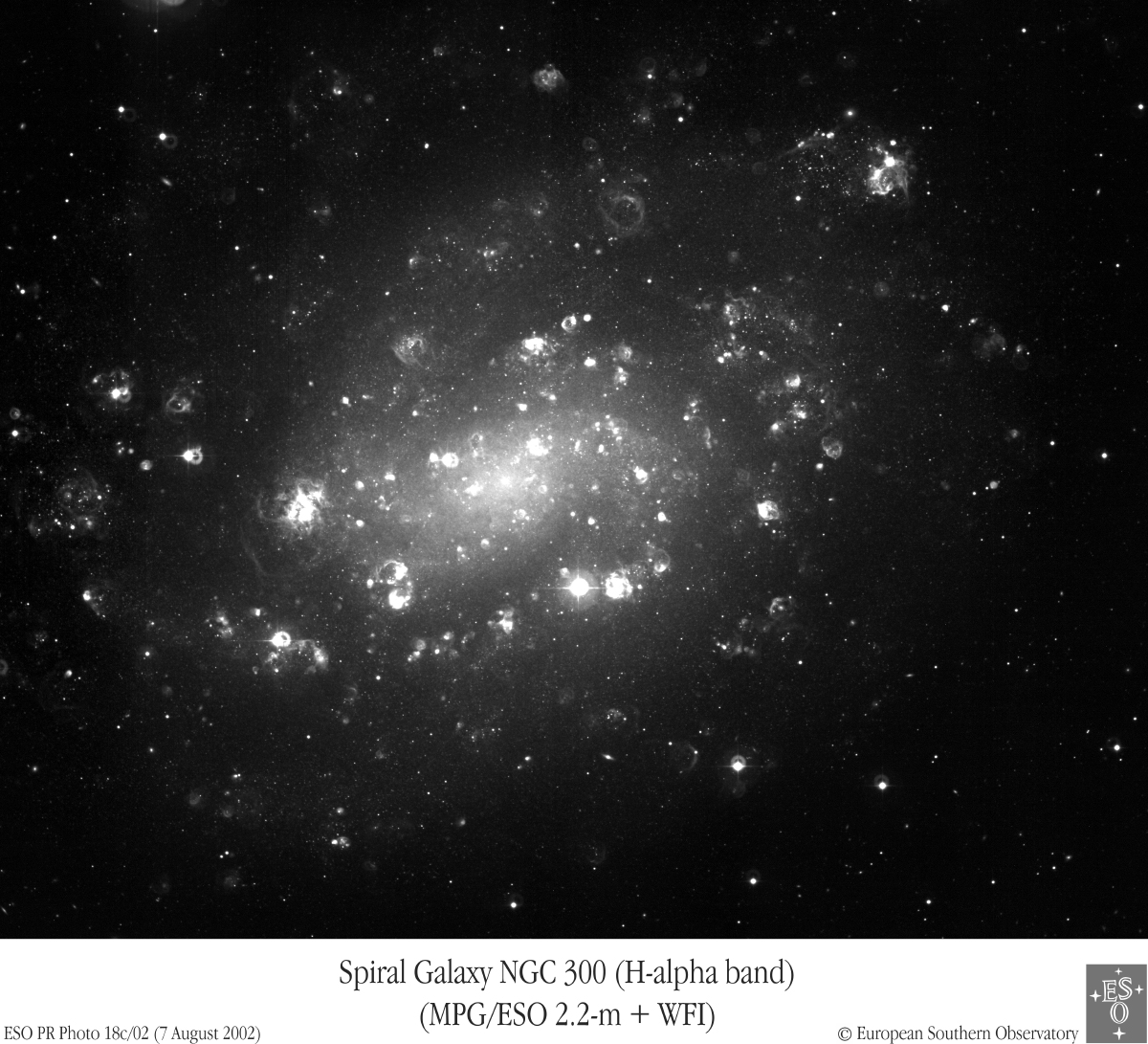
Featured in color in yesterday's episode, big, beautiful, face-on spiral galaxy NGC 300 is seen here through a narrow filter that transmits only the red light of hydrogen atoms. Ionized by energetic starlight, a hydrogen atom emits the characteristic red H-alpha light as its single electron is recaptured and transitions to lower energy states. As a result, this image of NGC 300 is dominated by regions filled with massive, young stars and shell-shaped clouds of hydrogen gas hundreds to thousands of light-years across. Formed in groups called OB associations, the stars are likely only a few million years young. The hydrogen clouds are glowing nebulae or HII regions that have been sculpted by the strong stellar winds and ultraviolet radiation. While picking out your favorite cosmic shell in this picture, don't be misled by the relatively bright foreground stars located in our own Milky Way galaxy. They often show spikes and rings caused by the telescope and camera system.
La gran y hermosa galaxia espiral cara a cara NGC 300 se observa aquí a través de un filtro estrecho que transmite únicamente la luz roja de los átomos de hidrógeno. Ionizado por la luz estelar energética, un átomo de hidrógeno emite la característica luz roja H-alfa cuando su único electrón es recapturado y realiza una transición a estados de menor energía. Como resultado, esta imagen de NGC 300 está dominada por regiones llenas de estrellas jóvenes y masivas, así como nubes de gas de hidrógeno con forma de concha que abarcan cientos a miles de años luz de diámetro. Formadas en grupos llamados asociaciones OB, estas estrellas tienen probablemente solo unos pocos millones de años de edad. Las nubes de hidrógeno son nebulosas brillantes o regiones HII que han sido esculpidas por los fuertes vientos estelares y la radiación ultravioleta. Al elegir su concha cósmica favorita en esta imagen, no se deje engañar por las estrellas del primer plano relativamente brillantes ubicadas en nuestra propia galaxia Vía Láctea. A menudo muestran puntas y anillos causados por el sistema de telescopio y cámara.