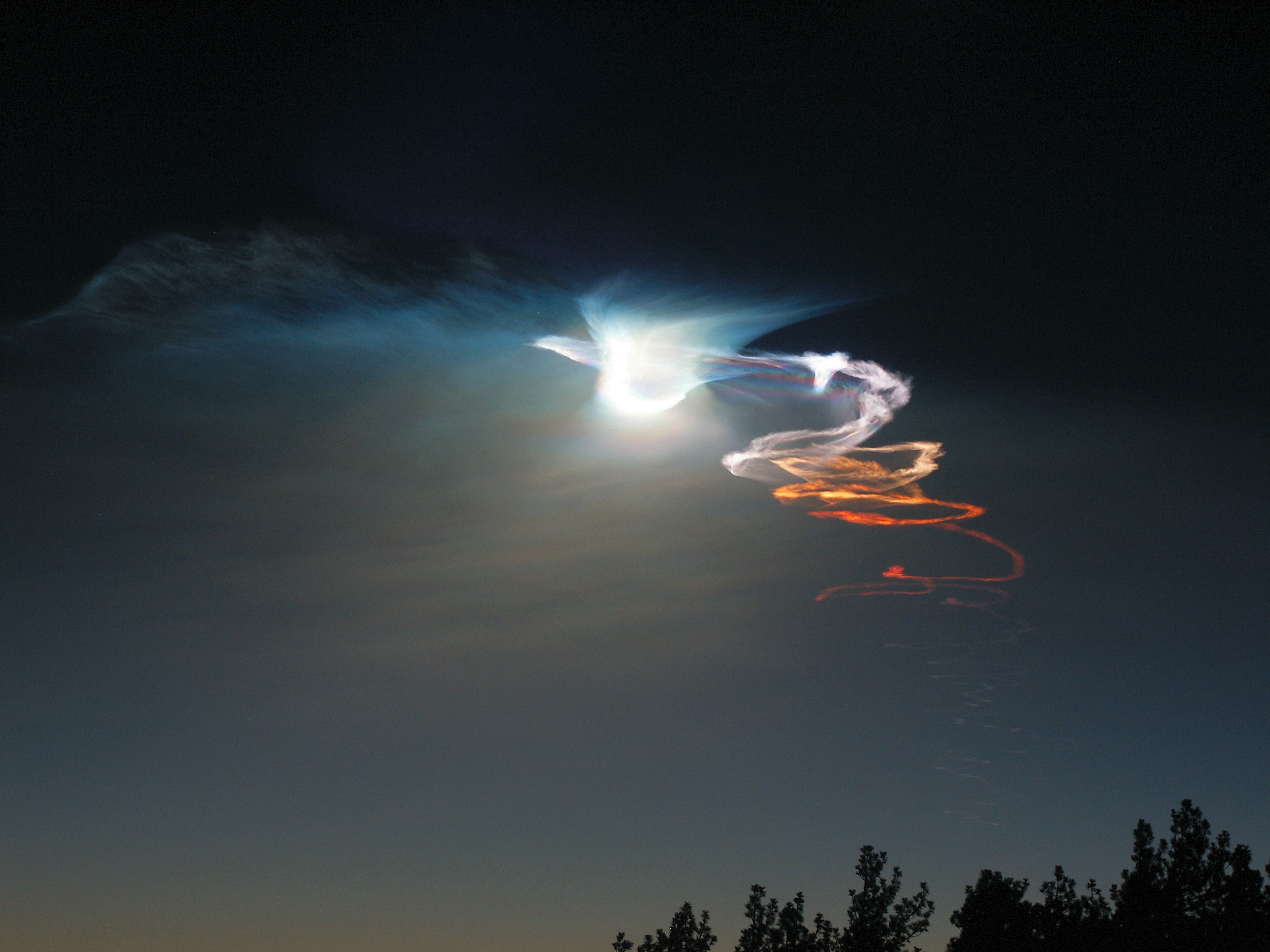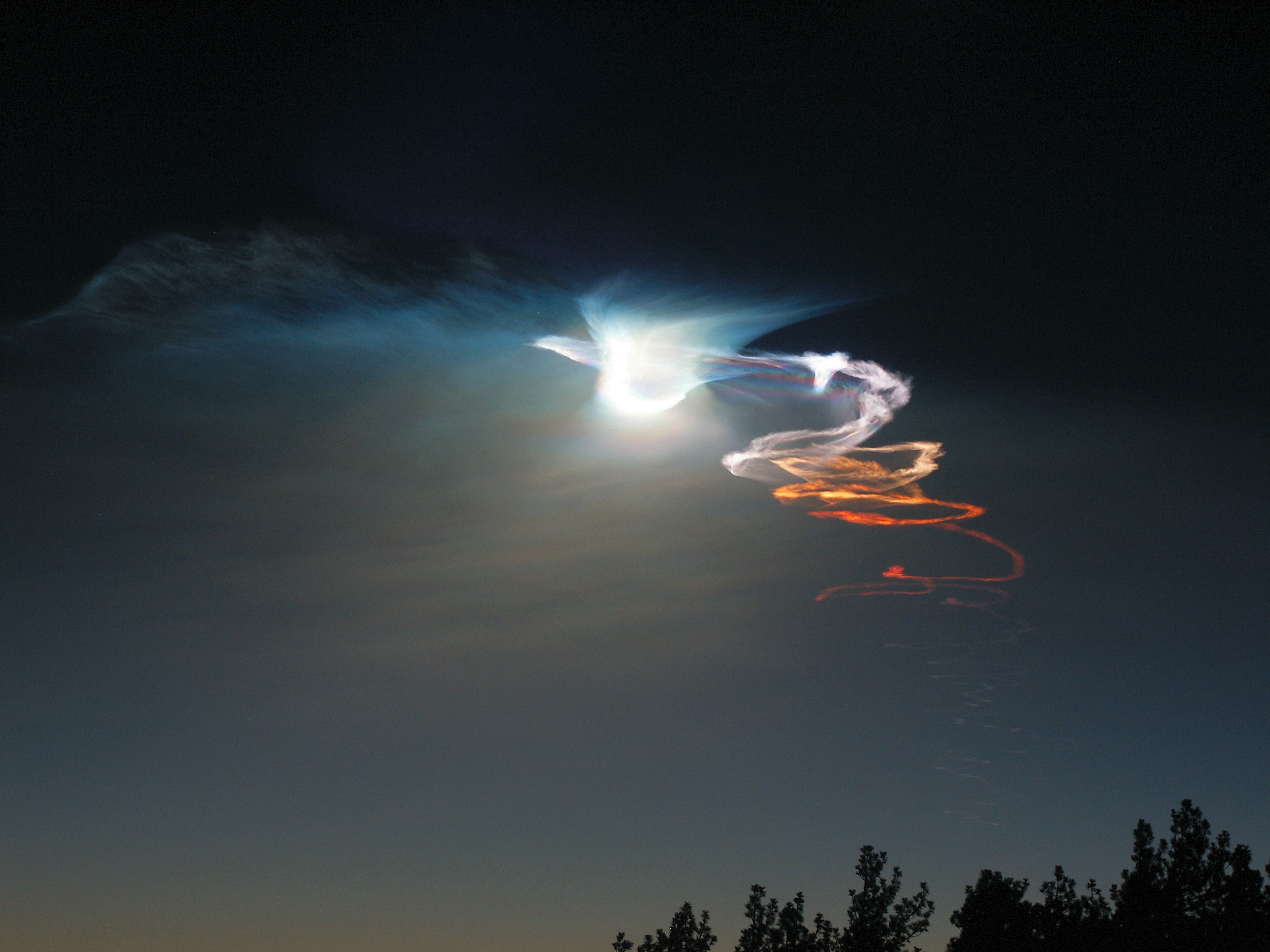
Bright light from a setting Sun and pale glow from a rising Moon both contribute to this stunning picture of a rocket exhaust trail twisting and drifting in the evening sky. Looking west, the digital telephoto view was recorded from Table Mountain Observatory near Wrightwood California, USA on September 19, four days before the autumnal equinox. The rocket, a Minuteman III solid fuel missile, was far down range when the image was taken. Launched from Vandenberg Air Force Base it carried its test payload thousands of miles out over the Pacific Ocean. The red/orange color from the setting Sun dramatically intensifies near the top of the rocket trail, but below the sunset line, the very bottom of the trail is faintly illuminated from the east by a nearly full Moon. Still in full sunlight, the bright diffuse cloud at the top of the trail, the result of a rocket stage separation, is tinged with rainbows likely produced by high altitude ice crystals forming in the exhaust plume. Astronomer James Young comments that the cloud takes on the appearance of a white dove flying from right to left across the sky.
La luz brillante de un Sol poniente y el débil brillo de una Luna naciente contribuyen a esta imagen impresionante de un rastro de escape de cohete retorciéndose y derivando en el cielo vespertino. Mirando hacia el oeste, esta vista de teleobjetivo digital fue registrada desde el Observatorio de Table Mountain cerca de Wrightwood, California, EE.UU., el 19 de septiembre, cuatro días antes del equinoccio de otoño. El cohete, un misil de combustible sólido Minuteman III, estaba muy lejos cuando se tomó la imagen. Lanzado desde la Base Aérea de Vandenberg, llevaba su carga útil de prueba miles de millas sobre el Océano Pacífico. El color rojo/naranja del Sol poniente se intensifica dramáticamente cerca de la parte superior del rastro del cohete, pero por debajo de la línea del atardecer, la parte más baja del rastro está débilmente iluminada desde el este por una Luna casi llena. Aún bajo la luz solar directa, la nube difusa brillante en la parte superior del rastro, resultado de una separación de etapa del cohete, está teñida de arcoíris probablemente producidos por cristales de hielo de gran altitud que se forman en la pluma de escape. El astrónomo James Young comenta que la nube adquiere la apariencia de una paloma blanca volando de derecha a izquierda a través del cielo.