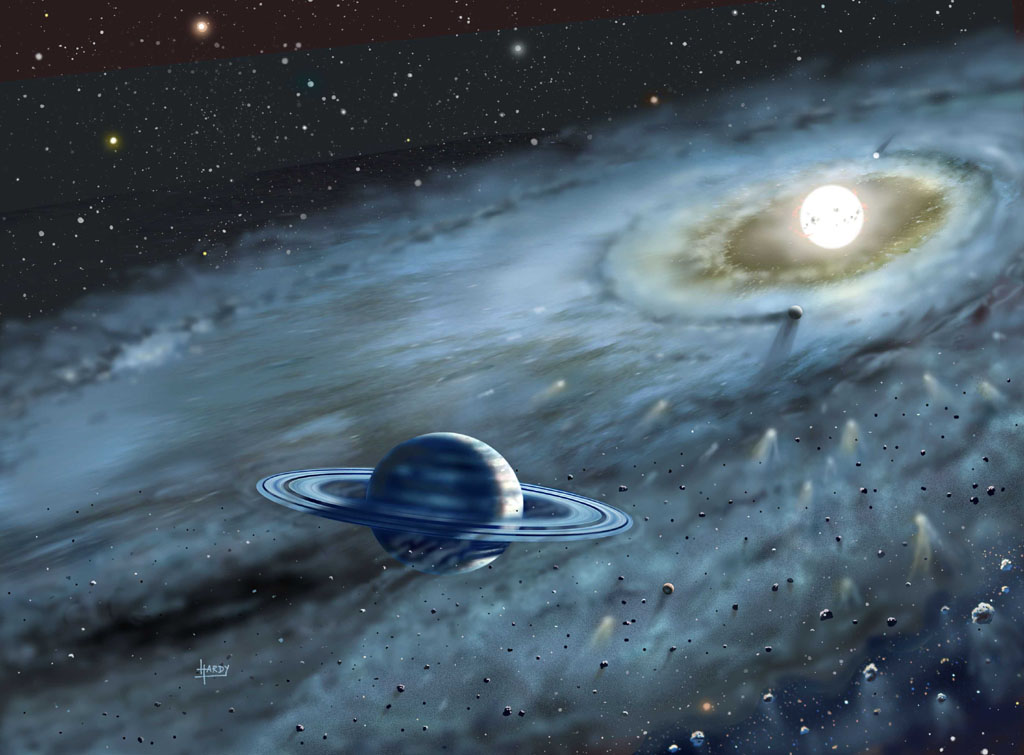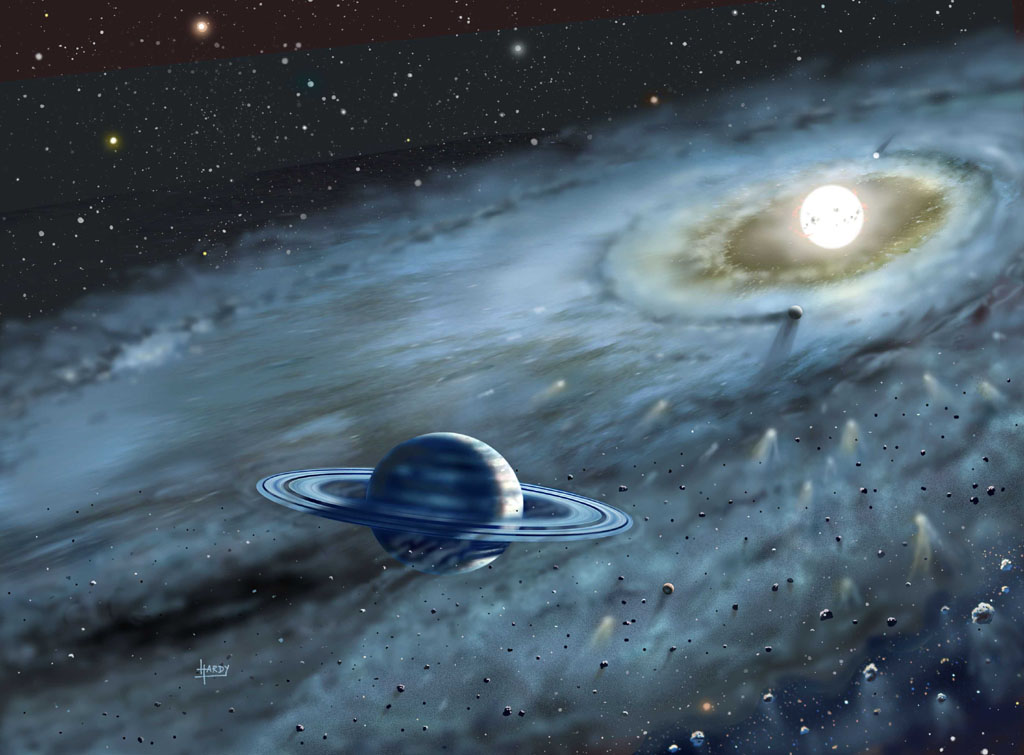
One of the brightest stars on the sky likely has planets. Fomalhaut, actually the 17th brightest star in the night sky, is a mere 22 light-years away but only a fraction of the age of our Sun. Recent observations in far infrared light with a detector cooled to near zero kelvins indicate a dust disk surrounding Fomalhaut that has both a hole in the center and a warped edge. Now the hole in the center indicates that dust has fallen onto interior planets -- possibly like the Earth -- while the warp at the edge indicates the gravitational pull of a planet like Jupiter or Saturn. The discovery image was taken with the SCUBA instrument through the James Clerk Maxwell Telescope in Hawaii, USA. The above illustration shows what the Fomalhaut dusty planetary system might look like from near the large planet.
Una de las estrellas más brillantes del cielo probablemente tiene planetas. Fomalhaut, en realidad la decimoséptima estrella más brillante en el cielo nocturno, se encuentra a apenas 22 años luz de distancia pero tiene solo una fracción de la edad de nuestro Sol. Las observaciones recientes en luz infrarroja lejana con un detector enfriado a temperaturas cercanas al cero kelvin indican un disco de polvo que rodea a Fomalhaut, el cual presenta tanto un agujero en el centro como un borde deformado. Ahora bien, el agujero en el centro indica que el polvo ha caído sobre planetas interiores —posiblemente como la Tierra—, mientras que la deformación en el borde indica la atracción gravitatoria de un planeta como Júpiter o Saturno. La imagen de descubrimiento fue capturada con el instrumento SCUBA a través del Telescopio James Clerk Maxwell en Hawái, EE.UU. La ilustración anterior muestra cómo podría verse el sistema planetario polvoriento de Fomalhaut desde cerca del planeta grande.