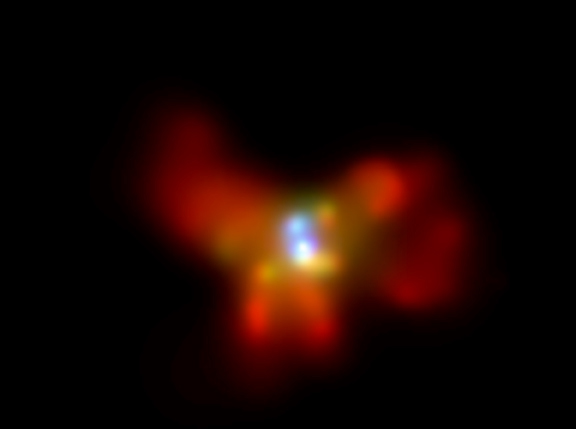
The Hubble optical image on the left shows NGC 6240 in the throes of a titanic galaxy - galaxy collision 400 million light-years away. As the cosmic catastrophe plays out, the merging galaxies spew forth distorted tidal tails of stars, gas, and dust and undergo frantic bursts of star formation. Using the orbiting Chandra Observatory's x-ray vision to peer within the bright central regions of NGC 6240 astronomers believe they have uncovered, for the first time, not one but two enormous orbiting black holes, by detecting the characteristic x-ray radiation from the interstellar debris swirling toward them. In the false-color close-up view at right, the x-ray data clearly show the black hole sources (shaded blue) separated by about 3,000 light-years. Einstein's theory of gravity predicts that such a pair of black holes must spiral closer together, and ultimately coalesce into a single, even more massive black hole after several hundred million years. In the final moments the merging supermassive black holes will produce an extremely powerful burst of gravitational radiation.
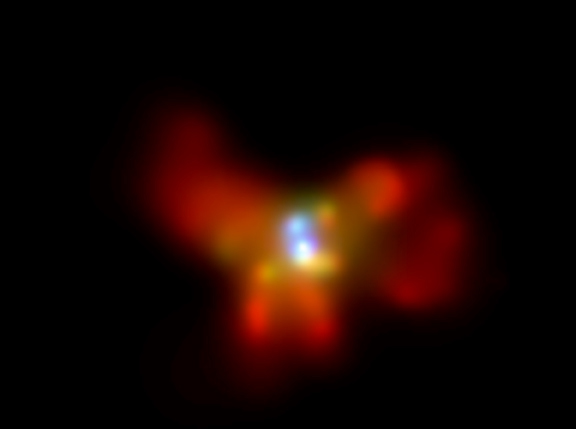
La imagen óptica del Hubble a la izquierda muestra NGC 6240 en medio de una titánica colisión entre galaxias, a 400 millones de años luz de distancia. Conforme se desarrolla esta catástrofe cósmica, las galaxias que se fusionan expulsan colas de mareas distorsionadas de estrellas, gas y polvo, y experimentan ráfagas frenéticas de formación estelar. Utilizando la visión en rayos X del Observatorio Chandra en órbita para examinar las regiones centrales brillantes de NGC 6240, los astrónomos creen haber descubierto, por primera vez, no uno sino dos enormes agujeros negros en órbita, al detectar la radiación característica de rayos X proveniente de los escombros intergalácticos que giran hacia ellos. En la vista de primer plano en falsos colores a la derecha, los datos de rayos X muestran claramente las fuentes de agujeros negros (sombreadas en azul) separadas por aproximadamente 3,000 años luz. La teoría de la gravedad de Einstein predice que tal par de agujeros negros debe espiral acercándose mutuamente y, en última instancia, coalescerse en un único agujero negro aún más masivo después de varios cientos de millones de años. En los momentos finales, la fusión de estos agujeros negros supermasivos producirá un estallido extremadamente potente de radiación gravitacional.