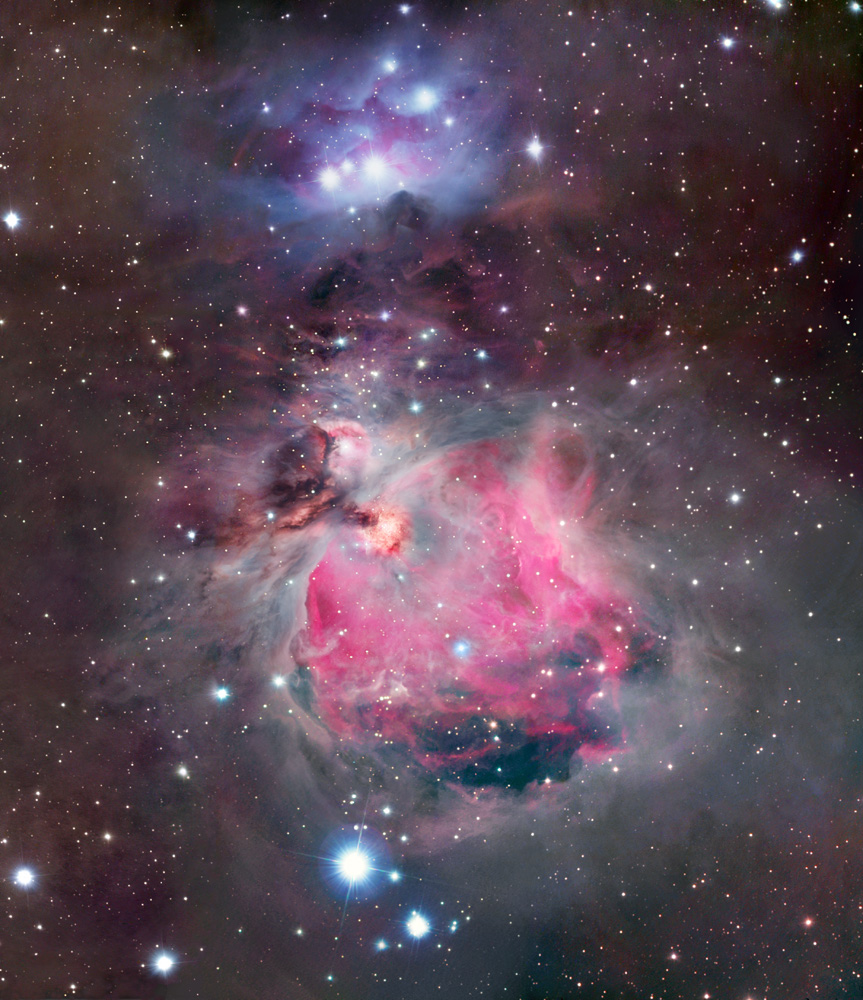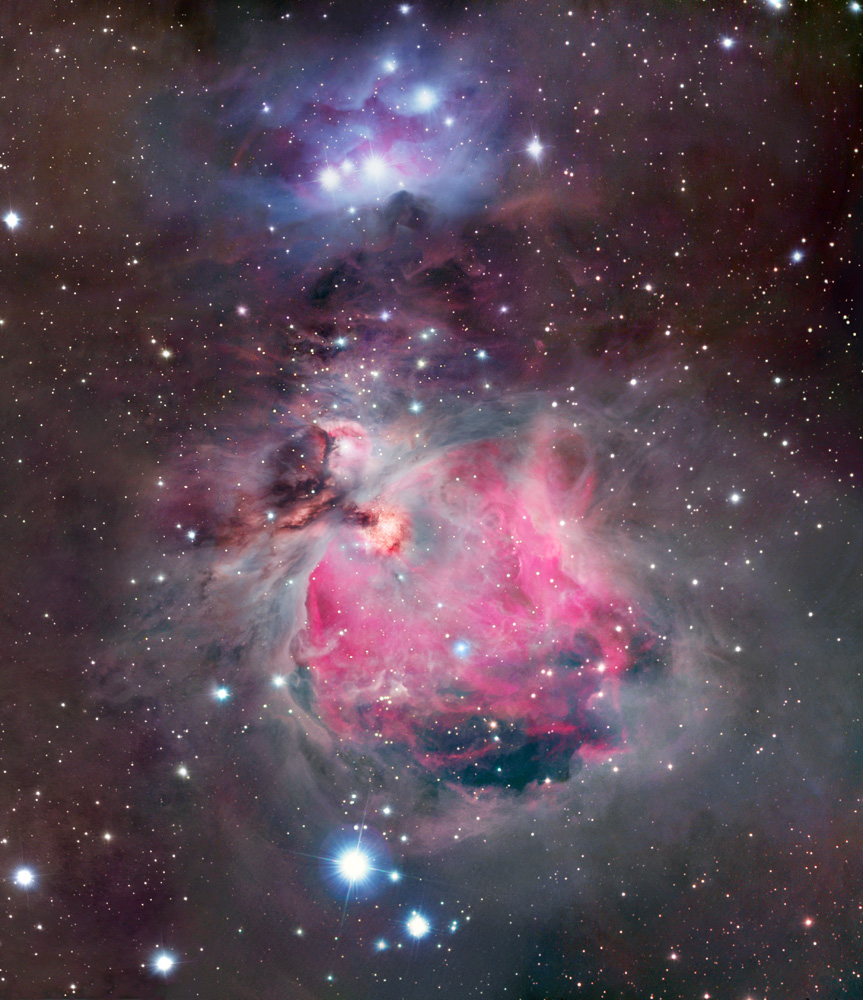
Revisiting one of the most famous nebulae in planet Earth's night sky, astrophotographer Robert Gendler has constructed this stunning, color-enhanced mosaic of the region surrounding the Great Nebula in Orion. As seen here, the clouds of Orion are dominated by the reddish emission nebula M42 near the bottom of the image, with blue reflection nebulae, including NGC 1977, near the top. Strewn with dust lanes and dark nebulae, the striking cosmic apparitions surrounding Orion's stellar nurseries are about 1,500 light-years away and are themselves several light-years across. Located at the edge of a giant molecular cloud complex spanning hundreds of light-years, these nebulae represent only a small, but very visible(!), fraction of this region's wealth of interstellar material. Within these colorful clouds of Orion, astronomers have also identified what appear to be numerous infant solar systems.
Revisitando una de las nebulosas más famosas en el cielo nocturno del planeta Tierra, el astrofotógrafo Robert Gendler ha construido este impresionante mosaico mejorado en color de la región que rodea la Gran Nebulosa de Orión. Como se ve aquí, las nubes de Orión están dominadas por la nebulosa de emisión rojiza M42 cerca de la parte inferior de la imagen, con nebulosas de reflexión azules, incluyendo NGC 1977, cerca de la parte superior. Salpicadas de bandas de polvo y nebulosas oscuras, las impresionantes apariciones cósmicas que rodean los viveros estelares de Orión se encuentran a aproximadamente 1.500 años luz de distancia y tienen varios años luz de diámetro. Ubicadas en el borde de un complejo de nube molecular gigante que abarca cientos de años luz, estas nebulosas representan solo una pequeña, pero muy visible, fracción de la riqueza de material interestelar de esta región. Dentro de estas nubes coloridas de Orión, los astrónomos también han identificado lo que parecen ser numerosos sistemas solares incipientes.