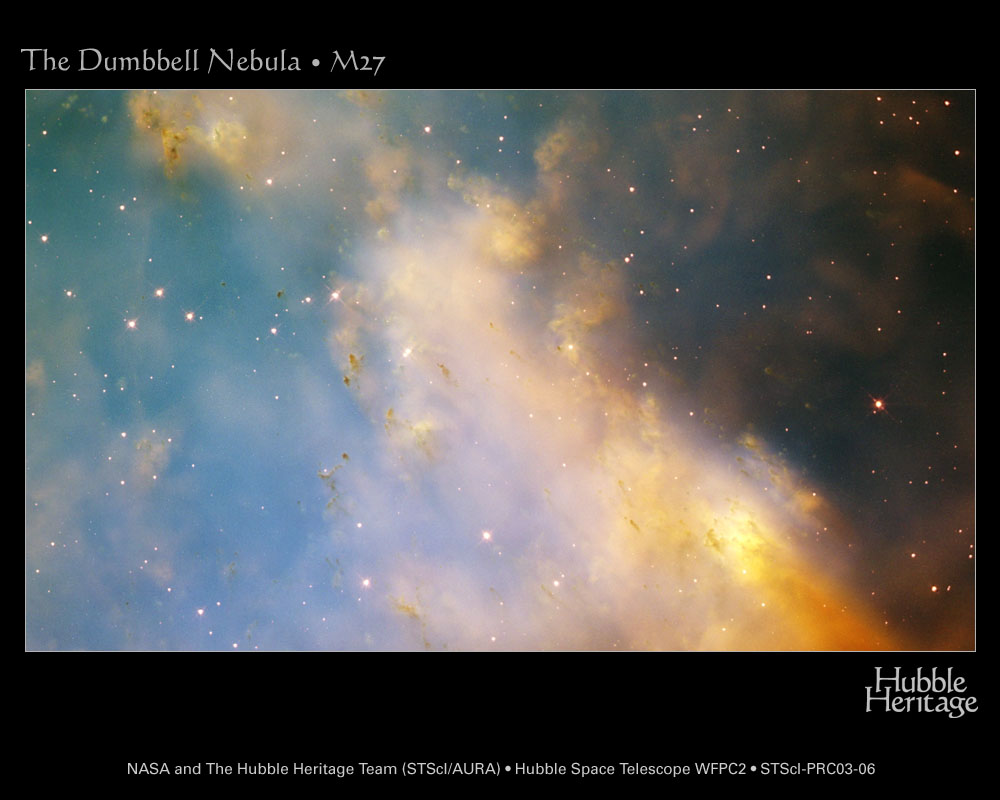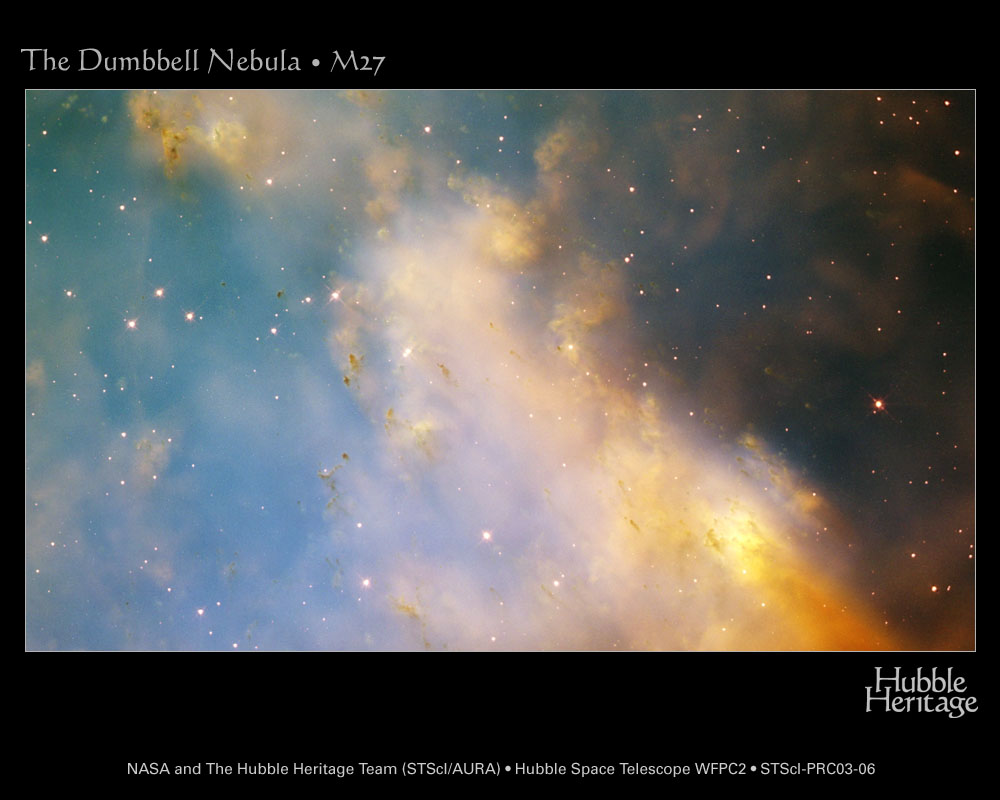
What causes unusual knots of gas and dust in planetary nebulas? Seen previously in the Ring Nebula, the Helix Nebula, and NGC 2392, the knots' existence was not predicted previously and still not well understood. Pictured above is a newly released image of the Dumbbell Nebula by the Hubble Space Telescope showing details of its gaseous knots. Also visible are many bright young stars and dark sheets of interstellar dust. The Dumbbell Nebula, also known as M27, is a planetary nebula thought similar to what our Sun will become when it runs out of core fuel for nuclear fusion. Recent study of similar cometary knots indicates that they include concentrations of relatively cold molecular gas and that they change significantly as the planetary nebula ages. APOD Update: APOD now also available from Japan in Japanese.
¿Qué causa los inusuales nudos de gas y polvo en las nebulosas planetarias? Observados previamente en la Nebulosa del Anillo, la Nebulosa Hélice y NGC 2392, la existencia de estos nudos no fue predicha anteriormente y aún no se comprende bien. La imagen que se muestra arriba es una imagen recién publicada de la Nebulosa Haltera capturada por el Telescopio Espacial Hubble, que muestra detalles de sus nudos gaseosos. También son visibles muchas estrellas jóvenes brillantes y láminas oscuras de polvo interestelar. La Nebulosa Haltera, también conocida como M27, es una nebulosa planetaria que se considera similar a lo que nuestro Sol se convertirá cuando agote el combustible en su núcleo para la fusión nuclear. Estudios recientes de nudos cometarios similares indican que incluyen concentraciones de gas molecular relativamente frío y que cambian significativamente a medida que la nebulosa planetaria envejece.