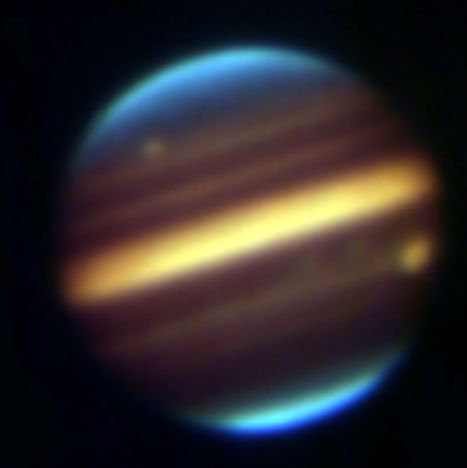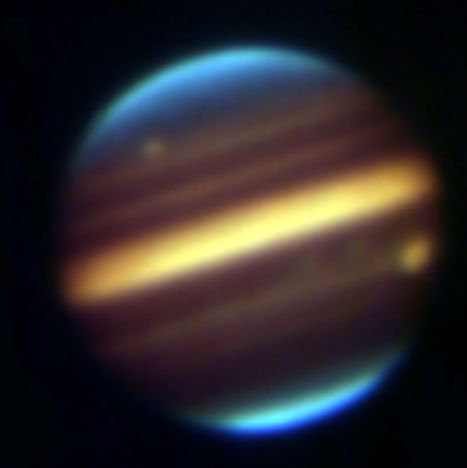
Gazing out over the mountaintops from the Wyoming InfraRed Observatory (WIRO), astronomers recently recorded this bizarre looking image of the solar system's ruling planet, gas giant Jupiter. The false-color picture is a composite of images taken to test a sophisticated digital camera operating at liquid helium temperatures and sensitive to wavelengths about three times longer than visible red light. At those infrared wavelengths (near 2.1 microns) the molecular hydrogen and methane gas in Jupiter's dense lower atmosphere strongly absorb sunlight, so the normally bright, banded planet looks very dark. But particles and haze over the equator and poles rise above the absorbing layers into Jupiter's stratosphere and reflect the infrared sunlight. Also clearly extending into the Jovian stratosphere is the famous Great Red Spot seen here in yellow just under the equatorial band at the right. North is up in this view and Jupiter's rapid 10 hour rotation will soon carry the Great Red Spot behind the planet's right limb.
Observando más allá de las cimas de las montañas desde el Observatorio Infrarrojo de Wyoming (WIRO, por sus siglas en inglés), los astrónomos registraron recientemente esta imagen de aspecto peculiar del planeta gobernante del sistema solar, el gigante gaseoso Júpiter. La imagen en falso color es un compuesto de imágenes tomadas para probar una sofisticada cámara digital que opera a temperaturas de helio líquido y es sensible a longitudes de onda aproximadamente tres veces más largas que la luz roja visible. En esas longitudes de onda infrarroja (cerca de 2,1 micrones), el hidrógeno molecular y el gas de metano en la densa atmósfera inferior de Júpiter absorben fuertemente la luz solar, por lo que el planeta normalmente brillante y con bandas se ve muy oscuro. Sin embargo, las partículas y la neblina sobre el ecuador y los polos se elevan por encima de las capas absorbentes hacia la estratosfera de Júpiter y reflejan la luz solar infrarroja. También extendiéndose claramente hacia la estratosfera jovilana se encuentra la famosa Gran Mancha Roja, visible aquí en amarillo justo bajo la banda ecuatorial a la derecha. El norte está hacia arriba en esta vista y la rápida rotación de 10 horas de Júpiter pronto llevará la Gran Mancha Roja detrás del limbo derecho del planeta.