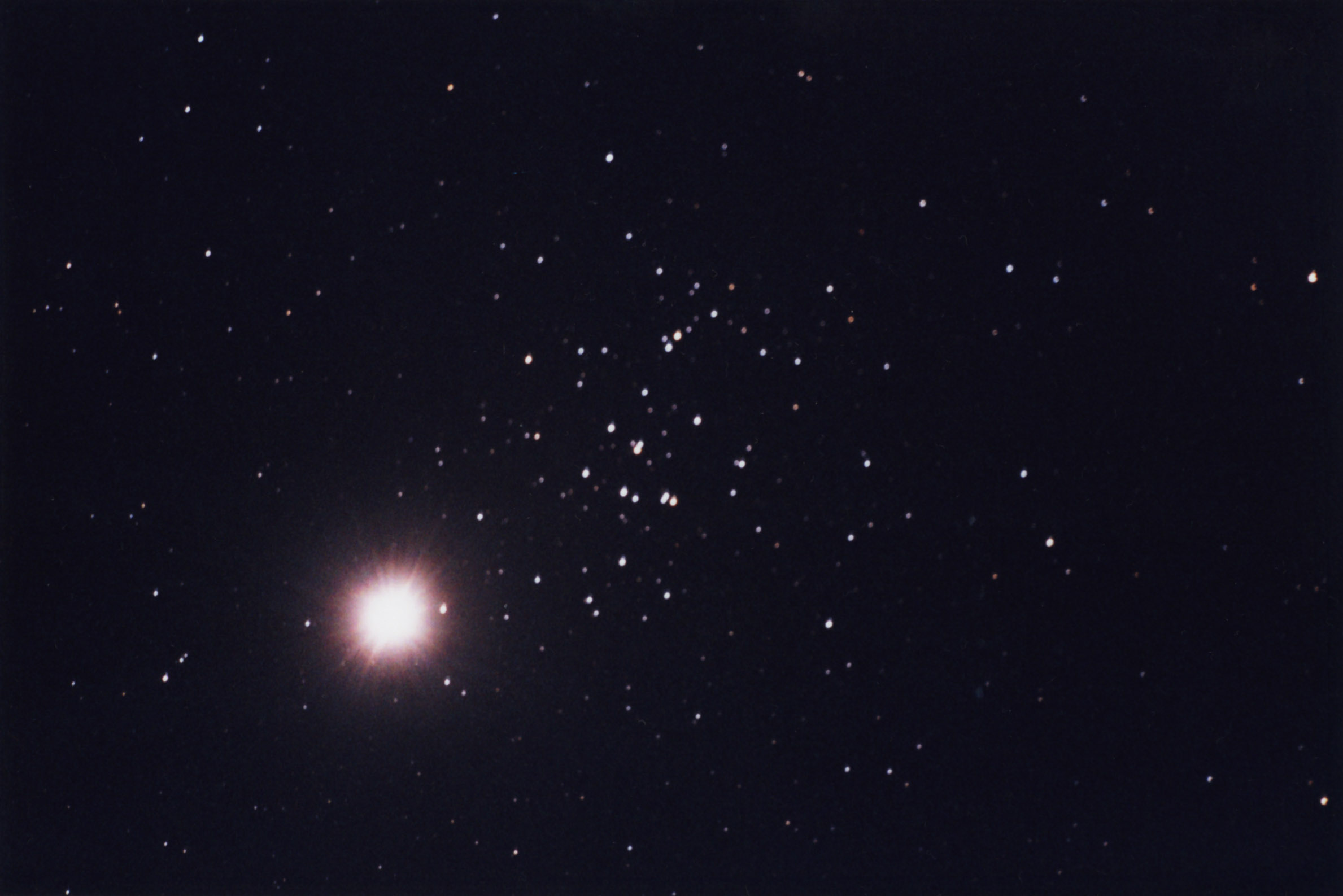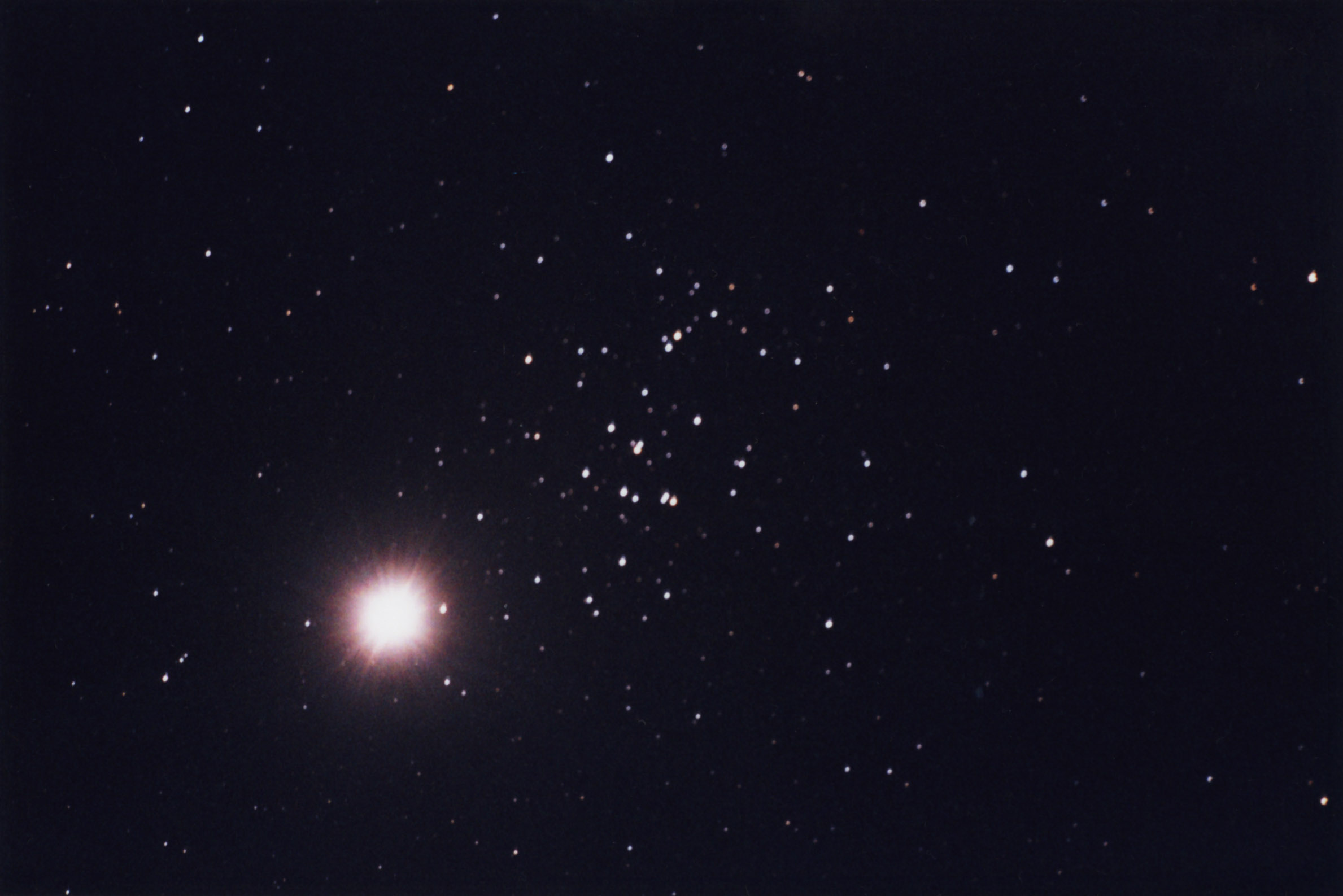
If you can find planet Jupiter in tonight's sky, then you can also find M44, popularly known as the Beehive star cluster. In fact, with a pair of binoculars most casual skygazers should find it easy to zero in on this celestial scene. It should be easy because after sunset Jupiter presently rules the night as the brightest "star" overhead. Now near the stationary part of its wandering path through the heavens, Jupiter will obligingly linger for a while at a spot only a degree or so southeast of M44 in the relatively faint constellation Cancer. Seen here in a photograph from March 28, Jupiter (lower left) is strongly overexposed with the stars of M44 swarming above and to the right. The picture approximately corresponds to the view when looking through a typical pair of binoculars. Jupiter is about 30 light-minutes from our fair planet while M44, one of the closest star clusters, is around 600 light-years away.
Si puede encontrar el planeta Júpiter en el cielo nocturno de esta noche, entonces también podrá encontrar M44, popularmente conocido como el cúmulo estelar de la Colmena. De hecho, con un par de binoculares, la mayoría de los observadores del cielo casual deberían encontrar fácil enfocar esta escena celestial. Debería ser fácil porque después de la puesta de sol, Júpiter domina actualmente la noche como la "estrella" más brillante sobre nuestras cabezas. Ahora cerca de la parte estacionaria de su errante camino a través de los cielos, Júpiter se posicionará gentilmente durante un tiempo en un lugar a solo un grado o más al sureste de M44 en la constelación relativamente débil de Cáncer. Visto aquí en una fotografía del 28 de marzo, Júpiter (abajo a la izquierda) está fuertemente sobreexpuesto con las estrellas de M44 enjambradas arriba y a la derecha. La imagen corresponde aproximadamente a la vista al observar a través de un par típico de binoculares. Júpiter está a unos 30 minutos luz de nuestro planeta, mientras que M44, uno de los cúmulos estelares más cercanos, está a unos 600 años luz de distancia.