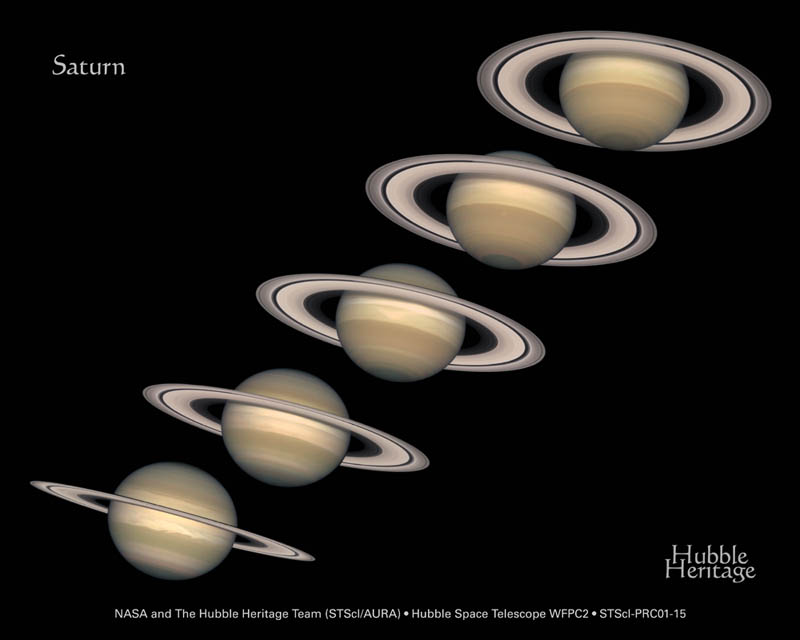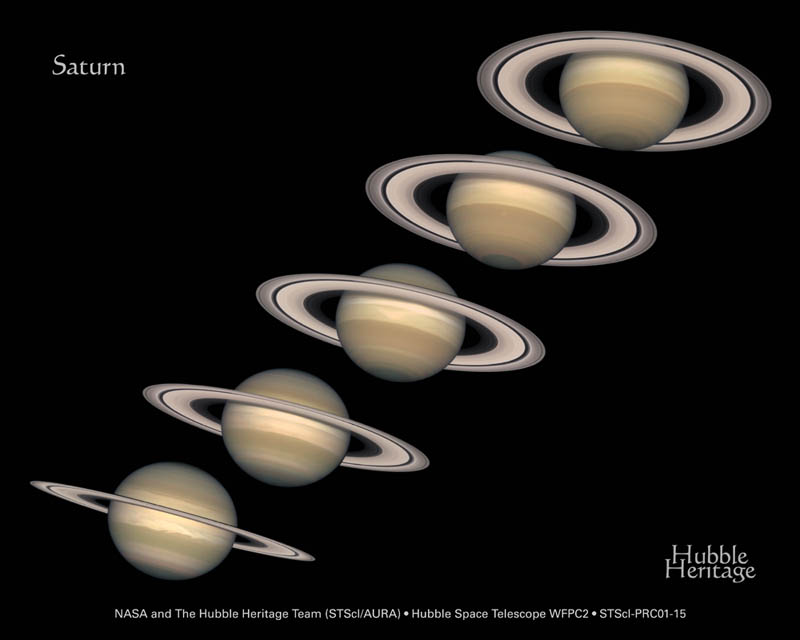
Since Saturn's axis is tilted as it orbits the Sun, Saturn has seasons, like those of planet Earth ... but Saturn's seasons last for over seven years. So what season is it on Saturn now? Orbiting the equator, the tilt of the rings of Saturn provides quite a graphic seasonal display. In fact, this month, Saturn's rings will reach their most "open" angle after appearing nearly edge on in the mid-1990s. The ringed planet is also well placed in evening skies providing a grand view as summer comes to Saturn's southern hemisphere and winter to the north. The Hubble Space Telescope took the above sequence of images about a year apart, starting on the left in 1996 and ending on the right in 2000. Although they look solid, Saturn's Rings are likely less than 50 meters thick and consist of individually orbiting bits of ice and rock ranging in size from grains of sand to barn-sized boulders.
Dado que el eje de Saturno está inclinado mientras orbita alrededor del Sol, Saturno tiene estaciones, como las del planeta Tierra... pero las estaciones de Saturno duran más de siete años. ¿Cuál es la estación actual en Saturno? Orbitando el ecuador, la inclinación de los anillos de Saturno proporciona un espectáculo estacional muy gráfico. De hecho, este mes, los anillos de Saturno alcanzarán su ángulo más "abierto" después de aparecer casi de canto a mediados de la década de 1990. El planeta anillado también se encuentra bien posicionado en los cielos vespertinos, ofreciendo una vista magnífica mientras llega el verano al hemisferio sur de Saturno e invierno al norte. El Telescopio Espacial Hubble tomó la secuencia anterior de imágenes aproximadamente un año aparte, comenzando a la izquierda en 1996 y terminando a la derecha en 2000. Aunque parecen sólidos, los anillos de Saturno tienen probablemente menos de 50 metros de espesor y consisten en fragmentos de hielo y roca que orbitan individualmente, con tamaños que varían desde granos de arena hasta rocas del tamaño de un granero.