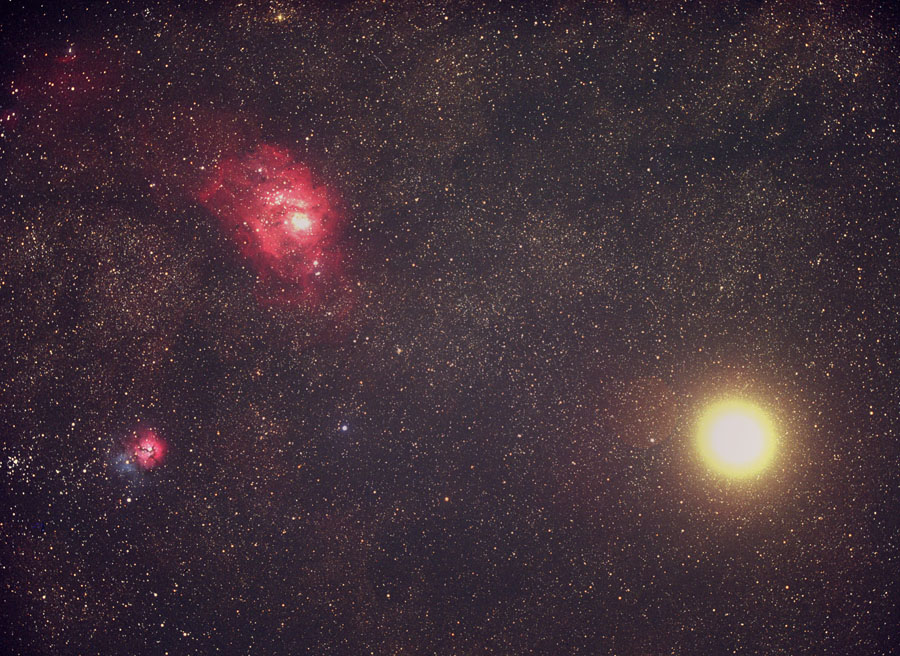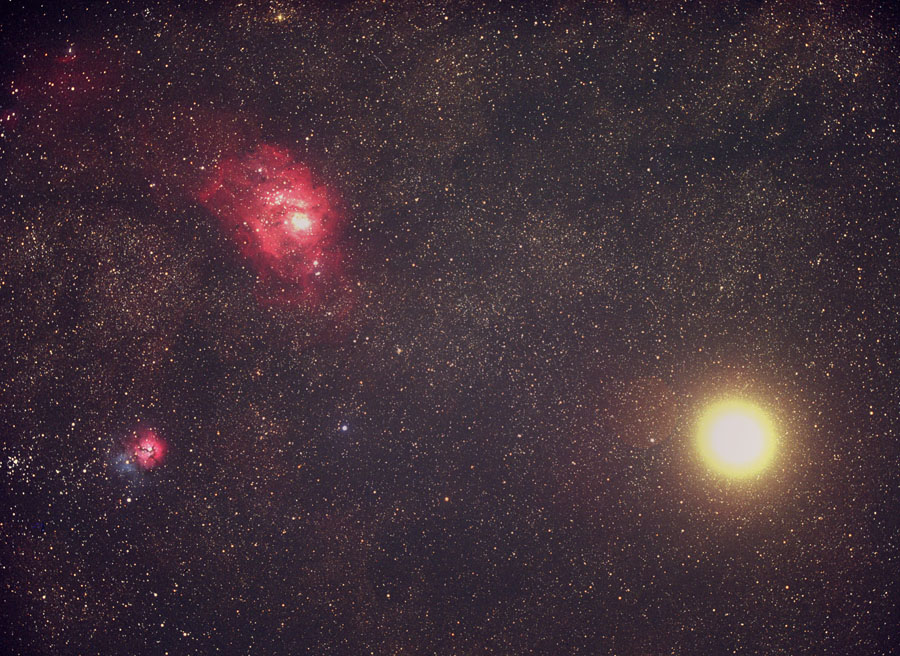
A telescopic tour of the constellation Sagittarius offers the many bright clusters and nebulae of dimensioned space in a starscape surrounding the galactic center. This gorgeous color deep-sky photograph visits two such lovely sights, cataloged by the 18th century cosmic tourist Charles Messier as M8 and M20. M20 (upper left), the Trifid Nebula, presents a striking contrast in red/blue colors and dark dust lanes. Just below and to the right is the expansive, alluring red glow of M8, the Lagoon Nebula. Both nebulae are a few thousand light-years distant but at the far right, the dominant celestial beacon is a "local" source, the planet Mars. Just passing through Sagittarius and strongly overexposed in this picture, the Red Planet was a short 4 light-minutes away. Now headed for its closest approach to planet Earth in recorded history, Mars rises in the east southeast by midnight shining brightly at about -1.4 magnitude. Urban imager Michael Cole recorded this photograph at 3:00 AM on May 20th, 2001 in clear skies over Camp Hancock, Oregon, USA.
Un recorrido telescópico por la constelación de Sagitario ofrece los muchos cúmulos brillantes y nebulosas del espacio tridimensional en un panorama estelar que rodea el centro galáctico. Esta magnífica fotografía de cielo profundo a todo color visita dos de estos hermosos objetos, catalogados por el turista cósmico del siglo XVIII Charles Messier como M8 y M20. M20 (arriba a la izquierda), la Nebulosa Trífida, presenta un contraste llamativo en colores rojo y azul con franjas de polvo oscuro. Justo debajo y a la derecha se encuentra el resplandor rojo expansivo y cautivador de M8, la Nebulosa de la Laguna. Ambas nebulosas se encuentran a algunos miles de años luz de distancia, pero en el extremo derecho, el faro celestial dominante es una fuente "local", el planeta Marte. Pasando simplemente por Sagitario y fuertemente sobreexpuesto en esta imagen, el Planeta Rojo se encontraba a solo 4 minutos luz de distancia. Ahora dirigiéndose hacia su aproximación más cercana al planeta Tierra en la historia registrada, Marte se eleva en el este-sureste a medianoche brillando intensamente con una magnitud de aproximadamente -1,4. El astrofotógrafo Michael Cole registró esta fotografía a las 3:00 AM del 20 de mayo de 2001 en cielos despejados sobre Camp Hancock, Oregón, USA.