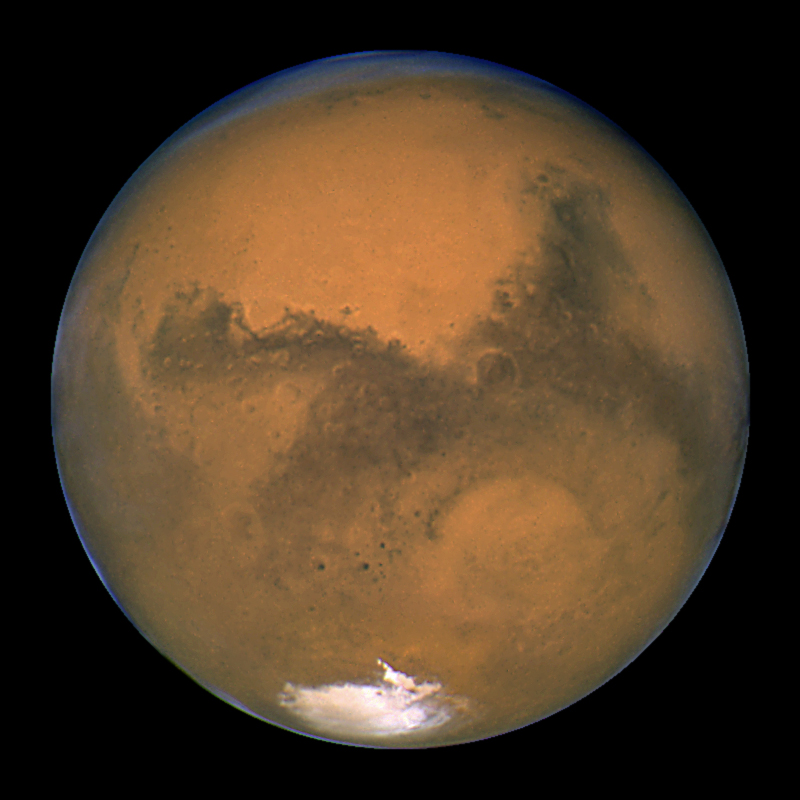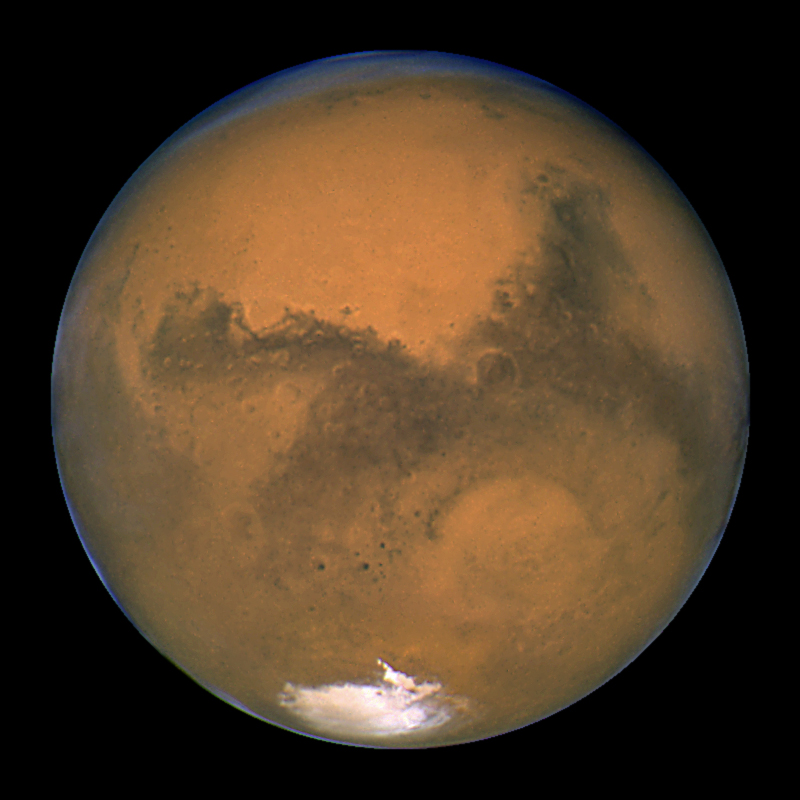
At about 10 am Universal Time today, Mars and Earth will pass closer than in nearly 60,000 years. Mars, noticeably red, will be the brightest object in the eastern sky just after sunset. Tonight and through much of this week, many communities around the world are running a public Mars Watch 2003 campaign, where local telescopes will zoom in on the red planet. Pictured above is an image of Mars taken just last night from the Hubble Space Telescope in orbit around the Earth. This image is the most detailed view of Mars ever taken from Earth. Visible features include the south polar cap in white at the image bottom, circular Huygens crater just to the right of the image center, Hellas Impact Basin - the large light circular feature at the lower right, planet-wide light highlands dominated by many smaller craters and large sweeping dark areas dominated by relatively smooth lowlands.
Alrededor de las 10 de la mañana, Hora Universal de hoy, Marte y la Tierra pasarán más cerca uno del otro que en casi 60.000 años. Marte, notoriamente rojo, será el objeto más brillante en el cielo oriental justo después de la puesta de sol. Esta noche y durante gran parte de esta semana, muchas comunidades de todo el mundo están realizando una campaña pública de "Vigilancia de Marte 2003", donde telescopios locales ampliarán la vista del planeta rojo. La imagen que se muestra arriba es una fotografía de Marte tomada anoche desde el Telescopio Espacial Hubble en órbita alrededor de la Tierra. Esta imagen es la vista más detallada de Marte jamás tomada desde la Tierra. Las características visibles incluyen la capa polar sur en blanco en la parte inferior de la imagen, el cráter circular Huygens justo a la derecha del centro de la imagen, la Cuenca de Impacto Hellas (la gran característica circular clara en la parte inferior derecha), las tierras altas de escala planetaria dominadas por numerosos cráteres más pequeños y grandes áreas oscuras barridas dominadas por tierras bajas relativamente suaves.