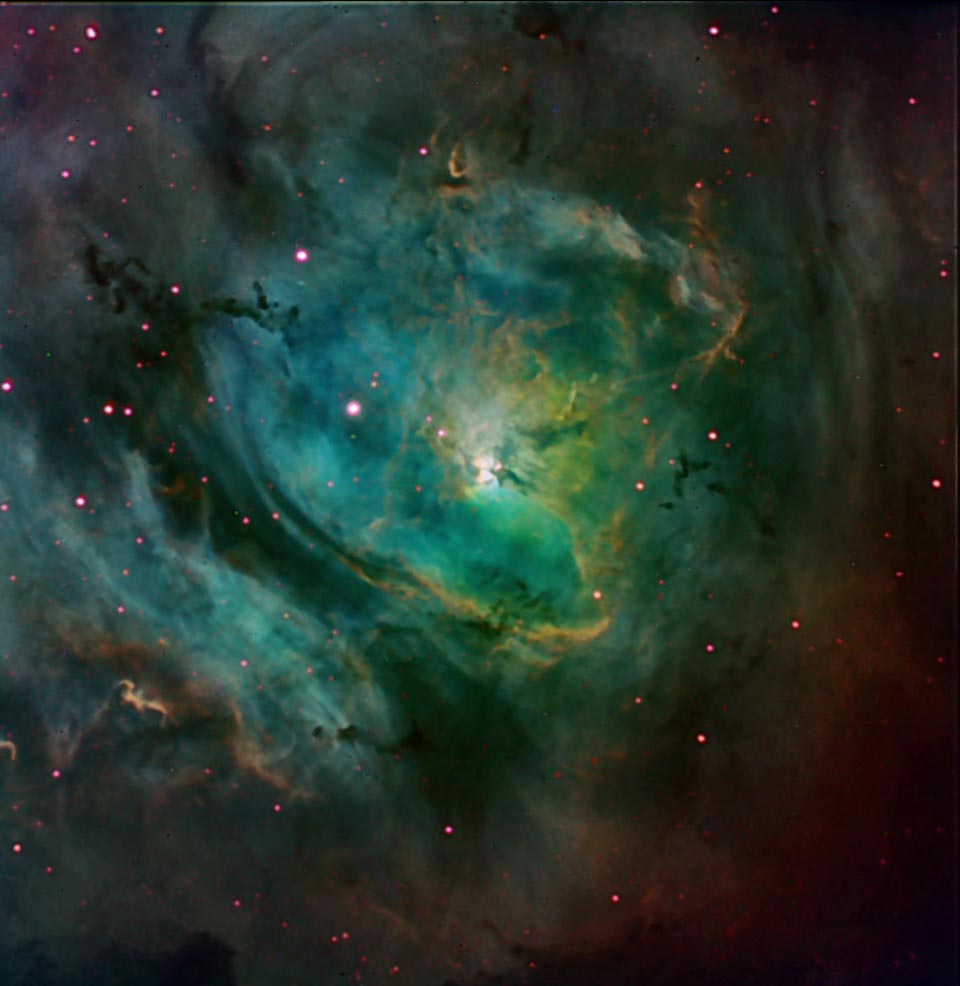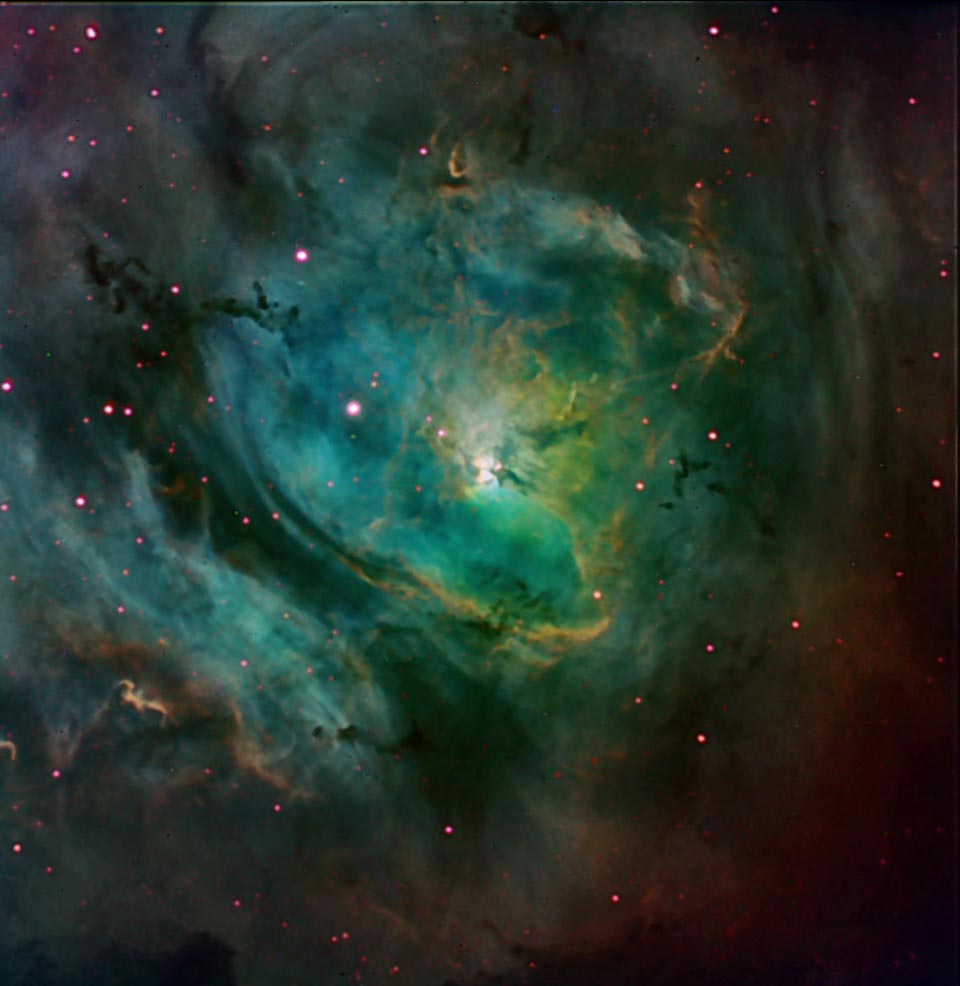
The large majestic Lagoon Nebula is home for many young stars and hot gas. Spanning 100 light years across while lying only about 5000 light years distant, the Lagoon Nebulae is so big and bright that it can be seen without a telescope toward the constellation of Sagittarius. Many bright stars are visible from NGC 6530, an open cluster that formed in the nebula only several million years ago. The greater nebula, also known as M8 and NGC 6523, is named "Lagoon" for the band of dust seen to the left of the open cluster's center. A bright knot of gas and dust in the nebula's center is known as the Hourglass Nebula. The above picture is a digitally sharpened composite of exposures taken in specific colors of light emitted by sulfur (red), hydrogen (green), and oxygen (blue). Star formation continues in the Lagoon Nebula as witnessed by the many globules that exist there.
La majestuosa y gran Nebulosa de la Laguna alberga muchas estrellas jóvenes y gas caliente. Abarcando 100 años luz de ancho y situándose a solo aproximadamente 5000 años luz de distancia, la Nebulosa de la Laguna es tan grande y brillante que puede observarse sin telescopio hacia la constelación de Sagitario. Muchas estrellas brillantes son visibles desde NGC 6530, un cúmulo abierto que se formó en la nebulosa hace solo varios millones de años. La nebulosa mayor, también conocida como M8 y NGC 6523, recibe el nombre de "Laguna" por la banda de polvo visible a la izquierda del centro del cúmulo abierto. Un nudo brillante de gas y polvo en el centro de la nebulosa se conoce como la Nebulosa de la Ampolleta. La imagen anterior es una composición digitalmente mejorada de exposiciones tomadas en colores específicos de luz emitida por azufre (rojo), hidrógeno (verde) y oxígeno (azul). La formación estelar continúa en la Nebulosa de la Laguna, como lo atestiguan los muchos glóbulos que existen allí.