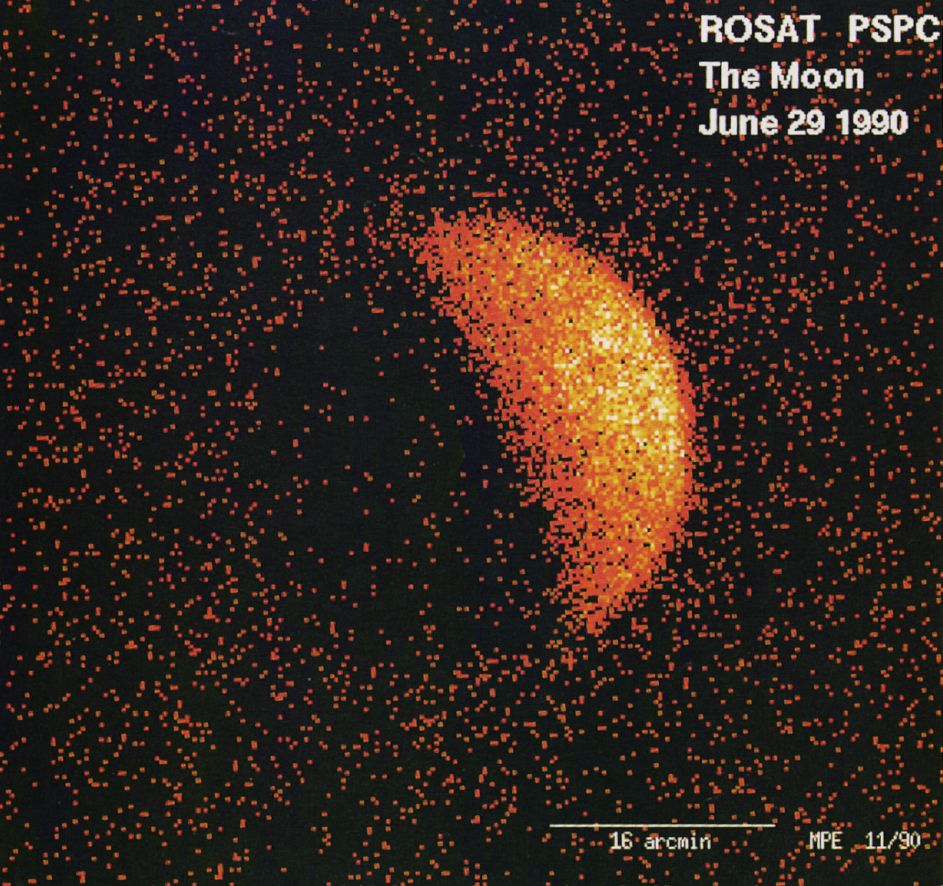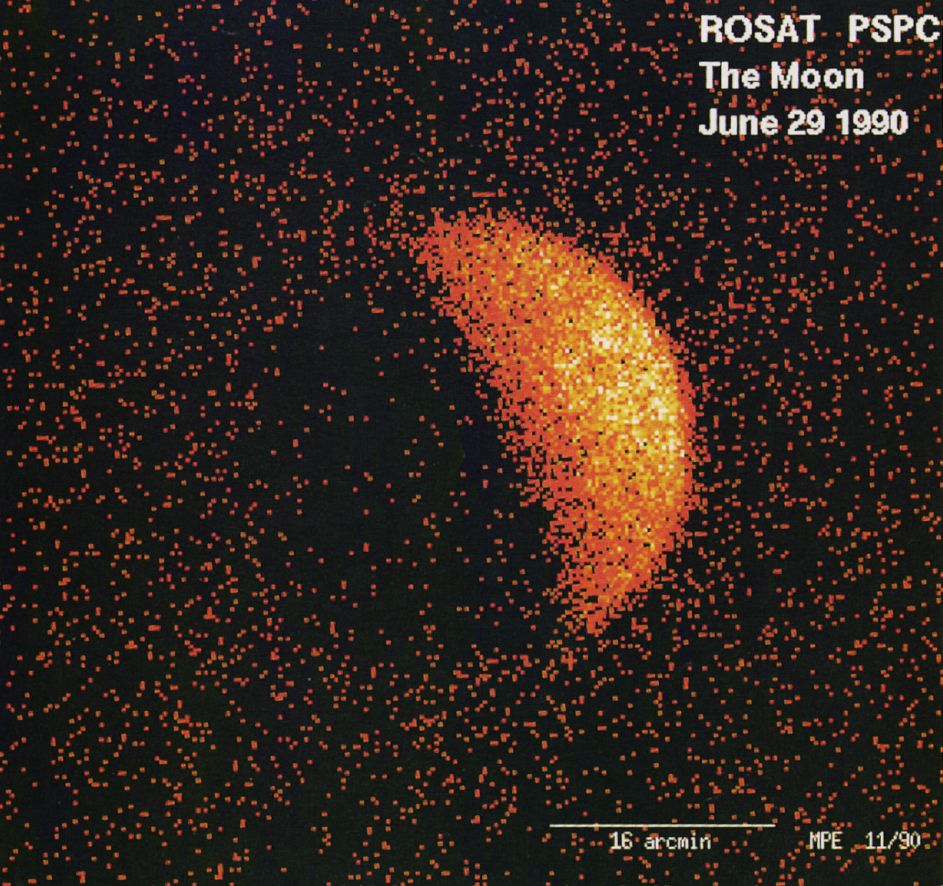
This x-ray image of the Moon was made by the orbiting ROSAT (Röntgensatellit) Observatory in 1990. In this digital picture, pixel brightness corresponds to x-ray intensity. Consider the image in three parts: the bright hemisphere of the x-ray moon, the darker half of the moon, and the x-ray sky background. The bright lunar hemisphere shines in x-rays because it scatters x-rays emitted by the sun. The background sky has an x-ray glow in part due to the myriad of distant, powerful active galaxies, unresolved in the ROSAT picture but recently detected in Chandra Observatory x-ray images. But why isn't the dark half of the moon completely dark? New Chandra results also suggest that a few x-rays only seem to come from the shadowed lunar hemisphere. Instead, they originate in Earth's geocorona or extended atmosphere which surrounds the orbiting x-ray observatories.
Esta imagen de rayos X de la Luna fue tomada por el observatorio espacial ROSAT (Röntgensatellit) en órbita en 1990. En esta imagen digital, el brillo de cada píxel corresponde a la intensidad de rayos X. Considere la imagen en tres partes: el hemisferio brillante de la Luna en rayos X, la mitad más oscura de la Luna y el fondo del cielo en rayos X. El hemisferio lunar brillante brilla en rayos X porque dispersa los rayos X emitidos por el Sol. El cielo de fondo presenta un brillo en rayos X en parte debido a la miríada de galaxias activas distantes y poderosas, sin resolver en la imagen de ROSAT pero recientemente detectadas en imágenes de rayos X del observatorio Chandra. ¿Pero por qué el lado oscuro de la Luna no está completamente oscuro? Los nuevos resultados de Chandra también sugieren que unos pocos rayos X parecen provenir del hemisferio lunar en sombra. En cambio, se originan en la geocorona terrestre o atmósfera extendida que rodea los observatorios espaciales de rayos X en órbita.