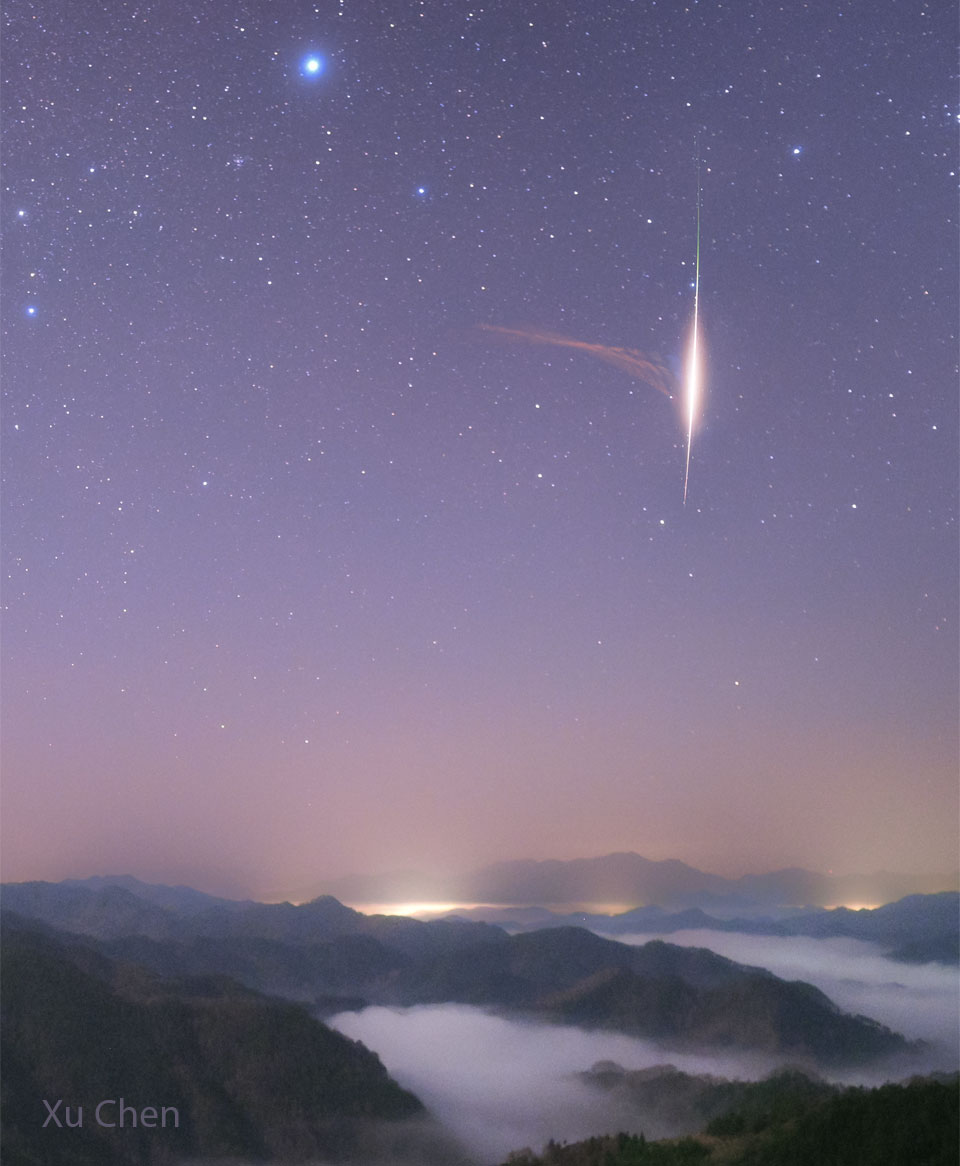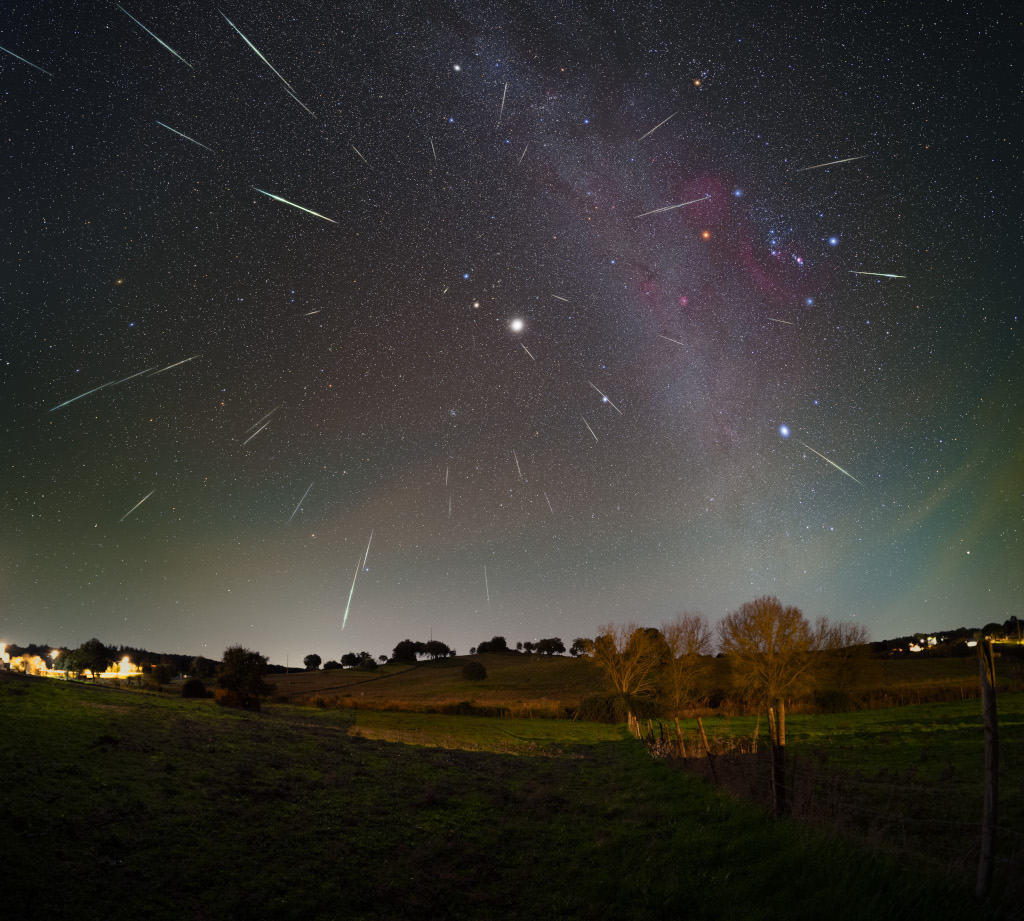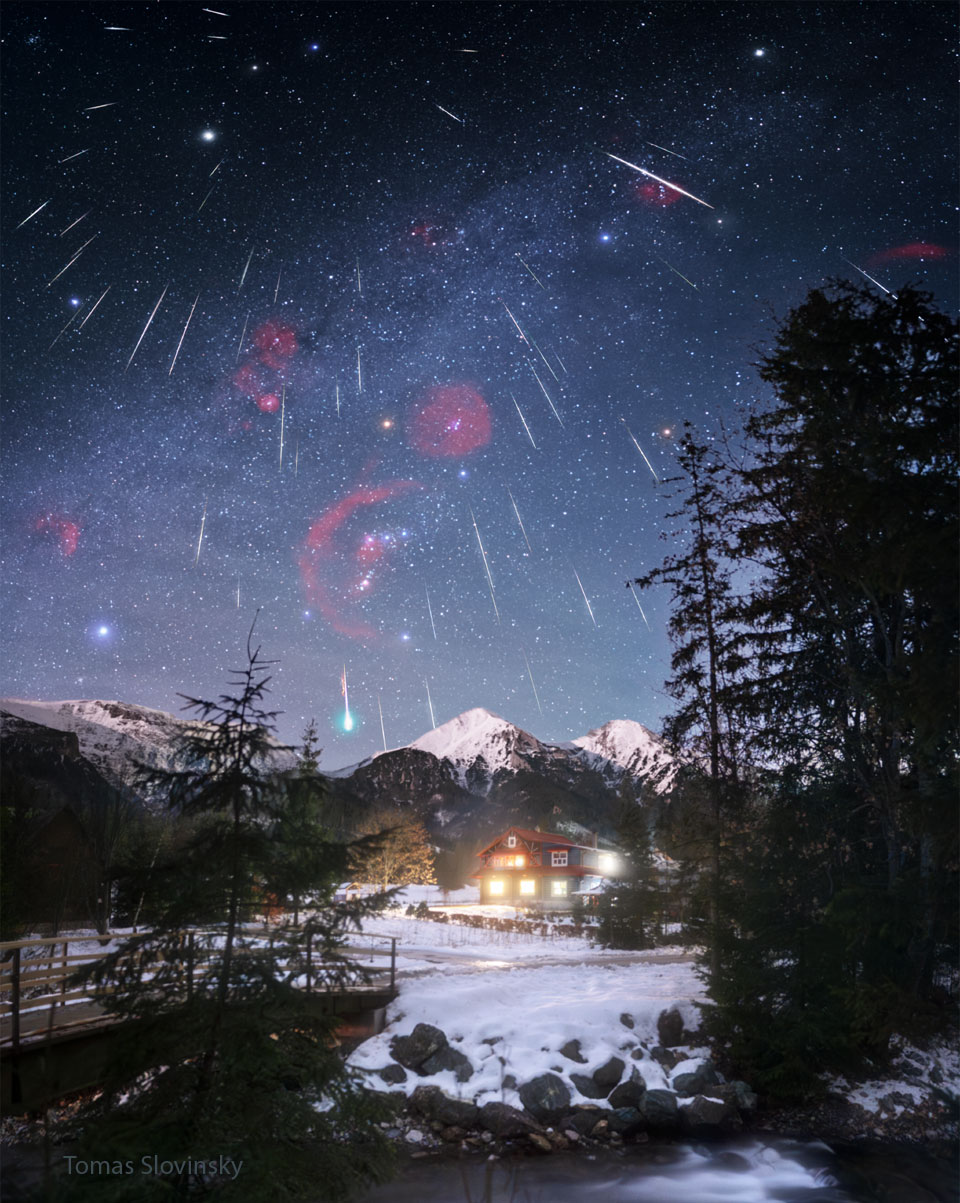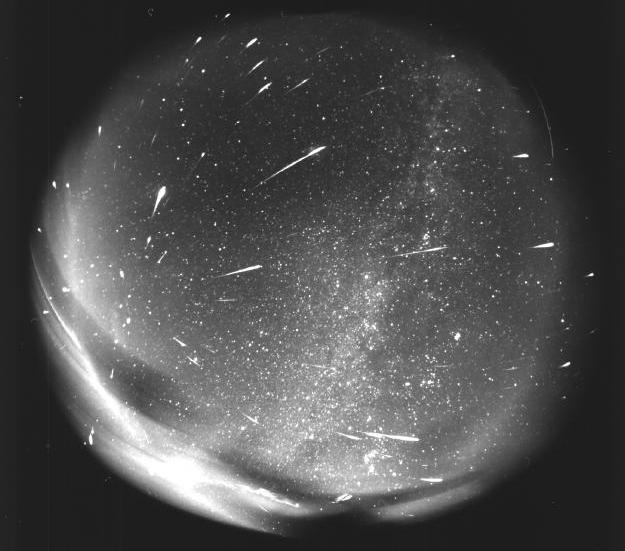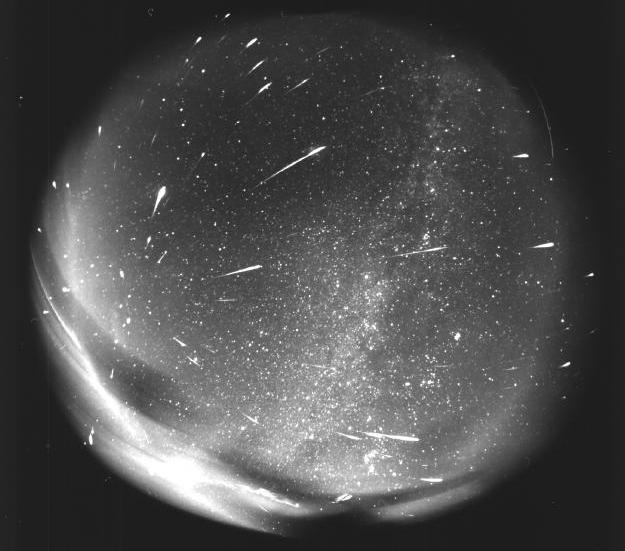
Is Leo leaking? Leo, the famous sky constellation visible on the left of the above all-sky photograph, appears to be the source of all the meteors seen in 1998's Leonids Meteor Shower. That Leonids point back to Leo is not a surprise - it is the reason that this November meteor shower is called the Leonids. Sand-sized debris expelled from Comet Tempel-Tuttle follows a well-defined orbit about our Sun, and the part of the orbit that approaches Earth is superposed in front of the constellation Leo. Therefore, when Earth crosses this orbit, the radiant point of falling debris appears in Leo. Over 150 meteors can be seen in the above four-hour effort. The Leonids Meteor Shower of 2003 is expected to have two peaks, the first three days ago and the second a long-duration peak covering much of November 19. Although visible meteor rates might approach one per minute, they are predicted to be much less than in the previous few years.
¿Está filtrándose Leo? La constelación Leo, famosa y visible en la izquierda de la fotografía de cielo completo anterior, parece ser la fuente de todos los meteoros observados en la lluvia de meteoros Leónidas de 1998. Que los Leónidas apunten hacia Leo no es sorprendente: es la razón por la cual esta lluvia de meteoros de noviembre se llama Leónidas. Los escombros del tamaño de granos de arena expulsados del cometa Tempel-Tuttle siguen una órbita bien definida alrededor de nuestro Sol, y la parte de la órbita que se acerca a la Tierra se superpone frente a la constelación Leo. Por lo tanto, cuando la Tierra cruza esta órbita, el punto radiante de los escombros que caen aparece en Leo. Se pueden ver más de 150 meteoros en el esfuerzo de cuatro horas anterior. Se espera que la lluvia de meteoros Leónidas de 2003 tenga dos picos: el primero hace tres días y el segundo un pico de larga duración que abarca gran parte del 19 de noviembre. Aunque las tasas de meteoros visibles podrían acercarse a uno por minuto, se predice que serán mucho menores que en los años anteriores.