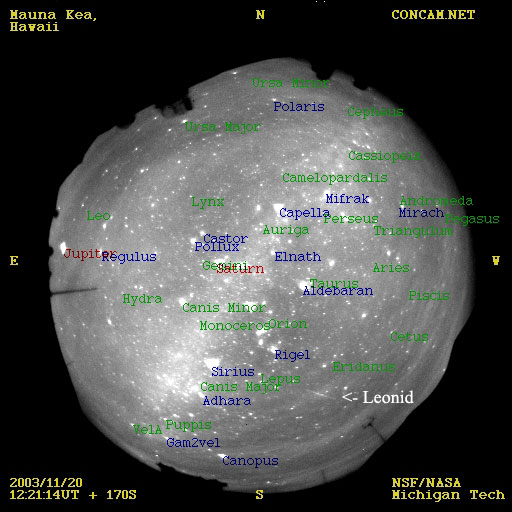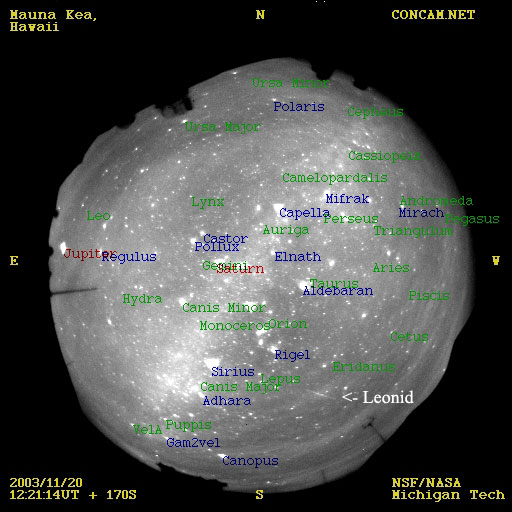
The 2003 Leonids Meteor Shower contained relatively few meteors. As expected and unlike the last few years, the Earth just did not pass through any dense particle streams left over by the Sun-orbiting Comet Tempel-Tuttle. Preliminary reports had the peak meteor rates only as high as about one relatively faint meteor a minute even from good locations at good times. Pictured above is one of the brighter Leonids of 2003, caught by one of the continuously operating night sky web cameras (CONCAMs) of the global Night Sky Live project. The fisheye image shows the night sky from horizon to horizon above Mauna Kea, Hawaii, USA. The image is annotated with several bright stars and planets. Note that this meteor, as do all Leonids, appears to emanate from the constellation Leo, labeled on the upper left. Although the peak of the Leonids this year was on November 19, this meteor flashed through the sky the next night.
La lluvia de meteoritos Leónidas de 2003 contenía relativamente pocos meteoros. Como era de esperar y a diferencia de los últimos años, la Tierra simplemente no pasó a través de ningún flujo denso de partículas dejado por el cometa Tempel-Tuttle que orbita alrededor del Sol. Los informes preliminares indicaban que las tasas máximas de meteoritos eran tan solo de aproximadamente un meteoro relativamente débil por minuto, incluso desde ubicaciones favorables y en momentos óptimos. La imagen superior muestra uno de los Leónidas más brillantes de 2003, capturado por una de las cámaras web de cielo nocturno en funcionamiento continuo (CONCAMs) del proyecto global Night Sky Live. La imagen de ojo de pez muestra el cielo nocturno de horizonte a horizonte sobre Mauna Kea, Hawái, EE.UU. La imagen está anotada con varios astros brillantes y planetas. Observe que este meteoro, como todos los Leónidas, parece emanar de la constelación de Leo, etiquetada en la esquina superior izquierda. Aunque el máximo de las Leónidas este año fue el 19 de noviembre, este meteoro surcó el cielo la noche siguiente.