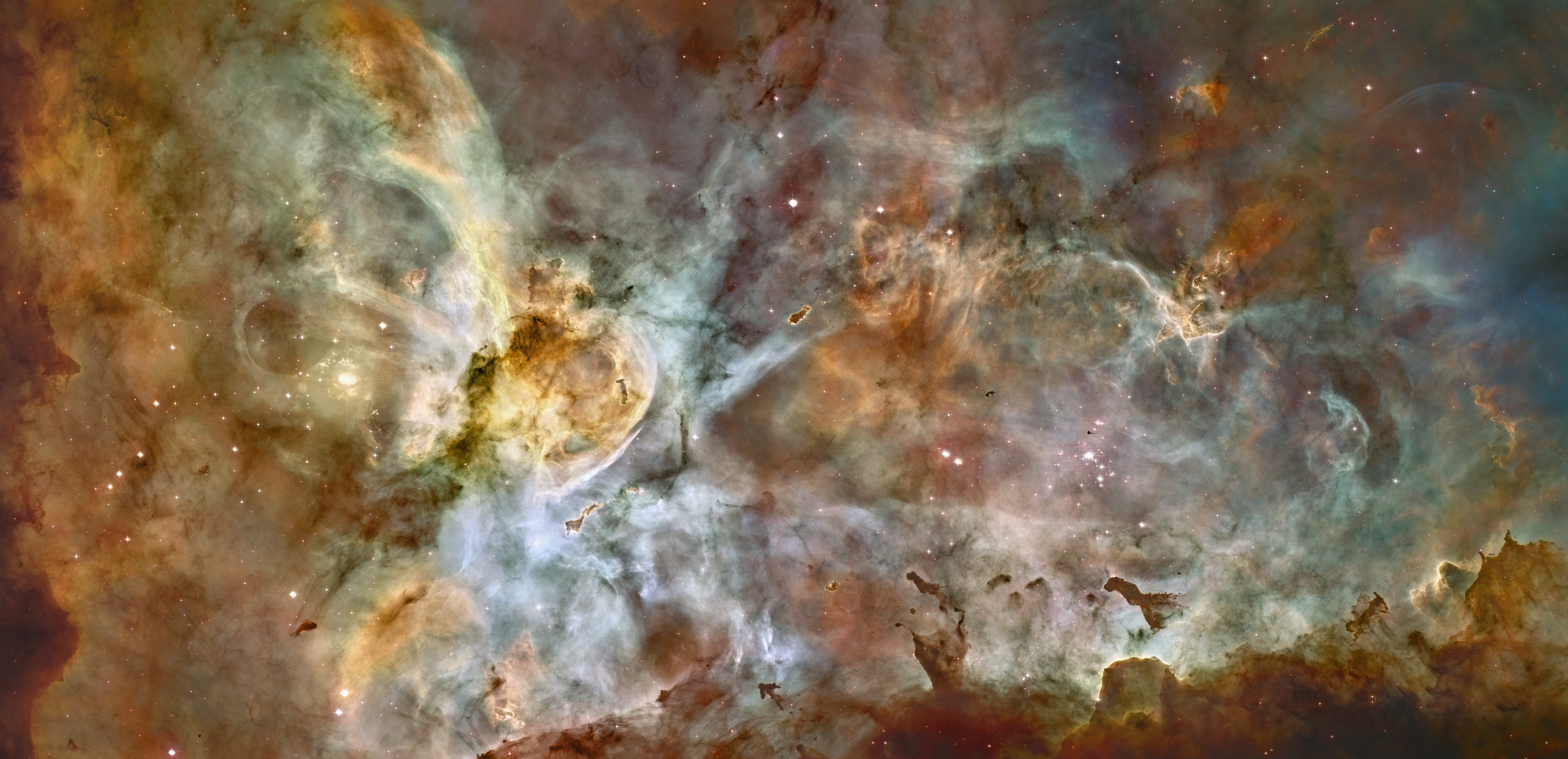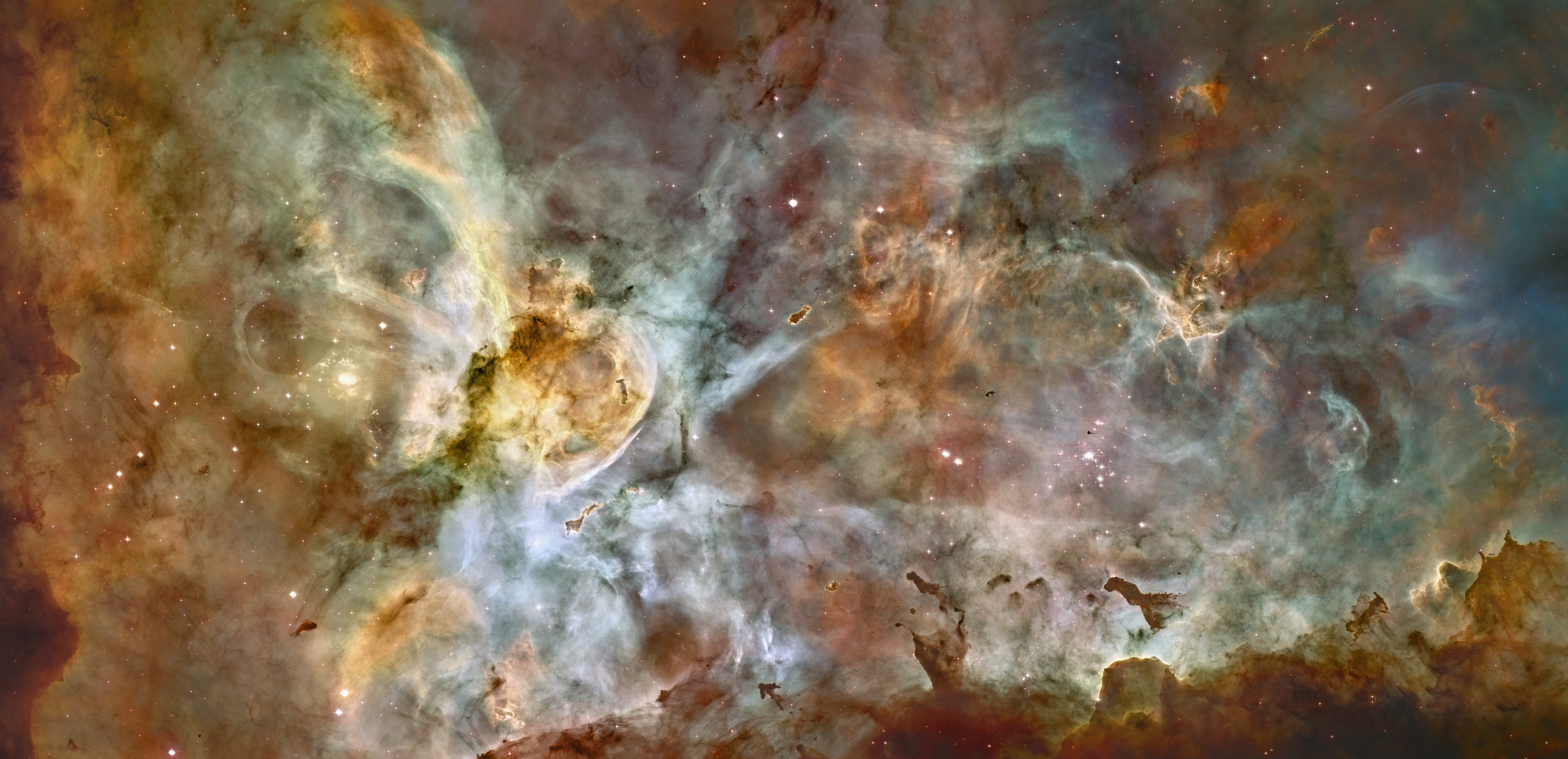
How do violent stars affect their surroundings? To help find out, astronomers pointed the Hubble Space Telescope to the regions surrounding Eta Carina, a star showing signs that it may explode sometime in the next million years. The nearby nebulosity, shown above, is home to streams of hot gas, pools of cool gas, knots of dark globules, and pillars of dense dusty interstellar matter likely forming young stars. The above image explores about three light-years, a region size intermediate to the Eta Carina cocoon, which spans only about one-half of a light year, and the Great Nebula in Carina, which spans over 300 light years. In April of 1843 Eta Car briefly became second only to Sirius as the brightest star in planet Earth's night sky, even though at a distance of about 7,500 light-years, it is about 800 times farther away.
¿Cómo afectan las estrellas violentas a su entorno? Para ayudar a responder esta pregunta, los astrónomos apuntaron el Telescopio Espacial Hubble hacia las regiones que rodean a Eta Carinae, una estrella que muestra signos de que podría explotar en algún momento durante el próximo millón de años. La nebulosidad cercana, mostrada arriba, alberga corrientes de gas caliente, depósitos de gas frío, nudos de glóbulos oscuros y pilares de materia interestelar densa y polvorienta que probablemente están formando estrellas jóvenes. La imagen anterior explora aproximadamente tres años luz, un tamaño de región intermedio entre el capullo de Eta Carinae, que abarca solo alrededor de medio año luz, y la Gran Nebulosa de Carina, que se extiende por más de 300 años luz. En abril de 1843, Eta Car se convirtió brevemente en la segunda estrella más brillante del cielo nocturno de la Tierra, solo después de Sirio, a pesar de que a una distancia de aproximadamente 7.500 años luz, se encuentra alrededor de 800 veces más lejos.