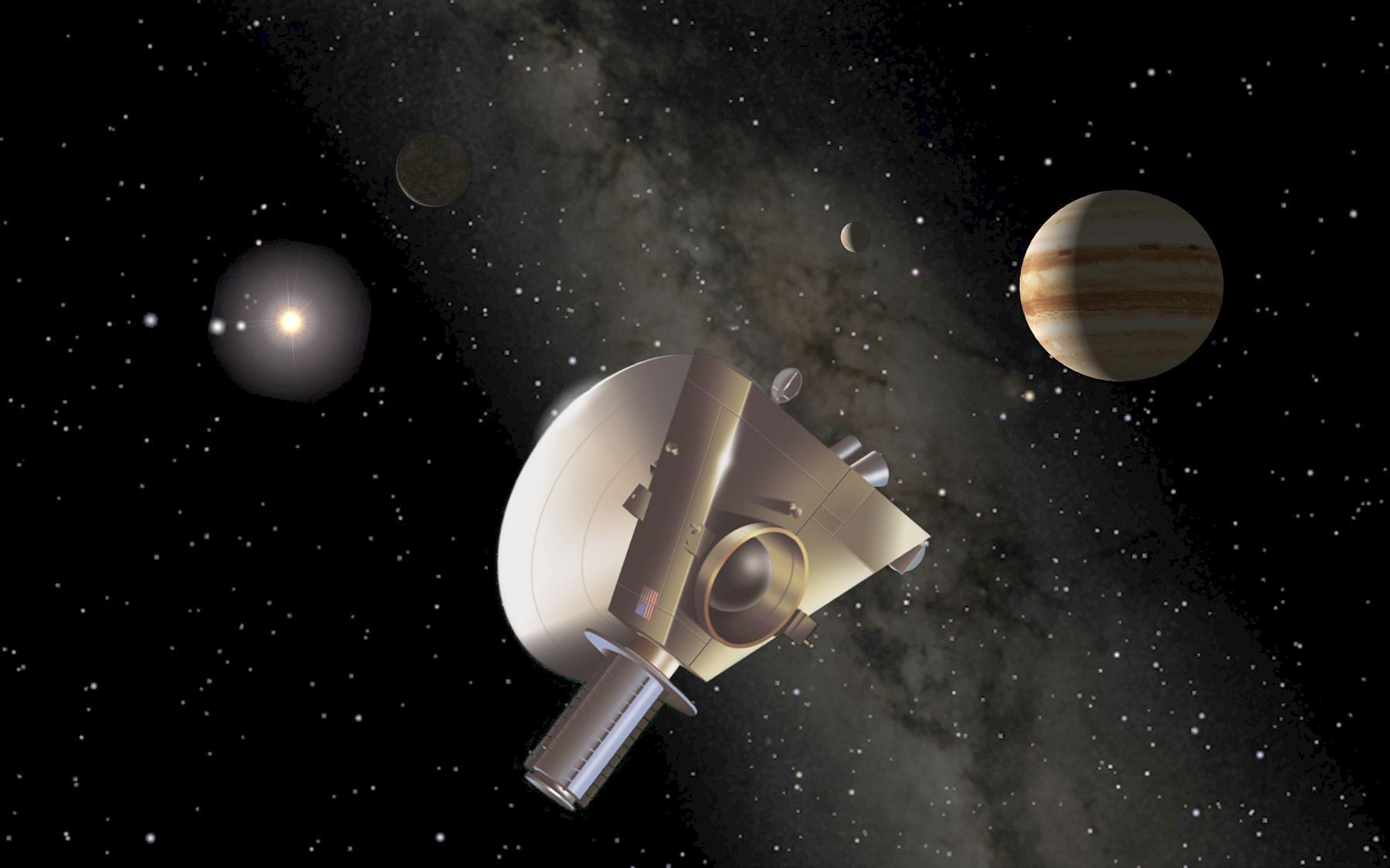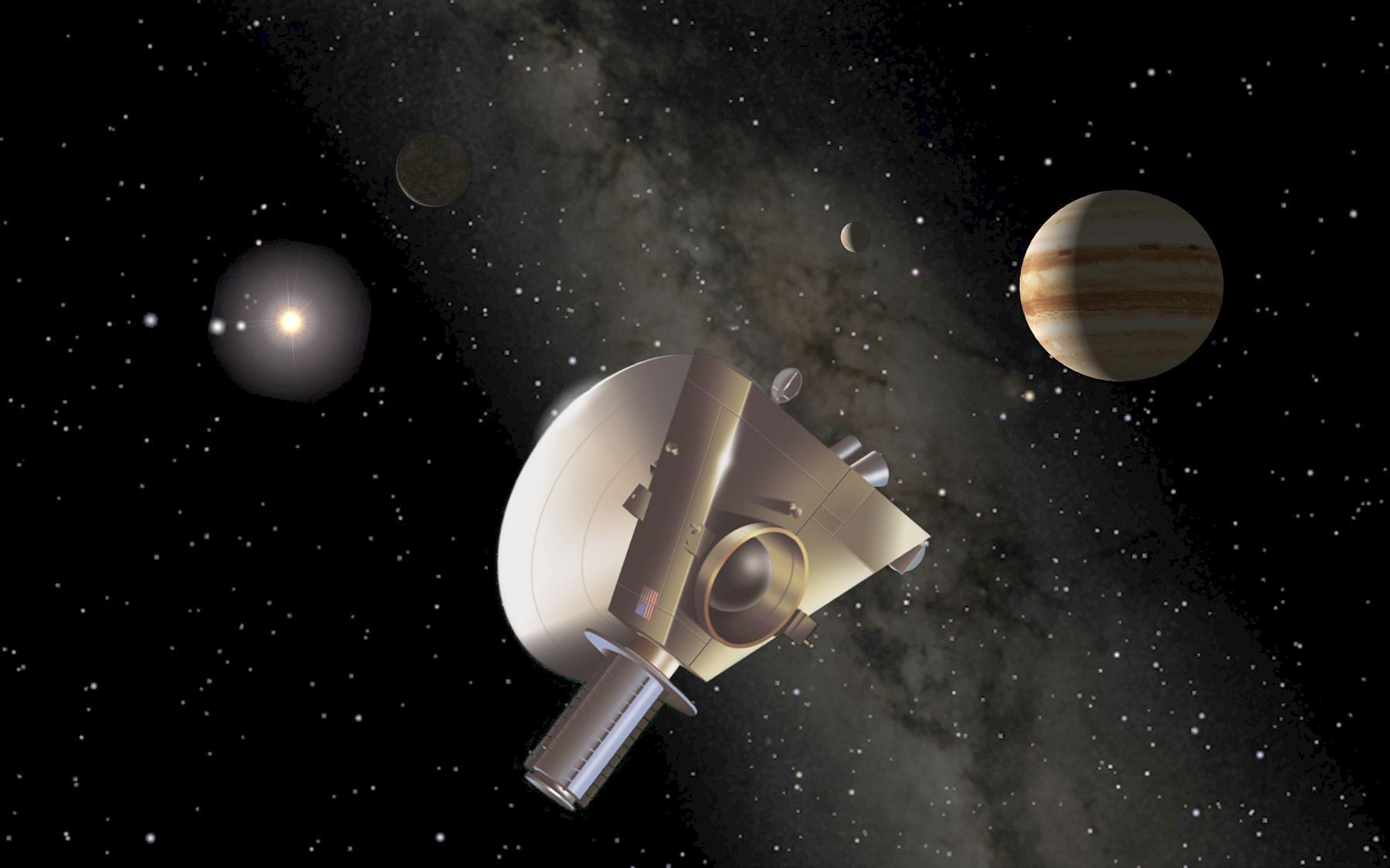
Headed for the first close-up exploration of the Pluto-Charon system and the icy denizens of the Kuiper belt, NASA's New Horizons spacecraft is pictured here in an artist's vision of the robot probe outward bound. The dramatic scene depicts the 465 kilogram spacecraft about one year after a planned 2006 launch, following a flyby of gas giant Jupiter. While the Jupiter flyby will be used as a gravity assist maneuver to save fuel and cut travel time to the outer reaches of the Solar System, it will also provide an opportunity to test instruments and study the giant planet, its moons, and magnetic fields. The Sun is seen from eight hundred million kilometers away, with inner planets Earth, Venus, and Mercury aligned on the left. A dim crescent of outermost Galilean moon Callisto, orbiting Jupiter just inside of the spacecraft's trajectory, appears to the upper right of the fading Sun. Left of Jupiter itself is Europa and in the distant background are the faint, unresolved stars and dust clouds of the Milky Way. New Horizons' planned arrival at Pluto-Charon is in the summer of 2015.
Dirigida hacia la primera exploración cercana del sistema Plutón-Caronte y los cuerpos helados del cinturón de Kuiper, la sonda espacial New Horizons de la NASA se muestra aquí en una visión artística de la sonda robótica en su viaje hacia el exterior. La escena dramática representa la nave espacial de 465 kilogramos aproximadamente un año después del lanzamiento planeado en 2006, tras un sobrevuelo del gigante gaseoso Júpiter. Aunque el sobrevuelo de Júpiter se utilizará como una maniobra de asistencia gravitatoria para ahorrar combustible y reducir el tiempo de viaje hacia los confines del Sistema Solar, también proporcionará una oportunidad para probar instrumentos y estudiar el gigante planeta, sus lunas y campos magnéticos. El Sol se ve desde ochocientos millones de kilómetros de distancia, con los planetas interiores Tierra, Venus y Mercurio alineados en la izquierda. Una luna galiléana tenue y con forma de creciente, Calisto, la más exterior, que orbita Júpiter justo en el interior de la trayectoria de la nave espacial, aparece en la parte superior derecha del Sol que se desvanece. A la izquierda de Júpiter está Europa y en el fondo distante están las estrellas tenues y sin resolver y las nubes de polvo de la Vía Láctea. La llegada planeada de New Horizons a Plutón-Caronte es en el verano de 2015.