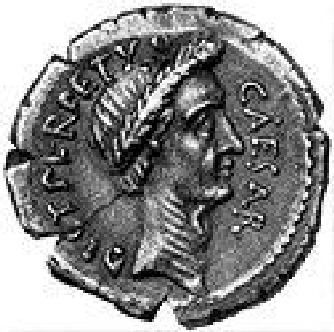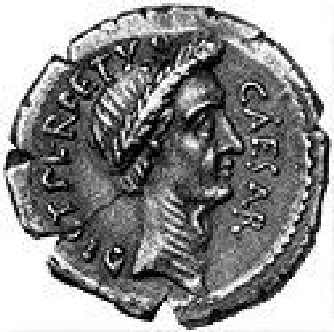
Today, February 29th, is a leap day - a relatively rare occurrence. In 46 BC, Julius Caesar, pictured above in a self-decreed minted coin, created a calendar system that added one leap day every four years. Acting on advice by Alexandrian astronomer Sosigenes, Caesar did this to make up for the fact that the Earth's year is slightly more than 365 days. In modern terms, the time it takes for the Earth to circle the Sun is slightly more than the time it takes for the Earth to rotate 365 times (with respect to the Sun -- actually we now know this takes about 365.24219 rotations). So, if calendar years contained 365 days they would drift from the actual year by about 1 day every 4 years. Eventually July (named posthumously for Julius Caesar himself) would occur during the northern hemisphere winter! By adopting a leap year with an extra day every four years, the calendar year would drift much less. This Julian Calendar system was used until the year 1582 when Pope Gregory XIIIprovided further fine-tuning when he added that leap days should not occur in years ending in "OO", unless divisible by 400. This Gregorian Calendar system is the one in common use today.
Hoy, 29 de febrero, es un día bisiesto, un acontecimiento relativamente raro. En el año 46 a.C., Julio César, retratado arriba en una moneda acuñada por su propio decreto, creó un sistema de calendario que añadía un día bisiesto cada cuatro años. Actuando siguiendo el consejo del astrónomo alejandrino Sosígenes, César hizo esto para compensar el hecho de que el año terrestre es ligeramente superior a 365 días. En términos modernos, el tiempo que tarda la Tierra en orbitar alrededor del Sol es ligeramente superior al tiempo que tarda en rotar 365 veces con respecto al Sol (de hecho, ahora sabemos que esto requiere aproximadamente 365,24219 rotaciones). Por lo tanto, si los años calendario contuvieran 365 días, se desplazarían del año real aproximadamente un día cada 4 años. ¡Eventualmente, julio (nombrado póstumamente para Julio César) ocurriría durante el invierno del hemisferio norte! Al adoptar un año bisiesto con un día adicional cada cuatro años, el año calendario se desplazaría mucho menos. Este sistema del Calendario Juliano se utilizó hasta el año 1582 cuando el Papa Gregorio XIII proporcionó un ajuste adicional al añadir que los días bisiestos no deberían ocurrir en años terminados en "00", a menos que fueran divisibles por 400. Este sistema del Calendario Gregoriano es el que se usa comúnmente hoy.