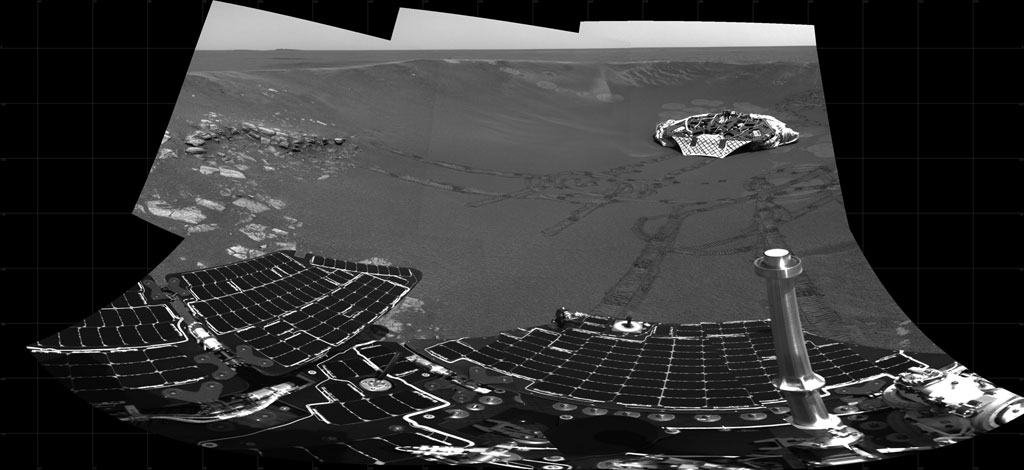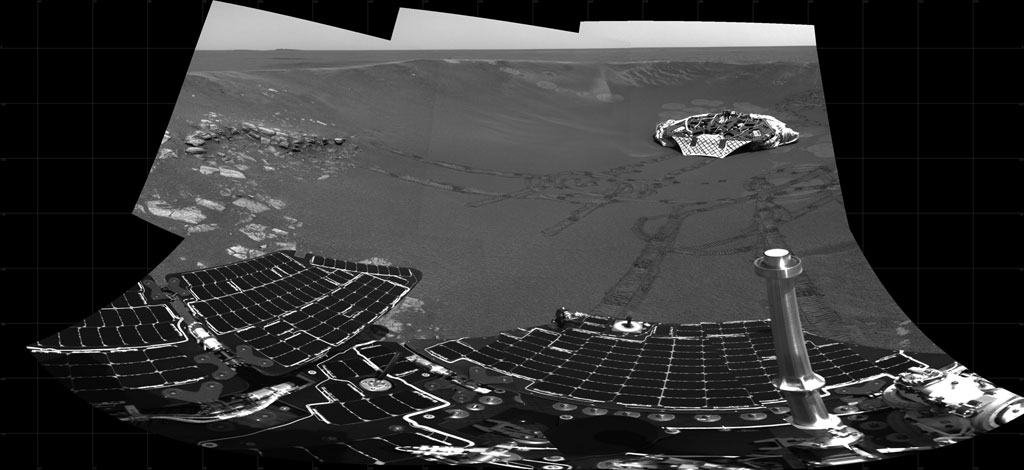
Was Mars ever wet enough to support life? To help answer this question, NASA launched two rover missions to the red planet and landed them in regions that satellite images indicated might have been covered with water. Yesterday, mounting evidence was released indicating that the Mars Opportunity rover had indeed uncovered indications that its landing site, Meridiani Planum, was once quite wet. Evidence that liquid water once flowed includes the physical appearance of many rocks, rocks with niches where crystals appear to have grown, and rocks with sulfates. Pictured above, Opportunity looks back on its now empty lander. Visible is some of the light rock outcropping that yielded water indications, as well as the rim of the small crater where Opportunity landed. The rover will continue to explore its surroundings and try to determine the nature and extent that water molded the region.
¿Fue Marte alguna vez lo suficientemente húmedo para albergar vida? Para ayudar a responder esta pregunta, la NASA lanzó dos misiones de róveres al planeta rojo y los aterrizó en regiones que las imágenes de satélite indicaban que podrían haber estado cubiertas de agua. Ayer, se reveló evidencia creciente indicando que el róver Opportunity de Marte había descubierto efectivamente indicios de que su sitio de aterrizaje, Meridiani Planum, fue en algún momento bastante húmedo. La evidencia de que líquido agua fluyó alguna vez incluye la apariencia física de muchas rocas, rocas con nichos donde parece que crecieron cristales, y rocas con sulfatos. En la imagen superior, Opportunity mira hacia atrás en su módulo de aterrizaje ahora vacío. Visible hay parte del afloramiento de rocas claras que mostró indicios de agua, así como el borde del pequeño cráter donde aterrizó Opportunity. El róver continuará explorando sus alrededores e intentará determinar la naturaleza y la extensión en que el agua modeló la región.