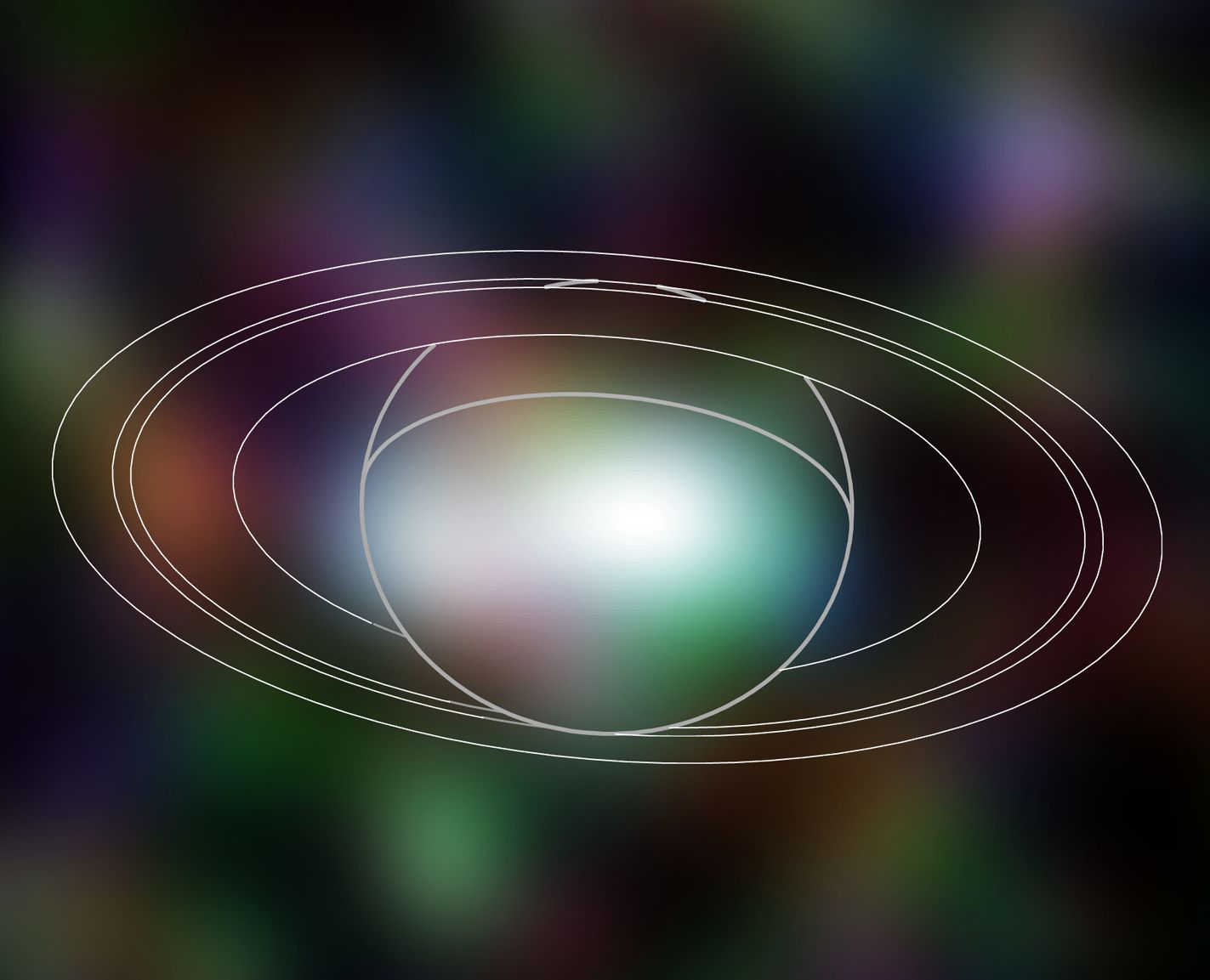
Above, the ringed planet Saturn shines in x-rays. Otherwise beyond the range of human vision, the eerie x-ray view was created by overlaying a computer generated outline of the gas giant's disk and ring system on a false-color picture of smoothed, reconstructed x-ray data from the orbiting Chandra Observatory. The data represent the first clear detection of Saturn's disk at x-ray energies and held some surprises for researchers. For starters, the x-rays seem concentrated near the planet's equator rather than the poles, in marked contrast to observations of Jupiter, the only other gas giant seen at such high energies. And while Saturn's high energy emission is found to be consistent with the reflection of x-rays from the Sun, the intensity of the reflected x-rays was also found to be unusually strong. Outside the planet's disk, only a faint suggestion of x-rays from Saturn's magnificent ring system is visible at the left.
En la imagen superior, el planeta anillado Saturno brilla en rayos X. Más allá del rango de la visión humana, esta perspectiva fantasmal en rayos X fue creada superponiendo un contorno generado por computadora del disco del gigante gaseoso y su sistema de anillos sobre una imagen en falso color de datos de rayos X suavizados y reconstruidos del Observatorio Chandra en órbita. Los datos representan la primera detección clara del disco de Saturno en energías de rayos X y presentaron algunas sorpresas para los investigadores. Para comenzar, los rayos X parecen concentrarse cerca del ecuador del planeta en lugar de los polos, en marcado contraste con las observaciones de Júpiter, el único otro gigante gaseoso observado a tales energías elevadas. Y aunque la emisión de alta energía de Saturno se encontró que es consistente con la reflexión de rayos X del Sol, la intensidad de los rayos X reflejados también resultó ser inusualmente intensa. Fuera del disco del planeta, solo una sugerencia tenue de rayos X del magnífico sistema de anillos de Saturno es visible a la izquierda.