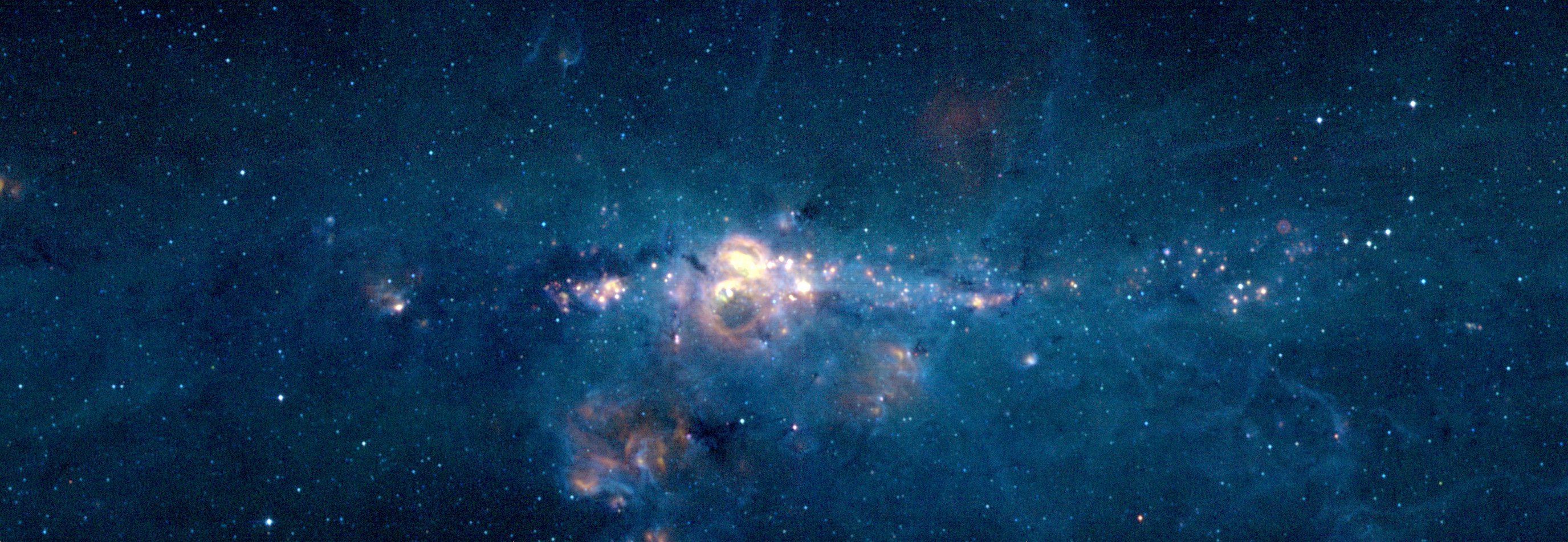
In Jules Verne's science fiction classic A Journey to the Center of the Earth, Professor Liedenbrock and his fellow explorers encounter many strange and exciting wonders. What wonders lie at the center of our Galaxy? Astronomers know of some of the bizarre objects that exist there, like vast cosmic dust clouds, bright star clusters, swirling rings of gas, and even a supermassive black hole. Much of the Galactic Center is shielded from our view in visible light by the intervening dust and gas, but it can be explored using other forms of electromagnetic radiation. This haunting wide angle image of the Galactic Center region in infrared light was constructed using data from the Midcourse Space Experiment (MSX) satellite. The image maps three mid-infrared bands, otherwise invisible to human eyes, into visible blue, green, and red colors revealing the thermal emission from dust clouds near the galactic center that have been heated by starlight. The galactic plane runs along the middle of this image while the galactic center itself is the bright spot at picture center. The field of view of this cropped picture is about 1.5 by 2.5 degrees.
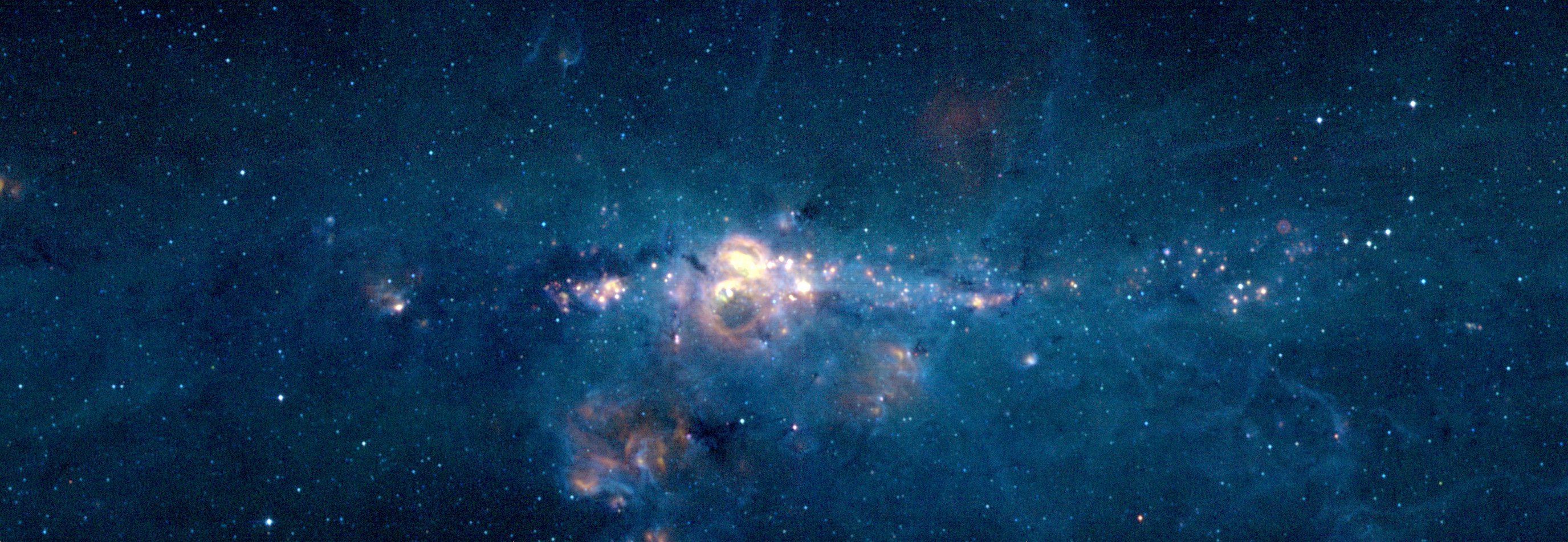
En el clásico de ciencia ficción de Jules Verne Viaje al Centro de la Tierra, el profesor Liedenbrock y sus compañeros exploradores encuentran muchas maravillas extrañas y emocionantes. ¿Qué maravillas se encuentran en el centro de nuestra Galaxia? Los astrónomos conocen algunos de los objetos bizarros que existen allí, como vastas nubes de polvo cósmico, brillantes cúmulos estelares, anillos de gas giratorios, e incluso un agujero negro supermasivo. Gran parte del Centro Galáctico está blindado de nuestra vista en luz visible por el polvo e gas intervinientes, pero puede ser explorado usando otras formas de radiación electromagnética. Esta inquietante imagen de campo amplio de la región del Centro Galáctico en luz infrarroja fue construida utilizando datos del satélite Midcourse Space Experiment (MSX). La imagen mapea tres bandas de infrarrojo medio, de otra manera invisibles para los ojos humanos, en colores azul, verde y rojo visibles, revelando la emisión térmica de las nubes de polvo cercanas al centro galáctico que han sido calentadas por la luz estelar. El plano galáctico discurre a lo largo del medio de esta imagen mientras que el centro galáctico en sí es el punto brillante en el centro de la imagen. El campo de visión de esta imagen recortada es aproximadamente de 1,5 por 2,5 grados.