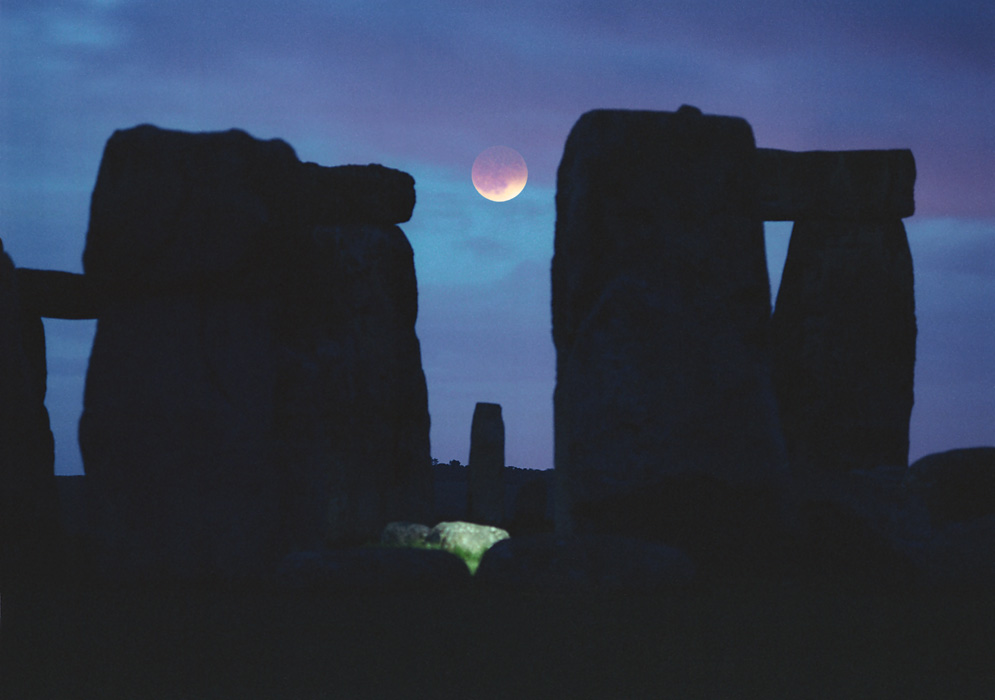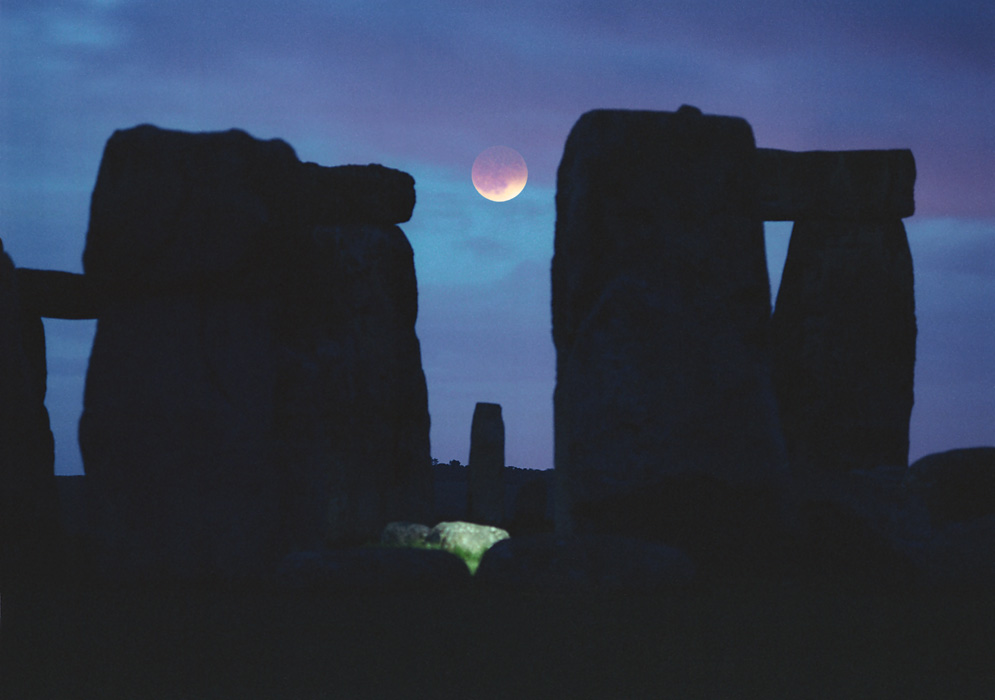
Despite clouds and rain showers astronomer Phillip Perkins managed to spot a reddened, eclipsed Moon between the stones of this well known monument to the Sun during May's total lunar eclipse, from Stonehenge, England. When he recorded this dramatic picture, the rising Moon was only about 5 degrees above the horizon, but conveniently located through a gap in the circle of ancient stones. Although at first glance there appears to be an eerie, luminous pool of water in the foreground, Perkins notes that his daughter produced the artistic lighting effect. She illuminated a fallen stone and surrounding grass with a flashgun from her hiding place behind the large sarsen stone to the right of center. As the picture looks toward the southeast, the stone just below the Moon is one of the inner bluestones rather than the famous Heel Stone, which marks the northeast direction of the summer solstice sunrise.
A pesar de las nubes y los chaparrones, el astrónomo Phillip Perkins logró divisar una Luna enrojecida y eclipsada entre las piedras de este monumento bien conocido dedicado al Sol durante el eclipse lunar total de mayo, desde Stonehenge, Inglaterra. Cuando capturó esta imagen dramática, la Luna ascendente estaba apenas unos 5 grados sobre el horizonte, pero convenientemente ubicada a través de un hueco en el círculo de piedras antiguas. Aunque a primera vista parece haber un inquietante estanque luminoso de agua en primer plano, Perkins señala que su hija produjo el efecto de iluminación artística. Ella iluminó una piedra caída y el pasto circundante con un flash fotográfico desde su escondite detrás de la gran piedra de arenisca al centro-derecha. Como la imagen está orientada hacia el sureste, la piedra justo debajo de la Luna es una de las bluestones interiores en lugar de la famosa Piedra del Talón, que marca la dirección noreste de la salida del sol en el solsticio de verano.