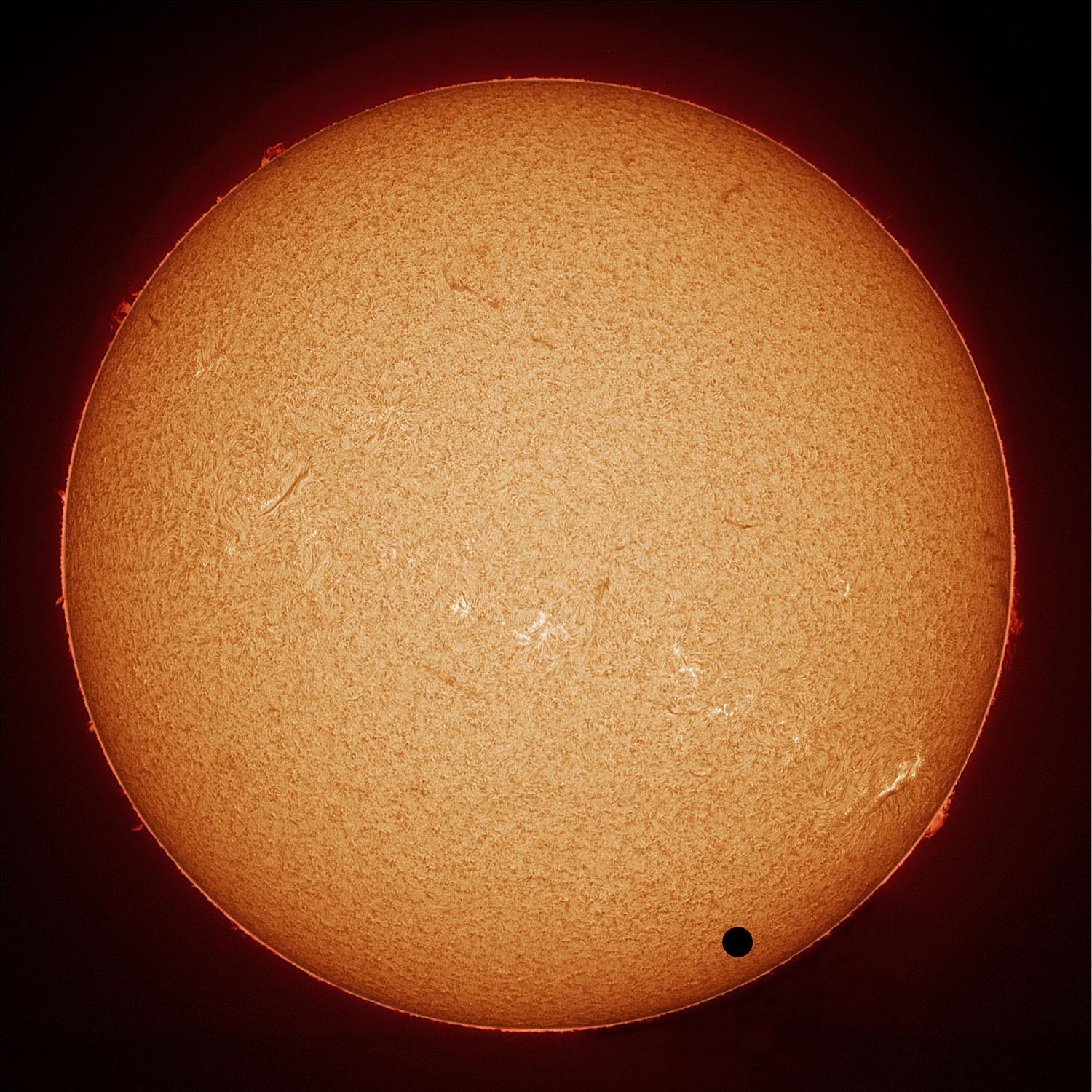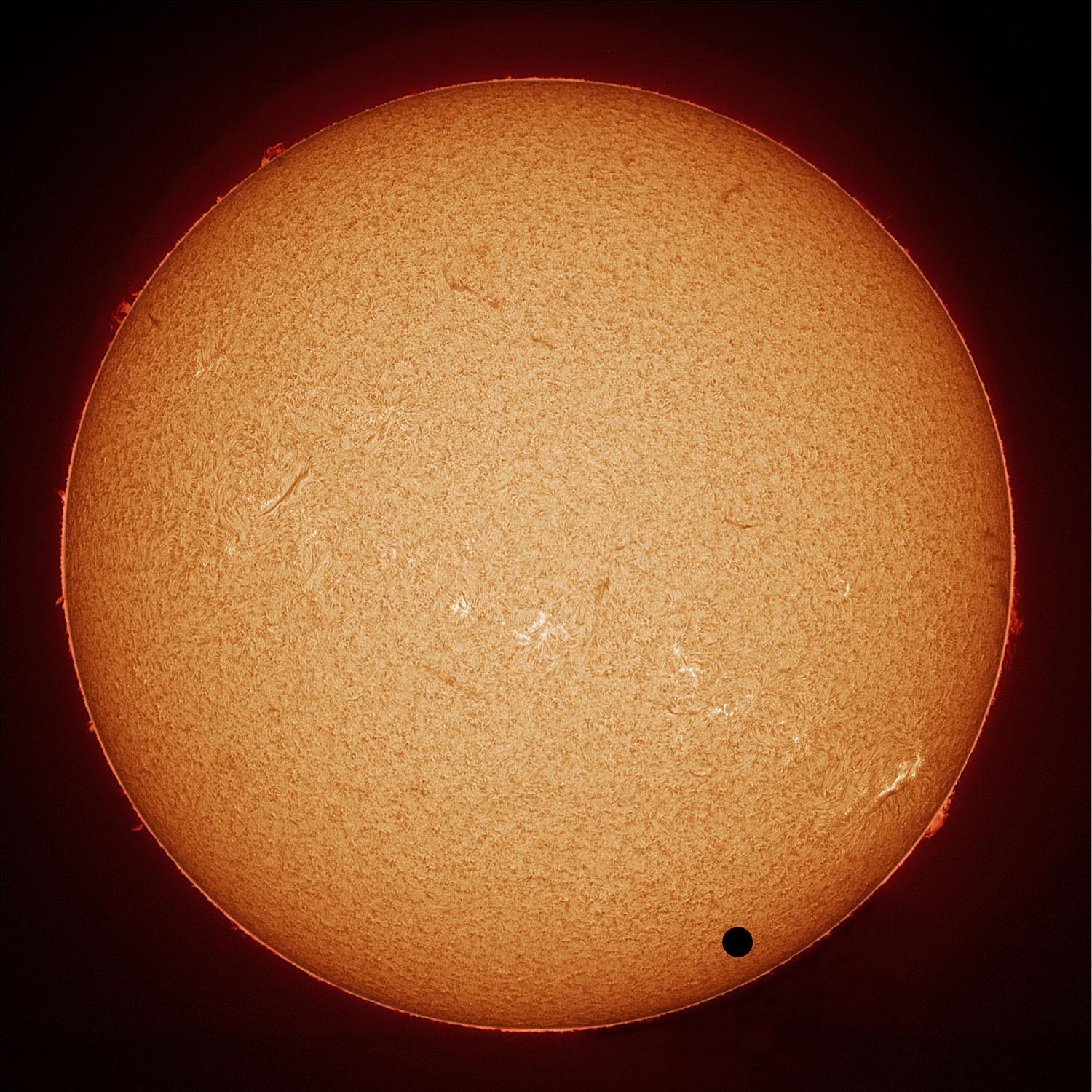
joying the 2004 Transit of Venus from Stuttgart, Germany, astronomer Stefan Seip recorded this fascinating, detailed image of the Sun. Revealing a network of cells and dark filaments against a bright solar disk with spicules and prominences along the Sun's limb, his telescopic picture was taken through an H-alpha filter. The filter narrowly transmits only the red light from hydrogen atoms and emphasizes the solar chromosphere -- the region of the Sun's atmosphere immediately above its photosphere or normally visible surface. Here, the dark disk of Venus seems to be imitating a giant sunspot that looks perhaps a little too round. But in H-alpha pictures like this one, sunspot regions are usually dominated by bright splotches (called plages) on the solar chromosphere.
Disfrutando del Tránsito de Venus de 2004 desde Stuttgart, Alemania, el astrónomo Stefan Seip registró esta imagen fascinante y detallada del Sol. Revelando una red de células y filamentos oscuros contra un disco solar brillante con espículas y protuberancias a lo largo del limbo solar, su fotografía telescópica fue capturada a través de un filtro H-alfa. El filtro transmite estrechamente solo la luz roja de los átomos de hidrógeno y enfatiza la cromosfera solar, la región de la atmósfera del Sol inmediatamente por encima de su fotosfera o superficie normalmente visible. Aquí, el disco oscuro de Venus parece estar imitando una mancha solar gigante que se ve quizás un poco demasiado redonda. Pero en imágenes H-alfa como esta, las regiones de manchas solares suelen estar dominadas por manchas brillantes (llamadas plages) en la cromosfera solar.