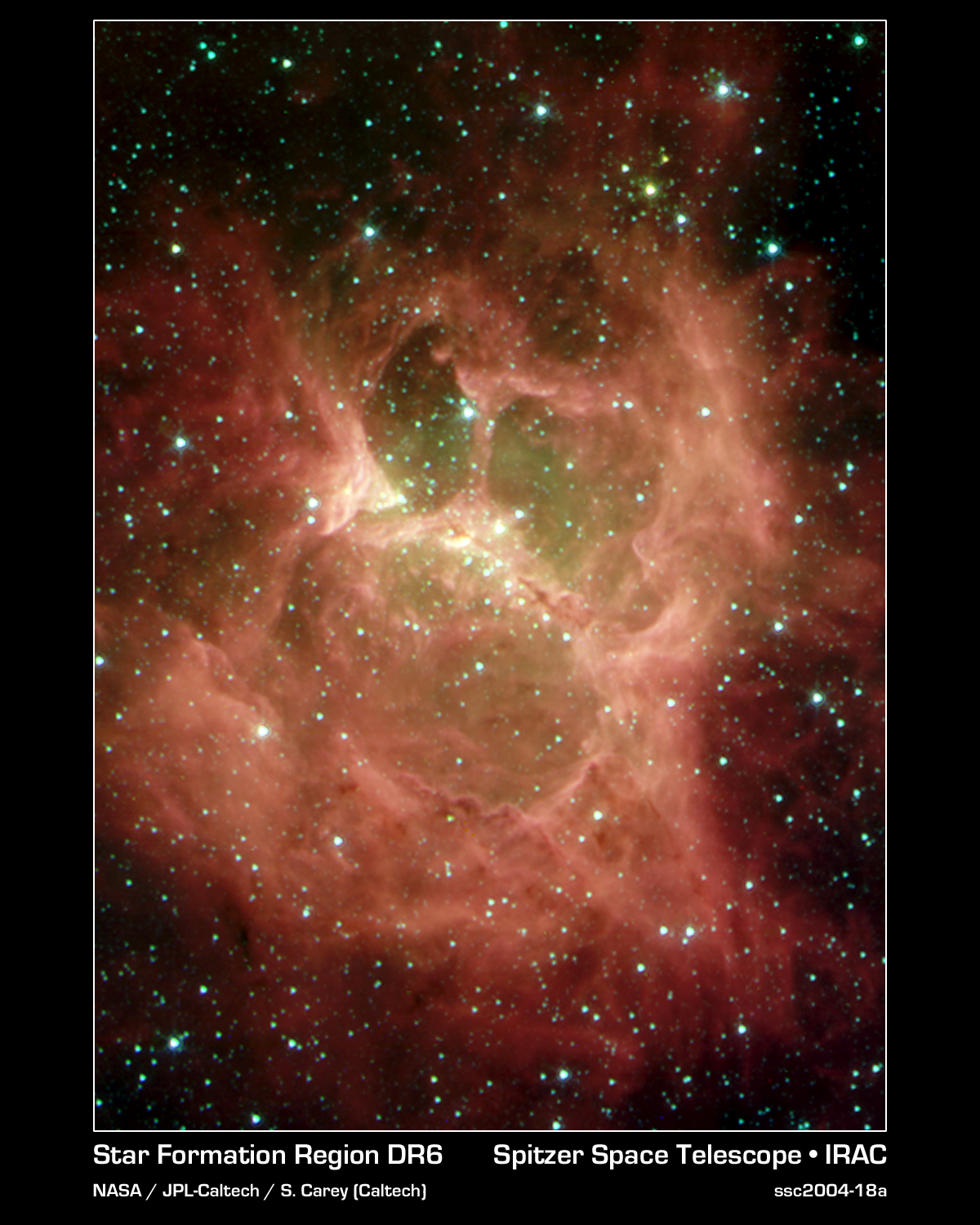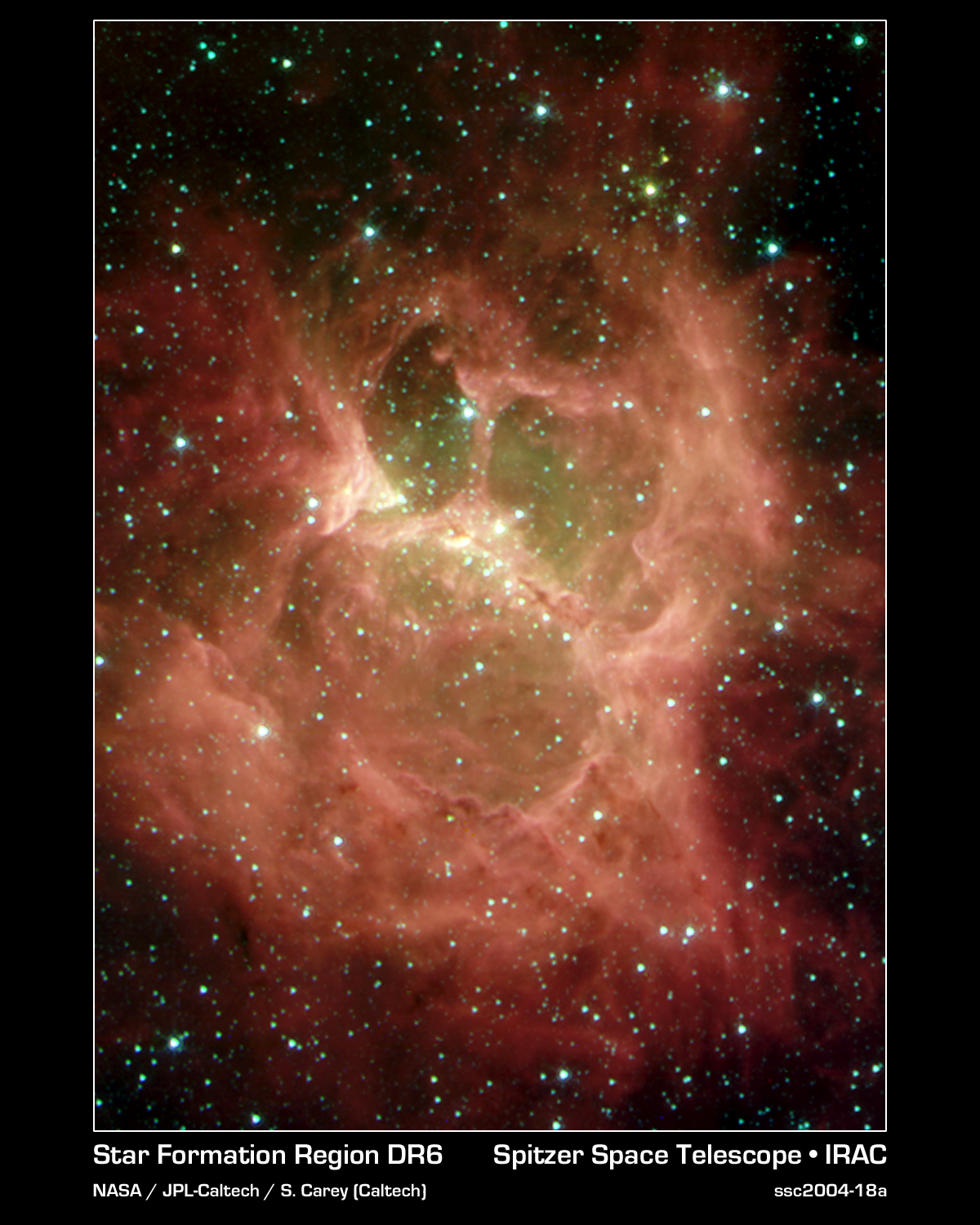
How could stars form such a spooky and familiar shape as a human skull? First, the complex process of star formation creates nebulas of many shapes and sizes -- it is human perception that identifies the skull shape. Next, the physical reasons for the large nearly empty cavities that resemble the skull's eyes and mouth in nebula DR 6 are the strong stellar winds and energetic light emanating from about ten bright young stars in the nebula's central "nose". The length of the central nasal bridge is about 3.5 light years. Star forming nebula DR 6 is located about 4000 light years away toward the constellation of Cygnus. The Spitzer Space Telescope took the above image last year in four infrared colors. The perhaps-perceived eeriness of nebula DR 6 commemorates today being historically spooky All Hallow's Day, which follows All Hallow's Eve or "Halloween".
¿Cómo podrían las estrellas formar una figura tan aterradora y familiar como un cráneo humano? En primer lugar, el complejo proceso de formación estelar crea nebulosas de muchas formas y tamaños, pero es la percepción humana la que identifica la forma del cráneo. En segundo lugar, las razones físicas de las grandes cavidades casi vacías que se asemejan a los ojos y la boca del cráneo en la nebulosa DR 6 son los fuertes vientos estelares y la luz energética emanada de aproximadamente diez estrellas jóvenes brillantes en la "nariz" central de la nebulosa. La longitud del puente nasal central es de aproximadamente 3,5 años luz. La nebulosa de formación estelar DR 6 se encuentra a unos 4000 años luz de distancia hacia la constelación del Cisne. El Telescopio Espacial Spitzer capturó la imagen anterior el año pasado en cuatro colores infrarrojos. Lo quizás percibido como inquietante de la nebulosa DR 6 conmemora que hoy es históricamente el día aterrador de Todos los Santos, que sigue a la Víspera de Todos los Santos o "Halloween".