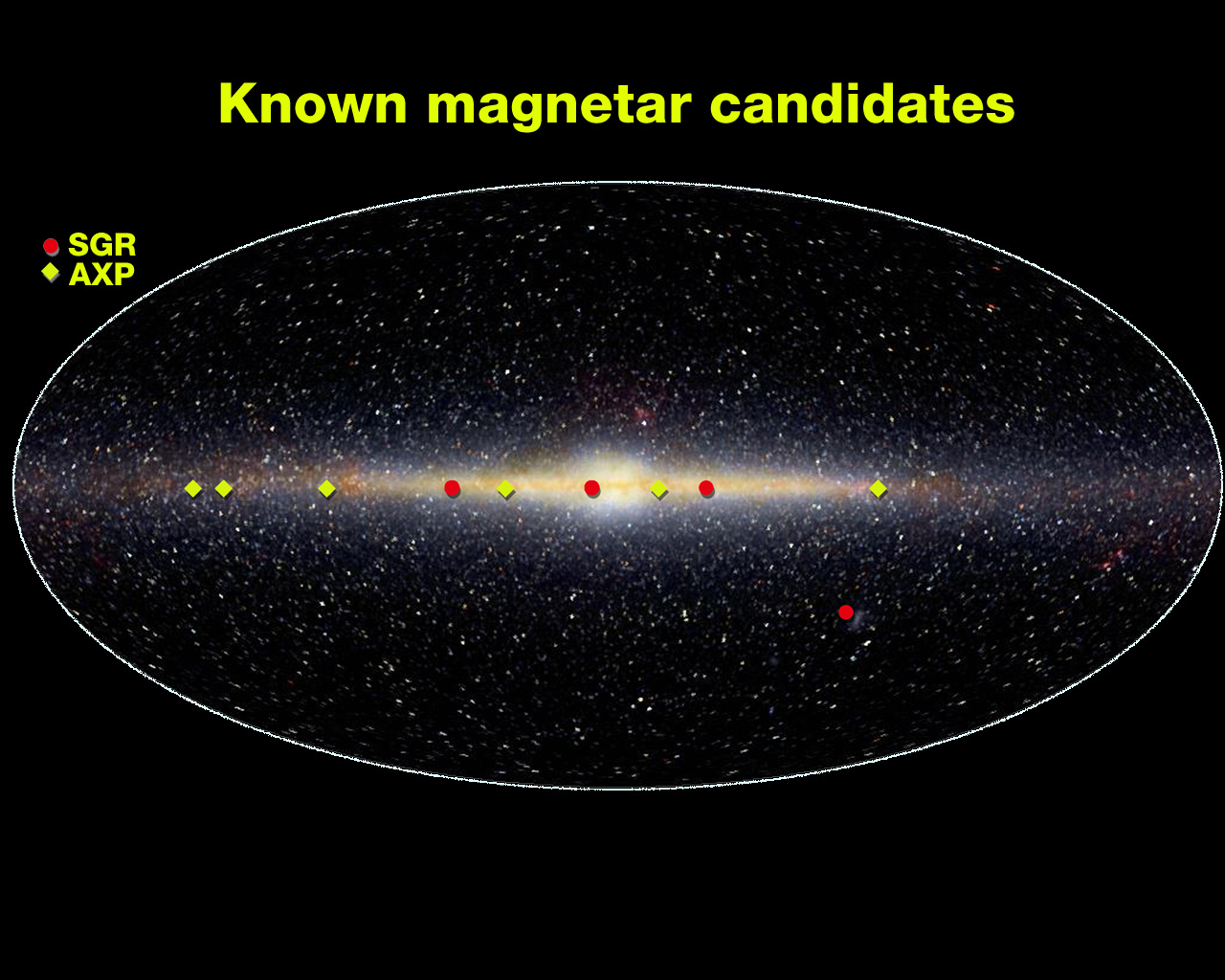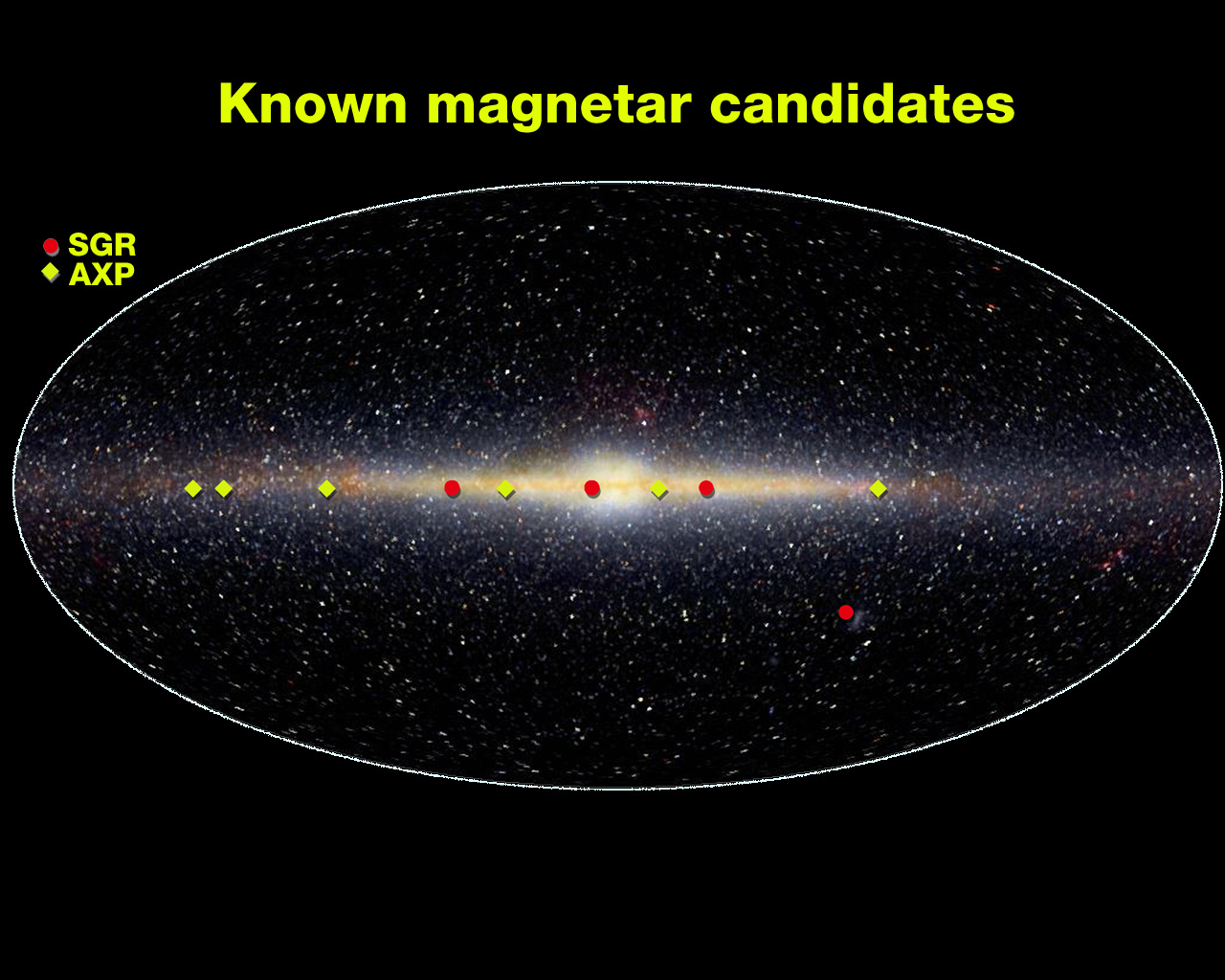
Indicated on this infrared image of the galactic center region are positions of candidate magnetars -- believed to be the strongest magnets in the galaxy. Classified by observers as Soft Gamma Repeaters (SGRs) and Anomalous X-ray Pulsars (AXPs), these cosmic powerhouses are likely city-sized, spinning, highly-magnetized neutron stars. How strong is a magnetar's magnetic field? The Earth's magnetic field which deflects compass needles is measured to be about 1 Gauss, while the strongest fields sustainable in earthbound laboratories are about 100,000 Gauss. A magnetar's monster magnetic field is estimated to be as high as 1,000,000,000,000,000 Gauss. A magnet this strong, located at about half the distance to the Moon would easily erase your credit cards and suck pens out of your pocket. In 1998, from a distance of about 20,000 light-years, one magnetar, SGR 1900+14 generated a powerful flash of gamma-rays detected by many spacecraft. That blast of high-energy radiation is now known to have had a measurable effect on Earth's ionosphere. At the surface of the magnetar, its powerful magnetic field is thought to buckle and shift the neutron star crust generating the intense high-energy flares
Se indican en esta imagen infrarroja de la región del centro galáctico las posiciones de magnetares candidatos, creídos como los imanes más fuertes de la galaxia. Clasificados por los observadores como Repetidores de Rayos Gamma Suave (SGR) y Púlsares de Rayos X Anómalos (AXP), estos colosos cósmicos probablemente son estrellas de neutrones que giran a gran velocidad y están altamente magnetizadas, con tamaños comparables al de una ciudad. ¿Cuán fuerte es el campo magnético de un magnetar? El campo magnético terrestre, que desvía las brújulas, se mide en aproximadamente 1 Gauss, mientras que los campos más intensos que se pueden mantener en laboratorios terrestres alcanzan unos 100.000 Gauss. Se estima que el colosal campo magnético de un magnetar puede alcanzar hasta 1.000.000.000.000.000 Gauss. Un imán tan poderoso, ubicado a aproximadamente la mitad de la distancia a la Luna, borraría fácilmente tus tarjetas de crédito y extraería bolígrafos de tu bolsillo. En 1998, a una distancia de aproximadamente 20.000 años luz, un magnetar llamado SGR 1900+14 generó un potente destello de rayos gamma detectado por numerosas naves espaciales. Ese estallido de radiación de alta energía ahora se sabe que tuvo un efecto medible en la ionosfera terrestre. En la superficie del magnetar, su poderoso campo magnético se cree que flexiona y desplaza la corteza de la estrella de neutrones, generando los intensos estallidos de alta energía.